3D battle maps with real walls, real light and a real grid
A flat map tells the players where things are. A 3D map tells them what it is like to be there: the torch at the end of the corridor, the balcony an archer would want, the cover behind a boulder. TerrainTale builds that map in a few minutes from a library of realistic pieces that all fit the same grid.
A library that fits together
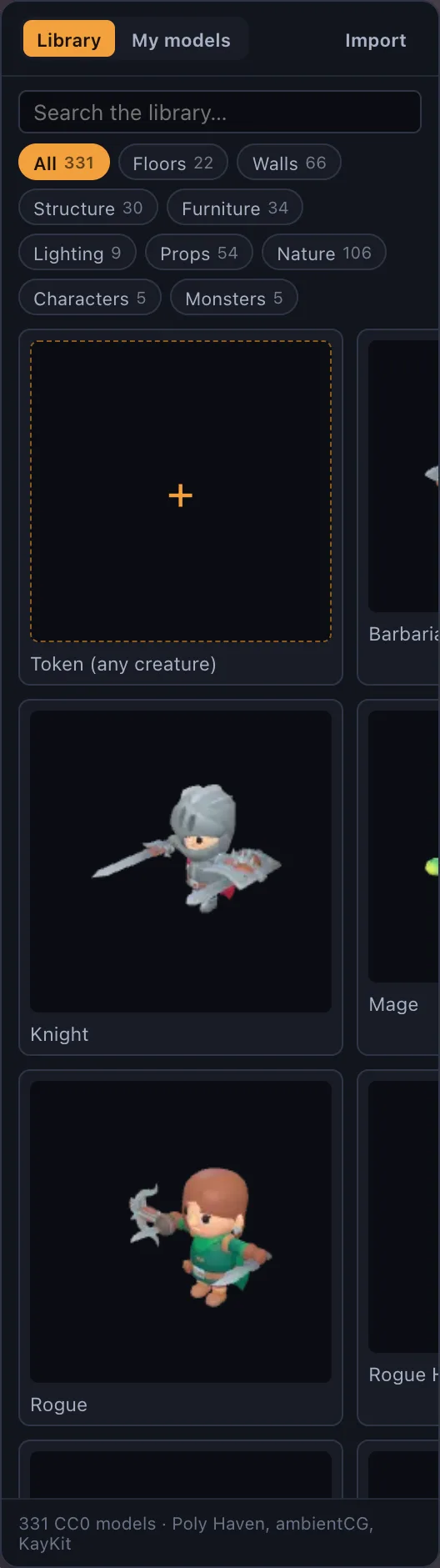
Floors are PBR tiles generated from scanned materials: grass, forest floor, mud, cobbles, flagstones, marble, planks, and more. Walls come in families (stone, stone brick, dungeon, brick, plaster, timber, cave, castle) with matching doorways, archways, windows, parapets and battlements, so a doorway replaces a wall segment and still lines up. Props are photoscans from Poly Haven: furniture, barrels, crates, chests, lanterns, candles, tools, weapons, statues, rocks and cliffs.
Three ways to build
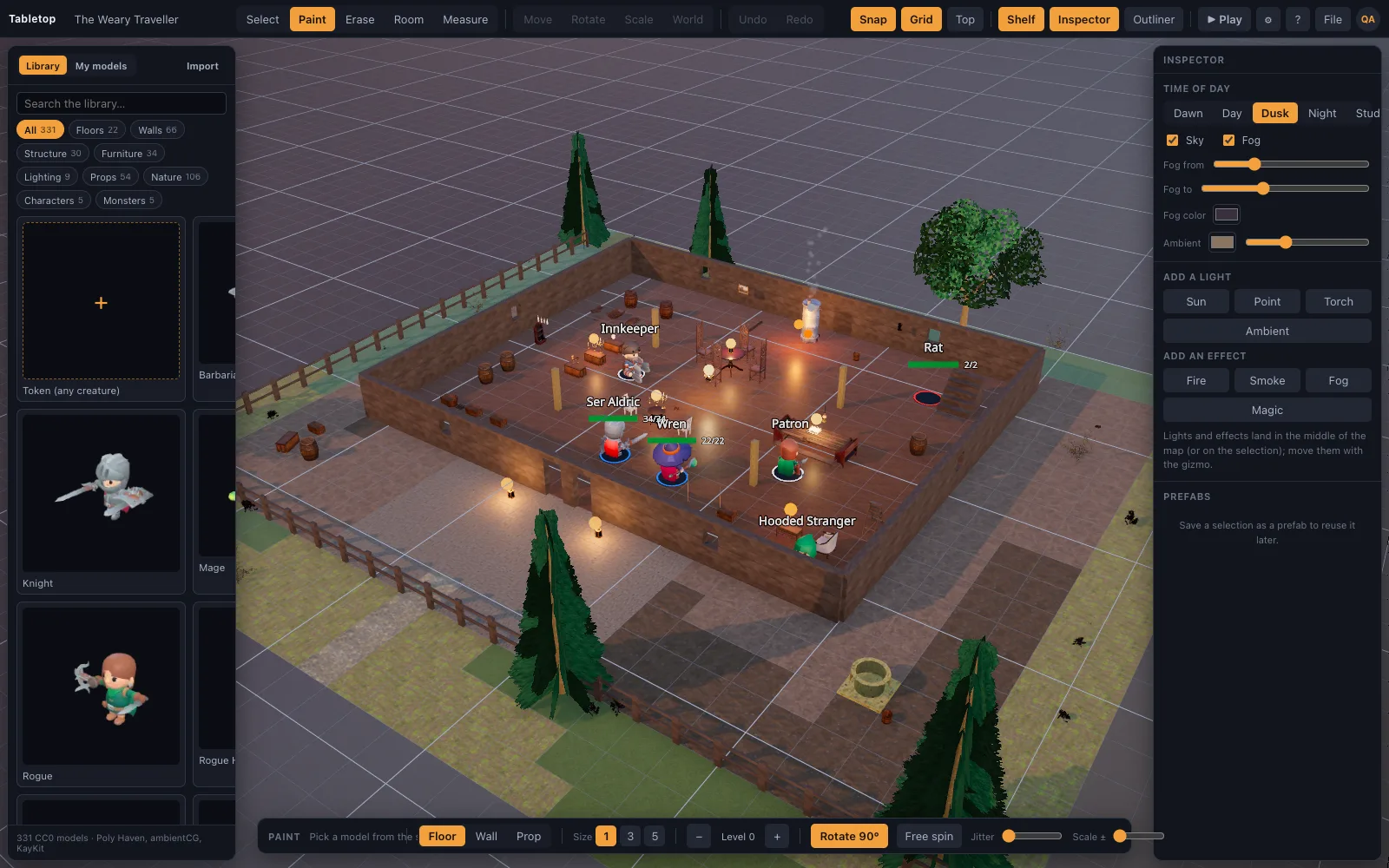
The room tool drags a rectangle and produces a floored, walled room with correct corners as one undo step. The tile brush paints floors and walls cell by cell, snapping walls to grid edges and auto-orienting them. Scene recipes describe a map as high-level operations (fill this rectangle, wall this perimeter, scatter trees here) in JSON, which is how the starter scenes are made and how an AI assistant can build one for you.
- Seven kits for the room tool
- Brush sizes, erase, randomised tile rotation for natural ground
- Import a recipe from File ▸ Import Scene JSON
Lighting is part of the map
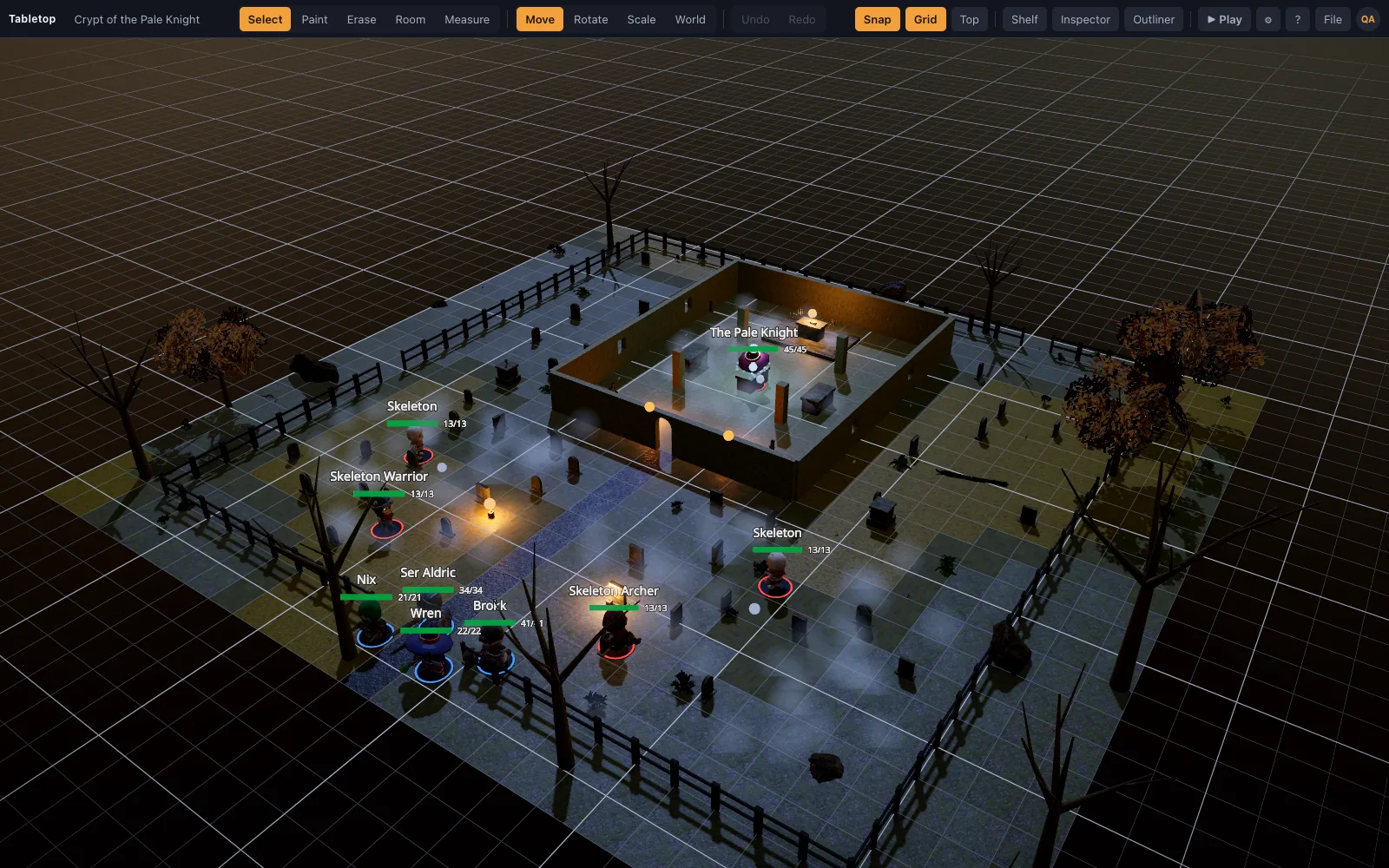
One time-of-day slider runs the sun from dawn to dusk and the moon through the night, and every wall, tree and miniature casts a real shadow that swings round with it. Soft shadows, bloom on flames, and torch lights you can attach to any lamp. Drag from noon to dusk to midnight and the same map becomes three encounters.
It runs on the laptop you have
Rendering is instanced (a 1600-tile floor is one draw call) and quality tiers are picked from the GPU: integrated Intel parts get a lighter path, discrete GPUs get ambient occlusion, MSAA and 4K shadows. Nothing to install; it is a web page.
Questions
Can I import my own 3D map?
On Premium, drop a .glb, .obj, .fbx or other model file on the window. Large single-mesh maps work and are simplified to a detail budget you control; the grid and ruler still apply on top of them.
Are the assets really free to use?
Yes. Surfaces are generated from ambientCG materials and props are Poly Haven scans, both CC0; the D&D characters, monsters and furniture were made by TerrainTale in Meshy and ship with the app for your games. There are no stylised low-poly packs; the library is realistic only.
How big can a map be?
The starter scenes are 20 to 30 squares a side. Because floors are instanced, a 60 by 60 map is fine on a discrete GPU; the practical limit is the number of lights casting shadows.
Keep reading
Battle Map Maker: Build a Map in Minutes
A fast battle map maker in the browser: drag a room, paint tiles, drop props and lights, then play on the same map with miniatures, a ruler and initiative.
3D Dungeon Map Maker: Rooms, Corridors and Torchlight in Minutes
Make a 3D dungeon map in the browser: drag rooms with the Dungeon kit, paint corridors with the tile brush, add doorways, torches, a treasure chest and a skeleton, then play on it.
A Realistic 3D Asset Library for D&D Maps
A free library of realistic 3D battle-map pieces: PBR-generated floors and walls, Poly Haven photoscanned props, and D&D minis and furniture made in Meshy.
3D Lighting and Dynamic Shadows for D&D Maps
Battle maps with real light: a time-of-day slider that moves the sun and every shadow with it, a moon at night, torch lights on lamps and bloom on flames.
Build with AI
Scene recipes, and how an assistant writes them.
From the blog
Misty Step 5e rules on a grid: where a teleport can land and what stops it
Misty Step 5e rules on a grid: 30 feet to an unoccupied space you can see, no opportunity attacks, escaping a grapple, Dimension Door's 500 feet and 4d6 bad landing, and how walls block a teleport.
· 5 min read
Throne room battle maps: the audience chamber as an arena
How to build a throne room battle map for D&D: the dais, the columns, the long approach, guards at the doors and where a fleeing monarch goes, with sizes in 5-foot squares.
· 5 min read
Underwater combat in D&D 2024: which attacks suffer, how long you can breathe, and how to draw depth
The underwater combat rules 5e uses in 2024: melee Disadvantage without a Swim Speed unless the weapon pierces, ranged attacks capped at normal range, fire Resistance, breath, and depth on a grid.
· 6 min read
All articles on battle maps, grid rules and running the game
Ready to put a map on the table?
Open the builder and start, no account needed. Sixteen starter scenes are on the welcome screen; sign up free when you want to save one or play it with your group.