A virtual tabletop that does not care which TTRPG you play
Most VTTs are built around one system's automation, and every other game is a compromise of unused sheets and half-supported rules. TerrainTale automates nothing about rules, which is exactly why it fits all of them: it gives you a 3D battle map, miniatures, a ruler and a turn order, and leaves the rules to you and your book.
Why "no rules engine" is the feature
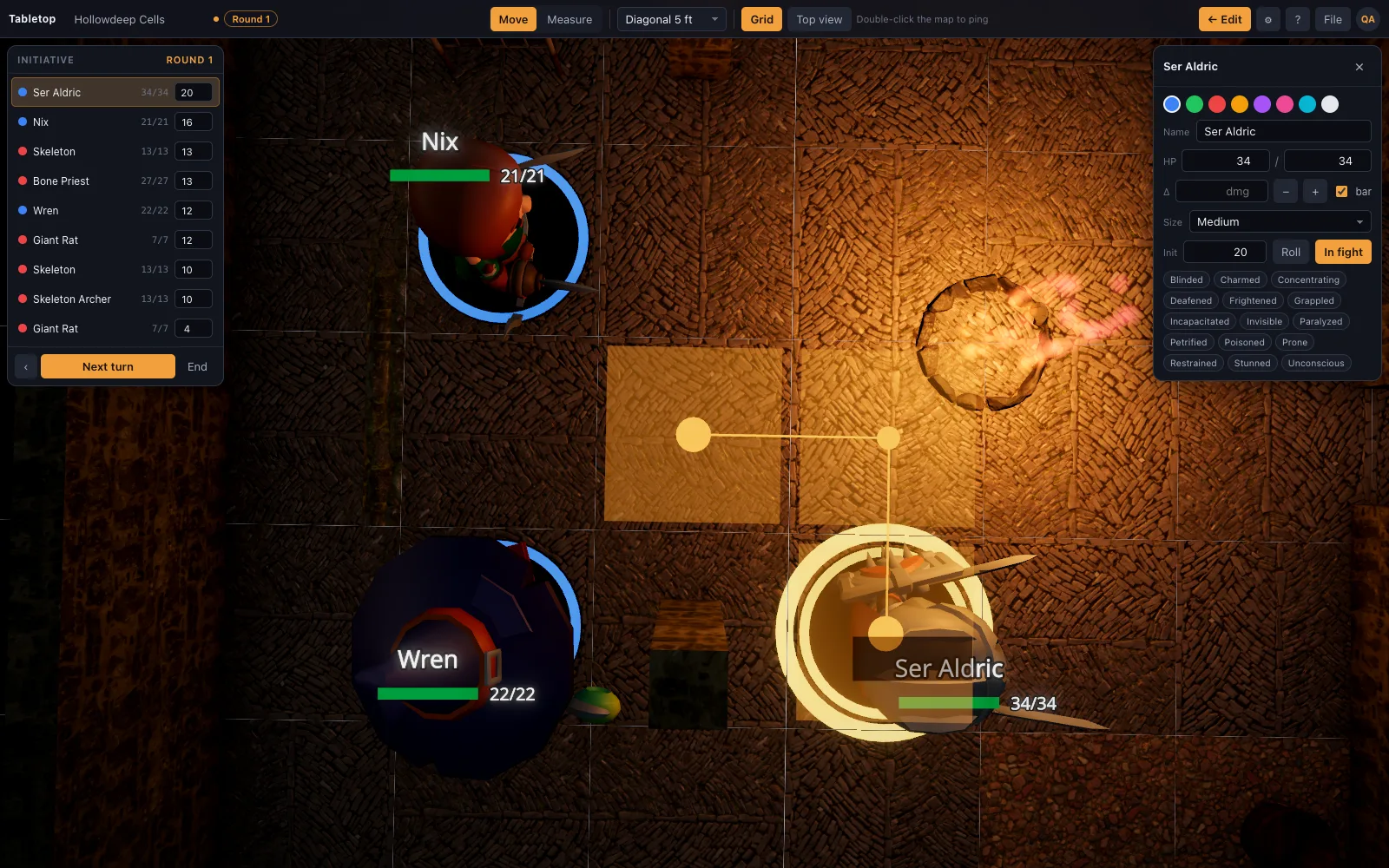
A rules engine is a commitment to one game. It has to know what a saving throw is, what a condition does, how a spell targets. Switch systems and the engine is in the way. TerrainTale tracks the things every grid-based game has in common (position, distance, whose turn, hit points, a list of conditions you name yourself) and resolves none of them. The DM reads the book; the table shows the fight.
What a grid-based game needs, and gets
The library is authored to a five-foot square, the ruler counts squares and reports feet, and the diagonal rule is a setting: every diagonal as one square (5e), alternating 5/10/5 (Pathfinder and the 3.5-era rules), or true distance. Elevation is measured alongside distance, so a game with flying or a fight on a wall has a readout instead of an argument. Creature size is a field: Medium is one square, Large is two by two.
That covers the systems most groups actually run:
- D&D, any edition, 2014 or 2024 rules
- Pathfinder 1e and 2e with the 5/10/5 diagonal
- OSR games: Old-School Essentials, Shadowdark, Dungeon Crawl Classics, and their 10-foot dungeon corridors
- Savage Worlds and other "one inch is one square" games
- Any homebrew or indie system that fights on a grid
Games that are not on a grid
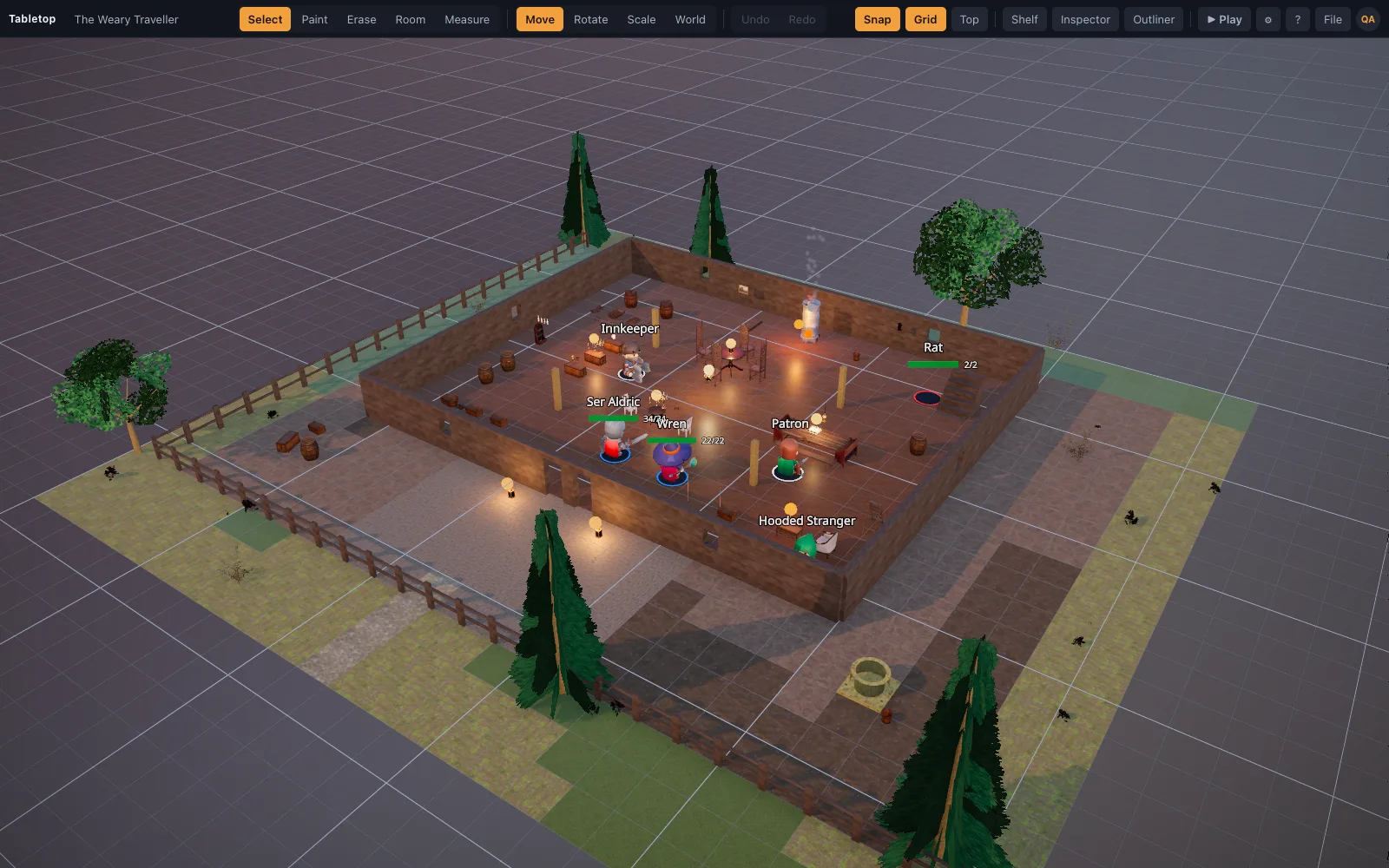
Turn the grid off and the map is a lit 3D set the table looks at while the DM narrates. The ruler still measures true distance between any two points, which is enough for zone-based and range-band games. Theatre-of-the-mind groups use it the way a film uses an establishing shot: here is the tavern, here is the crypt, now we talk.
Fantasy first, honestly
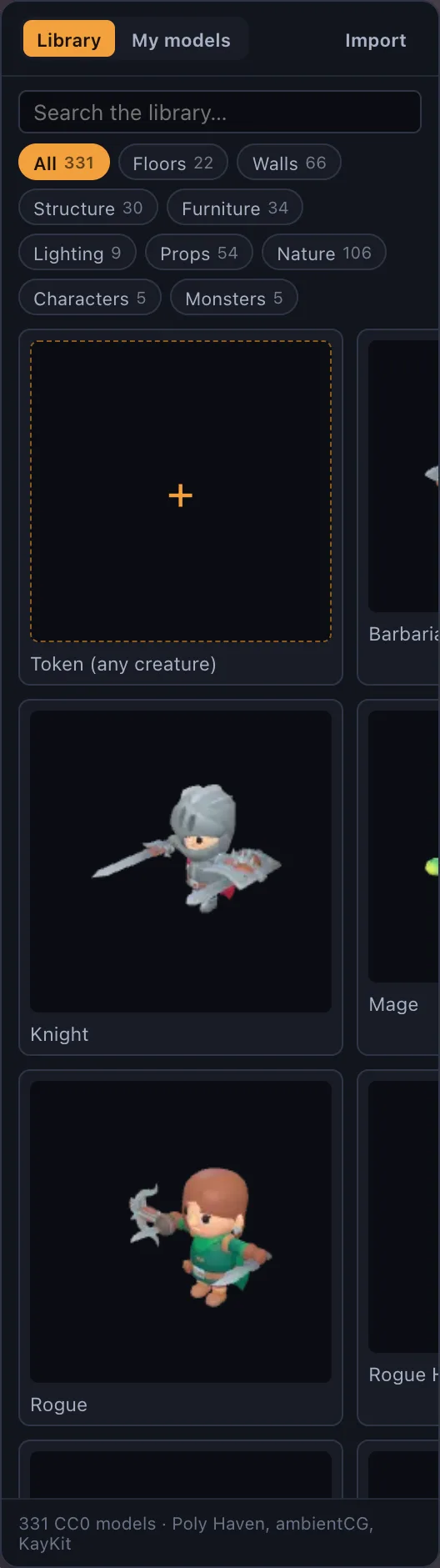
The built-in library is stone, timber, torchlight, forest and graveyard: it is built for fantasy, and a sci-fi or modern game will find it thin. Anything with a model can be added by dropping a .glb on the window, and any image becomes a standee token, so a Call of Cthulhu investigator or a starship corridor is possible with your own assets; it is just not in the box yet.
One tool for a group that switches games
Groups rotate: a 5e campaign, a Shadowdark one-shot, a Pathfinder arc. The same scenes, the same minis and the same play mode serve all three, and nobody re-learns a tool or re-buys a module. Scenes export as JSON, so a map built for one game is a file you keep for the next.
Questions
Does it work for Pathfinder 2e?
Yes. Set the diagonal rule to 5/10/5, and the grid, sizes and elevation readout match the rules. There is a page on Pathfinder specifically.
Can I play a gridless game?
Yes. Toggle the grid off; the ruler measures true distance between any two points on any surface.
Are there character sheets or dice?
No, by design. Use your system's sheets and your own dice; the table handles position, distance, turn order, HP and conditions.
Is there a hex grid?
Not yet. The grid is square, which is what the library and the ruler are built around.
Does it work for sci-fi or horror games?
On Premium, with your own models and image tokens, yes. The built-in library is fantasy.
Keep reading
D&D Virtual Tabletop in 3D
A 3D virtual tabletop built for Dungeons & Dragons: realistic battle maps, painted-miniature figures, a ruler in feet, initiative and HP.
Pathfinder Virtual Tabletop in 3D
A 3D virtual tabletop that fits Pathfinder: 5-foot squares, the 5/10/5 diagonal rule, Large and bigger creatures, a ruler with height, and initiative.
3D Virtual Tabletop (3D VTT): Free, in the Browser
A 3D virtual tabletop that runs in a browser tab: realistic battle maps with walls, light and height, painted-miniature figures, a ruler in feet and initiative.
What Is D&D? Dungeons & Dragons Explained in Plain Words
What Dungeons & Dragons is, how a session actually works, what a DM does, what you need to start (almost nothing), and where a battle map fits.
D&D Distance Ruler: Feet, Diagonals, Elevation
Measure distance in feet on a real 3D grid: pick 5e's every-diagonal-5-ft, the 5/10/5 DMG/Pathfinder variant, or true distance.
Best VTT for OSR Games: OSE, B/X and Old-School Play
The best virtual tabletops for OSR games like Old-School Essentials and B/X: Foundry for sheets, Owlbear Rodeo for simple maps, TerrainTale for 3D dungeons.
From the blog
CC0 assets for D&D maps: where good free models actually come from
ambientCG and Poly Haven explained — what CC0 means for a map you publish, why the minis are made rather than downloaded, and why a library authored to one grid beats a bigger library that is not.
· 6 min read
Self-hosting a virtual tabletop: what it really takes
A realistic account of running your own VTT — the box, the bandwidth, TLS, accounts, backups — and when self-hosting is worth it versus using a hosted table.
· 7 min read
Forest ambush encounters that are not a coin flip
Building the road-through-the-woods ambush so it is tense rather than a surprise-round execution: sightlines, cover, escape routes, and giving the party something to do on round one.
· 6 min read
All articles on battle maps, grid rules and running the game
Ready to put a map on the table?
Open the builder and start, no account needed. Sixteen starter scenes are on the welcome screen; sign up free when you want to save one or play it with your group.