How to play D&D with your friends, starting this month
Most groups never happen for two reasons: nobody wants to be the DM, and everyone is waiting for the perfect free weekend. Here is the shortest path from "we should play D&D" to a first session, in person or online, and how to make the first fight look good enough that people ask when the next one is.
Somebody has to run it, and it can be you
The group starts the moment one person says "I'll DM". You do not need to have played before: the Starter Set adventures are written for a first-time DM, tell you what to read aloud, and explain each rule the first time it matters. Read the first chapter, watch one session of any actual-play show to hear the rhythm, and you are ahead of most first DMs.
Pick a written adventure, not your own world
A homebrew setting is the classic way to spend three months preparing and never play. Run the adventure in the current Starter Set or a free one-shot: a village, a problem, a dungeon, a fight at the end. Your own world can come in campaign two, when you know what your group enjoys.
Scheduling is the real boss fight
Adult groups survive on one rule: a fixed slot (say, every other Thursday at seven) and the game runs with whoever shows up, as long as three players do. Waiting for a night everyone can make is how a group dies before session two. Keep sessions to about two and a half hours; people come back to a game that ends on time.
Make the first fight a place
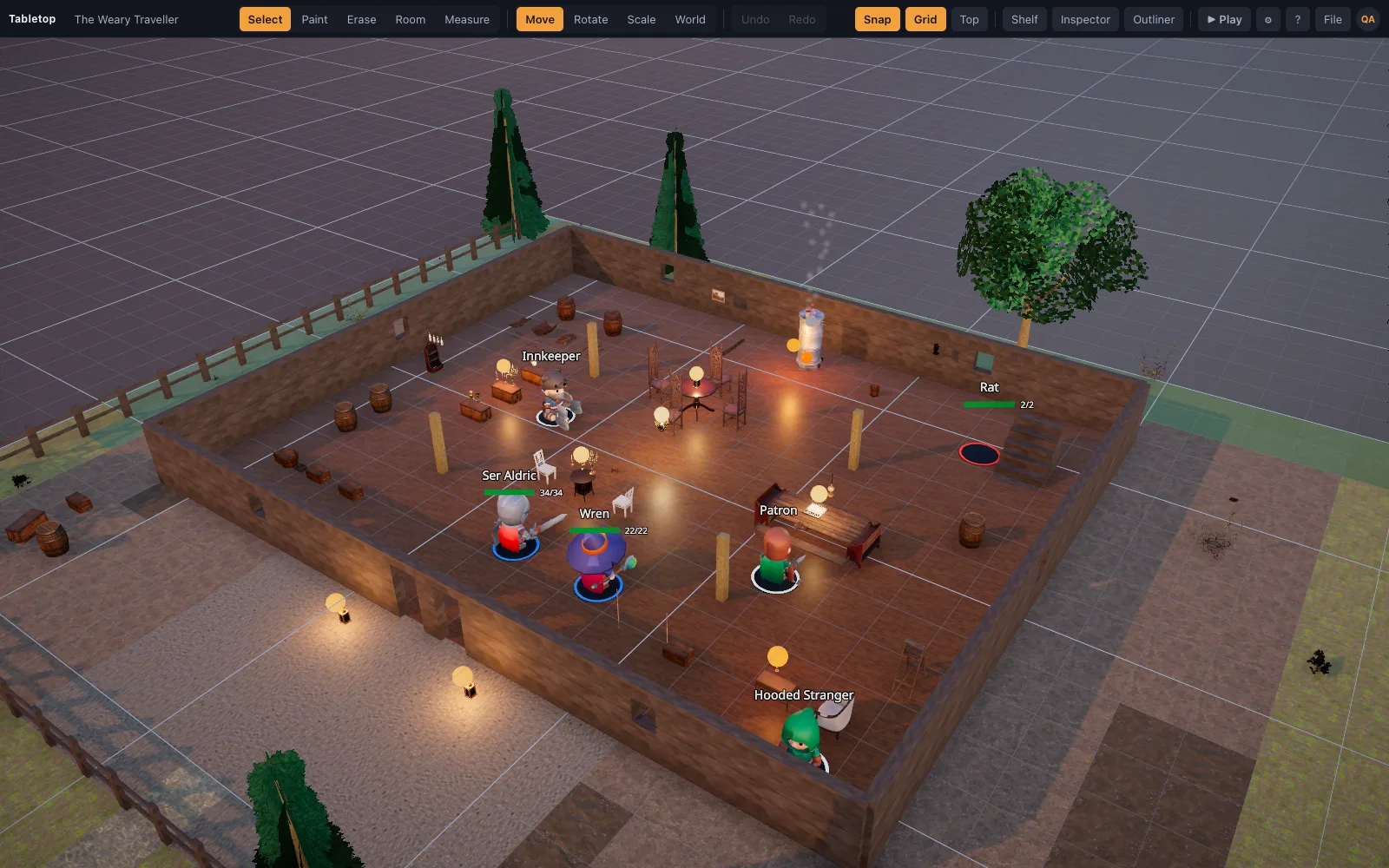
The first session sells the hobby. Talking works for the road and the village; when the fight starts, put it on a map the players can see. Open one of the starter scenes, a candlelit tavern or a torchlit dungeon, set the minis down and let the players lean in. In person, that is a laptop or a TV on the table; online, it is the DM sharing the tab, or sharing the scene by link so everyone signs in and sees the table live on their own screen. It takes a minute and it is the moment newcomers stop saying "so how does this work" and start saying "I climb on the table".
Character creation is session zero
Make characters together, in person or on a call, before the first real session. Use the pre-made characters if the group is impatient; they are good and they are balanced. Talk about what kind of game people want (funny, grim, tactical, chatty) and any subjects to leave out. Half an hour here saves a session of mismatched expectations.
What it costs and what to bring
For a group of five:
- The free core rules, or one Starter Set for the table (the only purchase worth making early)
- One set of dice per table; players buy their own once they are hooked, which they will
- Pencils and a printed sheet each, or a free sheet app
- A map for the fights: TerrainTale is free, runs in the browser, and the starter scenes are ready
- Snacks; this is not optional
Questions
How many friends do I need to play D&D?
One DM and two to five players. Two players works with a slightly easier adventure; six is the practical ceiling before turns get slow.
Can I DM if I have never played?
Yes. The Starter Set adventures are written for exactly that, and every group's first DM was once a first DM.
How long should the first session be?
Two to three hours, including character introductions. End at the first cliffhanger, not when the adventure runs out.
Do we need a battle map for the first game?
Not for the talking parts. For the first fight, a map on a screen is free and makes the difference between a rules lesson and a memory.
In person or online?
In person if you can; online if you cannot. Both work with the same rules and, if the DM shares the screen, the same map.
Keep reading
What Is D&D? Dungeons & Dragons Explained in Plain Words
What Dungeons & Dragons is, how a session actually works, what a DM does, what you need to start (almost nothing), and where a battle map fits.
How to Play D&D Online with Friends: Free, Nothing to Install
How to run D&D online with friends: voice on Discord, a free browser tabletop for the map, sheets and dice, and how to keep remote sessions fun.
A Virtual Tabletop for In-Person Games
Use a 3D virtual tabletop on a TV or projector for in-person D&D: top-down view, big grid, drag miniatures, measure in feet, run initiative.
Starter scenes
Sixteen finished battle maps with real screenshots.
Save, Export and Import D&D Scenes as JSON
Scenes autosave to your account and are also plain JSON: export a scene to a file, import one back, or hand a recipe to an AI assistant.
From the blog
AI-generated battle maps: what works, what does not, and why
Image models make pretty maps you cannot play on. A structured scene recipe an assistant writes — rooms, walls, props on a real grid — is the version that survives contact with a table.
· 7 min read
Lighting and vision: making darkness do tactical work
Bright, dim and darkness as game mechanics rather than mood — plus darkvision, light sources with real range, and how to light a map so players walk where you want them to.
· 6 min read
Theatre of the mind vs battle maps: the answer is both, on purpose
When narration beats a grid, when a grid beats narration, and a simple rule for switching between them mid-session without anyone losing the thread.
· 6 min read
All articles on battle maps, grid rules and running the game
Ready to put a map on the table?
Open the builder and start, no account needed. Sixteen starter scenes are on the welcome screen; sign up free when you want to save one or play it with your group.