Underwater combat in D&D 2024: which attacks suffer, how long you can breathe, and how to draw depth
Underwater, a creature without a Swim Speed has Disadvantage on melee weapon attack rolls unless the weapon deals Piercing damage, a ranged weapon attack has Disadvantage inside the weapon's normal range and automatically misses beyond it, and anything underwater has Resistance to Fire damage. Those three sentences are the 2024 Player's Handbook's underwater combat rules, shorter than the 2014 list of named weapons they replace. Add the swimming cost, the breath rule and the fact that water is a volume, not a floor, and a fight in a flooded crypt needs one more thing from the DM than a fight on land: a way to say how deep everyone is.
· 6 min read · TerrainTale
Which attacks are penalised
Melee first. If you lack a Swim Speed, your melee attack rolls with a weapon underwater have Disadvantage unless the weapon deals Piercing damage. A spear, a trident, a dagger, a shortsword and a rapier all swing normally; a longsword, a mace and a greataxe do not. Under the 2014 rules the exception was a list of five weapons, dagger, javelin, shortsword, spear and trident, so a 2014 rapier had Disadvantage and a 2024 rapier does not. The rule names weapons, so an Unarmed Strike is unaffected and a monk fights underwater as well as anywhere, and a melee spell attack such as Shocking Grasp is not a weapon attack either.
Ranged weapon attacks are worse off in 2024 than in 2014. A ranged attack roll with a weapon has Disadvantage against a target within the weapon's normal range and automatically misses anything beyond it, so a longbow reaches 150 feet at Disadvantage and never 600, and a thrown dagger 20 feet, not 60. The 2014 text exempted crossbows, nets and thrown weapons such as javelins and tridents; the 2024 text has no exceptions and adds the Disadvantage. Spell attacks are not weapon attacks, so a Fire Bolt flies its full 120 feet with a normal roll, which makes the caster the party's best ranged option in water.
Fire, lightning and the spells that change
Anything underwater has Resistance to Fire damage. That is the only damage rule; there is no bonus to lightning, no muffling of thunder, and a Fireball cast underwater still works, at half damage to everything submerged in it. Spells with a verbal component are castable, since nothing in the 2024 rules stops speech underwater, though a table can rule that a character out of breath cannot speak. Under the 2014 rules the fire Resistance line was the same and the rest was equally silent, which is why most of the folklore about lightning in water comes from other games.
The spells that matter are the ones that grant a Swim Speed or breathing. Water Breathing gives up to ten creatures the ability to breathe underwater for 24 hours and is the reason a level 5 party can fight in a flooded temple at all. Alter Self's Aquatic Adaptation gives gills and a Swim Speed equal to walking speed, which also removes the melee Disadvantage. Freedom of Movement lets a creature move normally in water and spend 5 feet to escape a grapple, which is the answer to the giant octopus.
Swimming cost and holding your breath
Swimming without a Swim Speed costs 1 extra foot for every foot moved, so a Speed of 30 buys 15 feet of water a turn, three squares, and a Dash three more. A Swim Speed moves at its full value with no extra cost, which is why the merrow at 40 feet swimming runs rings around a party at 15. Difficult Terrain in the water, weeds or wreckage, stacks with the swimming cost for 3 feet per foot. Armour makes no difference under the rules, though a DM may ask for a Strength (Athletics) check to swim in heavy armour against a current.
Breath is a timer. A creature can hold its breath for 1 plus its Constitution modifier in minutes, minimum 30 seconds, which in combat is 10 rounds per minute. When the breath runs out the creature is Suffocating and gains 1 Exhaustion level at the end of each of its turns; the levels are removed when it can breathe again. That is the 2024 rule. The 2014 rule was harsher: after the breath ran out you survived a number of rounds equal to your Constitution modifier, minimum 1, then dropped to 0 hit points and were dying. Under 2024 a fighter with 14 Constitution has three minutes of air, 30 rounds, and then a slow slide through Exhaustion rather than a sudden collapse.
Drawing depth on a flat grid
A flooded room is a box, and every creature in it has a depth as well as a square. Movement counts in three dimensions: a creature 15 feet below another and 20 feet across is not 20 feet away; with the diagonal rule that every square is 5 feet it is 20, since the larger of the two distances wins on a square grid, but with the alternating 5-10-5 rule it is 25, and either way the DM has to know the vertical number to say it. Write a depth on each token, or use a small die beside the mini, and change it when the creature moves up or down. The rule for vertical movement is the same as horizontal: each foot costs a foot, and two extra without a Swim Speed.
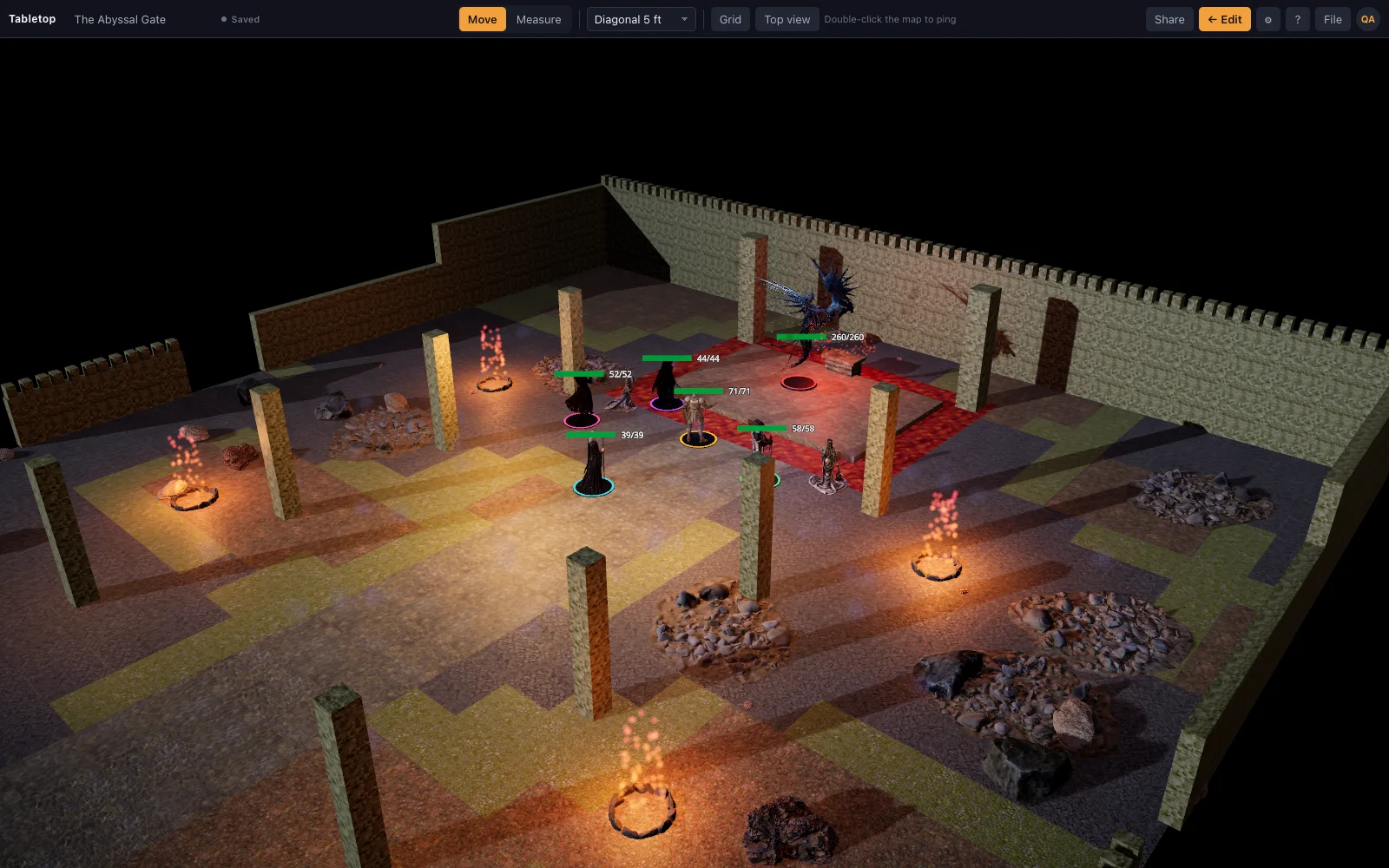
Reach and area work the same way. A creature's 5-foot reach is a sphere, so an enemy 5 feet below can be hit and one 10 feet below cannot. A Fireball is a 20-foot-radius sphere in water as in air and catches creatures at every depth inside it. On a 3D table the depth is simply where the mini is; the ruler that counts height gives the true straight-line distance between two swimmers, and the camera tilted to eye level shows the shark under the boat rather than beside it.
Running a fight in a flooded crypt
Build the water as a hazard with an edge. A crypt where the lower level is flooded to the ceiling and the stair is the only air gives the party a reason to fight at the surface and the monsters a reason to drag them down; the breath timer is the clock, and the Exhaustion rule means a rescued character comes back rather than dying on the spot. Give the monsters Swim Speeds and Piercing attacks, since bites are Piercing, and give the party a Piercing weapon each or a spear rack on the way in, so the melee rule is a choice they can make rather than a penalty they discover.
Track three numbers per creature: hit points, depth and rounds of breath left. The initiative tracker carries the first; the other two go in a token's condition slot or on a scrap of paper. State the fire Resistance before the sorcerer casts, remind the ranger that the bow rolls at Disadvantage, and the room runs itself. A flooded fight is not more complicated than a land fight; it is a land fight with a ceiling.