What is D&D, and what actually happens at the table?
Dungeons & Dragons is a tabletop roleplaying game. One person, the Dungeon Master, describes a world and plays everyone in it; the others each play one character in that world; dice settle the parts nobody can be sure of. There is no board, nobody wins, and a game can run for one evening or several years. This page explains it without the vocabulary, and says where a map like ours comes in.
A conversation with dice in it
A session is a loop. The DM describes where you are and what is happening: a rain-soaked road, a cart on its side, something moving in the trees. Each player says what their character does. If the outcome is certain, it simply happens. If it is not, the player rolls a twenty-sided die, adds a number from their character sheet, and compares it with a target the DM sets. High enough and it works; too low and the DM says what went wrong instead. Then the DM describes the new situation and the loop goes round again.
The rulebook exists to make those rolls consistent: what a fighter is good at, how much damage a sword does, how far a spell reaches. The current edition is the fifth (the 2024 rules revise the 2014 ones and are compatible with them). The core rules are free to read online; the printed books add options, monsters and adventures.
The two jobs at the table
The Dungeon Master prepares the adventure, plays every character the party meets, runs the monsters in a fight, and referees the rules. It is more work than playing and more fun than it sounds; most long-running groups have one DM who loves it.
The players each build one character: a species, a class (fighter, wizard, rogue, cleric and so on), six ability scores, some equipment, a name and a reason to be here. A party is usually three to six players. Characters gain levels as the story goes on, and the same character can be played for years.
Theatre of the mind versus the battle map
Much of a session is talk: the DM describes, the players decide, everyone imagines the same scene well enough. That is called theatre of the mind and it needs nothing but voices.
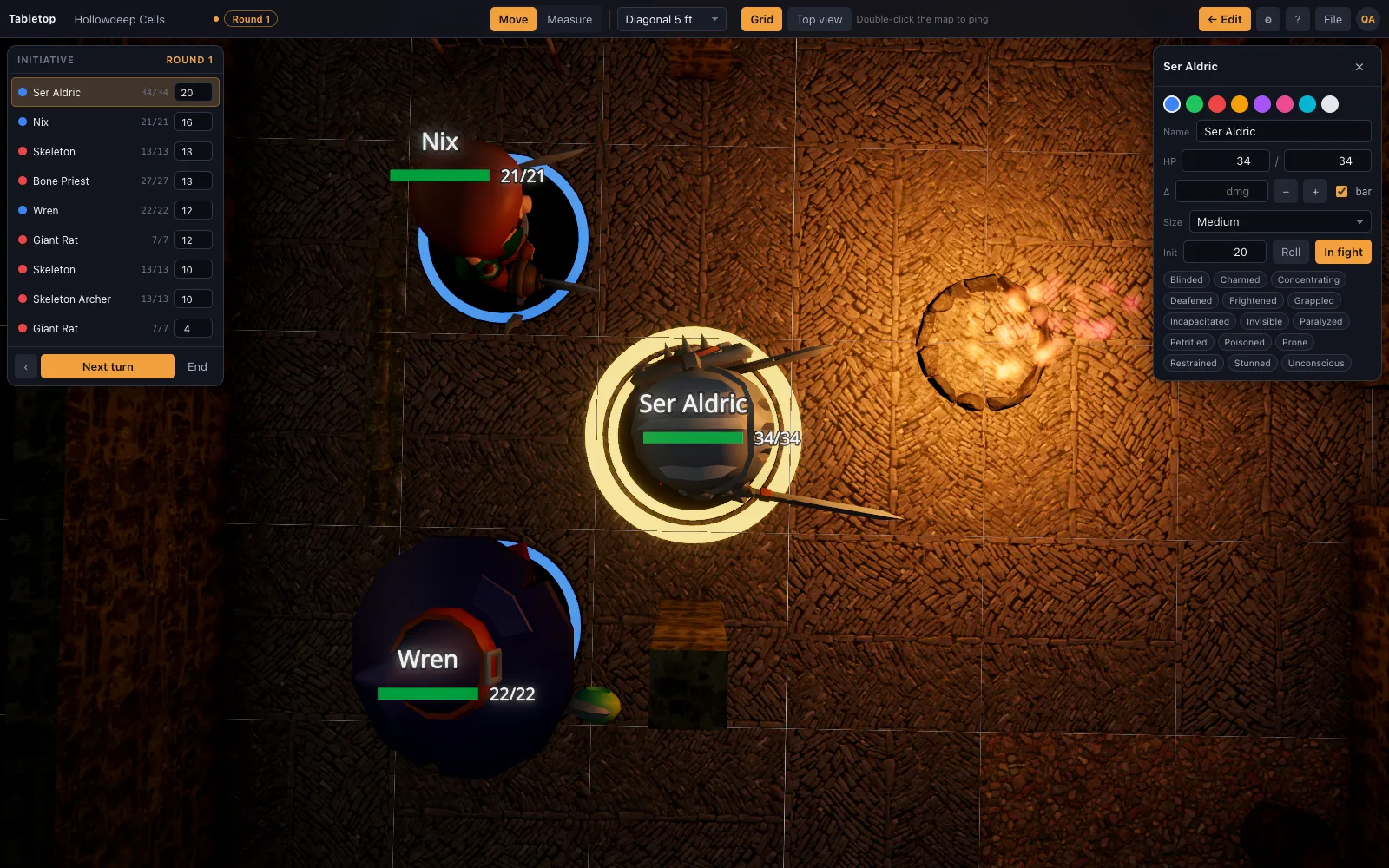
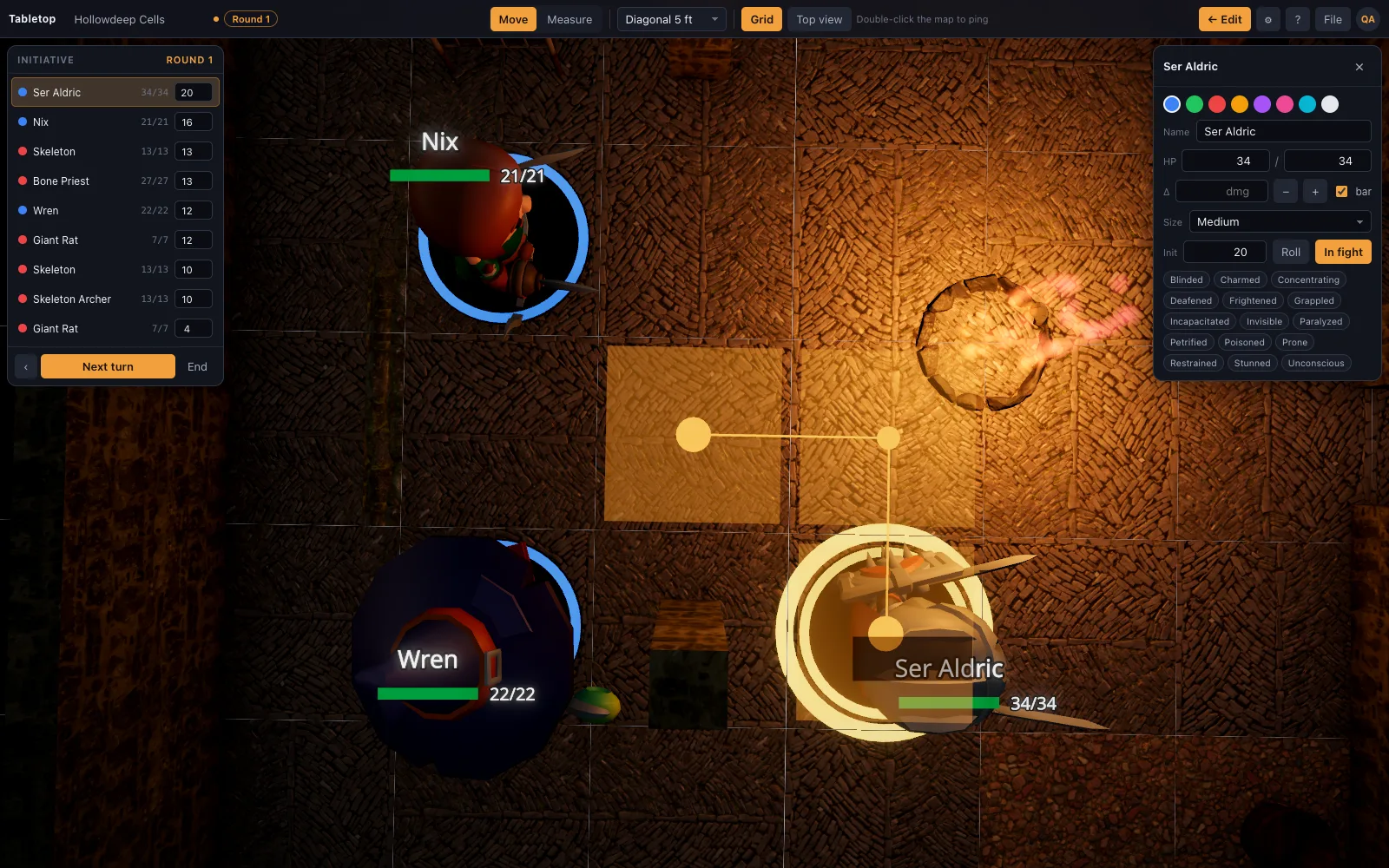
Fights are where a map earns its place. D&D combat is measured in five-foot squares: a character moves thirty feet, a longbow reaches six hundred, a fireball has a twenty-foot radius. Once four players, six goblins and a burning cart all need positions, the table wants a grid and something to stand on it. Traditionally that is a paper mat and miniatures; increasingly it is a screen, which is what a virtual tabletop is.
What you need to start
Less than people assume. A first session needs:
- One person willing to DM, and two to five who will show up
- The free core rules (a web page) or a Starter Set, which includes a short adventure and pre-made characters
- One set of polyhedral dice per table, or a dice app
- About three hours and a table, or a voice call
- A map and minis for the first fight: optional, and free if the map is a screen
Where TerrainTale fits
TerrainTale is the map layer and nothing else. It is a free 3D virtual tabletop in the browser: the DM builds a place (a tavern, a crypt, a forest road) from a realistic library or opens a ready-made one, puts miniatures on it, and runs the fight with a ruler that counts feet and a tracker for whose turn it is. It does hold a dice tray for physics rolls shared with the table, but it does not automate rolls from a stat block or hold character sheets, because the game already has those and you already own them. If you are the new DM in your group, it is the part of the setup that makes the first fight look like the pictures.
D&D and the wider hobby
D&D is the most played tabletop roleplaying game, but it is one of many with the same shape: Pathfinder, Call of Cthulhu, Daggerheart, Shadowdark, dozens of smaller ones. Together they are called TTRPGs. Almost everything on this page applies to all of them, and so does the map.
Questions
How long does a game of D&D take?
A session is usually three to four hours. A campaign is a series of sessions with the same characters and can last months or years; a one-shot is a complete story in one evening.
Do I need to buy anything to play D&D?
No. The core rules are free online, dice apps are free, and a Starter Set is the only purchase worth making early. A battle map on a screen costs nothing.
Is D&D hard to learn?
The loop (describe, decide, roll) takes ten minutes. The details take a few sessions, and a good DM only explains a rule when it comes up.
Can you play D&D with two people?
Yes: one DM and one player works, with a sidekick or a slightly easier adventure. Three to five players is the usual size.
Do you need miniatures and a map?
Not for most of a session. For fights they help a lot, and a virtual tabletop gives you both without buying or painting anything.
Keep reading
Play D&D with Friends: Start a Group and Run Your First Night
How to get a D&D group going with friends: who runs it, what to buy (almost nothing), a first adventure, a schedule that survives adult life, and a free 3D battle map for the first fight.
How to Play D&D Online with Friends: Free, Nothing to Install
How to run D&D online with friends: voice on Discord, a free browser tabletop for the map, sheets and dice, and how to keep remote sessions fun.
D&D Virtual Tabletop in 3D
A 3D virtual tabletop built for Dungeons & Dragons: realistic battle maps, painted-miniature figures, a ruler in feet, initiative and HP.
TTRPG Virtual Tabletop for Any System: 3D, Free, No Rules Engine
A virtual tabletop for any tabletop RPG on a grid: D&D, Pathfinder, OSR, Shadowdark, Savage Worlds and more.
From the blog
Squeezing in D&D 2024: the rule that became Difficult Terrain, and what to do about the missing penalties
The squeezing rules 5e uses in 2024: a narrow opening one size too small is Difficult Terrain and nothing more, the 2014 penalties are gone, which gaps count, and a house rule that keeps it tactical.
· 5 min read
Two-weapon fighting in D&D 2024: how dual wielding actually works
The two weapon fighting 5e rules as written in 2024: the Light property's bonus action attack, which weapons qualify, the ability modifier question, Nick, Dual Wielder, and what changed from 2014.
· 5 min read
Underwater combat in D&D 2024: which attacks suffer, how long you can breathe, and how to draw depth
The underwater combat rules 5e uses in 2024: melee Disadvantage without a Swim Speed unless the weapon pierces, ranged attacks capped at normal range, fire Resistance, breath, and depth on a grid.
· 6 min read
All articles on battle maps, grid rules and running the game
Ready to put a map on the table?
Open the builder and start, no account needed. Sixteen starter scenes are on the welcome screen; sign up free when you want to save one or play it with your group.