The best virtual tabletop in 2026, by what you need
There is no single best virtual tabletop; there is the best one for your group. This guide sorts the common choices by need, with a one-line reason each. Prices and features change, so treat it as a starting point and check each site.
Best free virtual tabletop
Several good tabletops cost nothing to start.
- Owlbear Rodeo: a fast, minimal shared map with a free tier.
- Roll20: a full platform with sheets on its free tier.
- Fantasy Grounds: the software has been free since November 2025; licensed content is paid.
- Tableplop and other community projects: free, with smaller feature sets.
Best for automation
If you want the software to resolve attacks, damage and effects:
- Foundry VTT: deep automation through systems and modules, one-time licence.
- Fantasy Grounds Unity: deep built-in automation for supported rulesets.
- Roll20 (top tier): roll templates and API scripts.
Best for beginners
Fewest decisions before session one:
- Owlbear Rodeo: almost nothing to learn.
- Roll20: clickable sheets help new players.
- D&D Beyond Maps: easiest if your campaign is already on D&D Beyond.
Best 3D virtual tabletop
For a map that is a place rather than a picture:
- TaleSpire: the established 3D RPG table on Steam, bought per person.
- Tabletop Simulator: a physics sandbox with a huge Workshop.
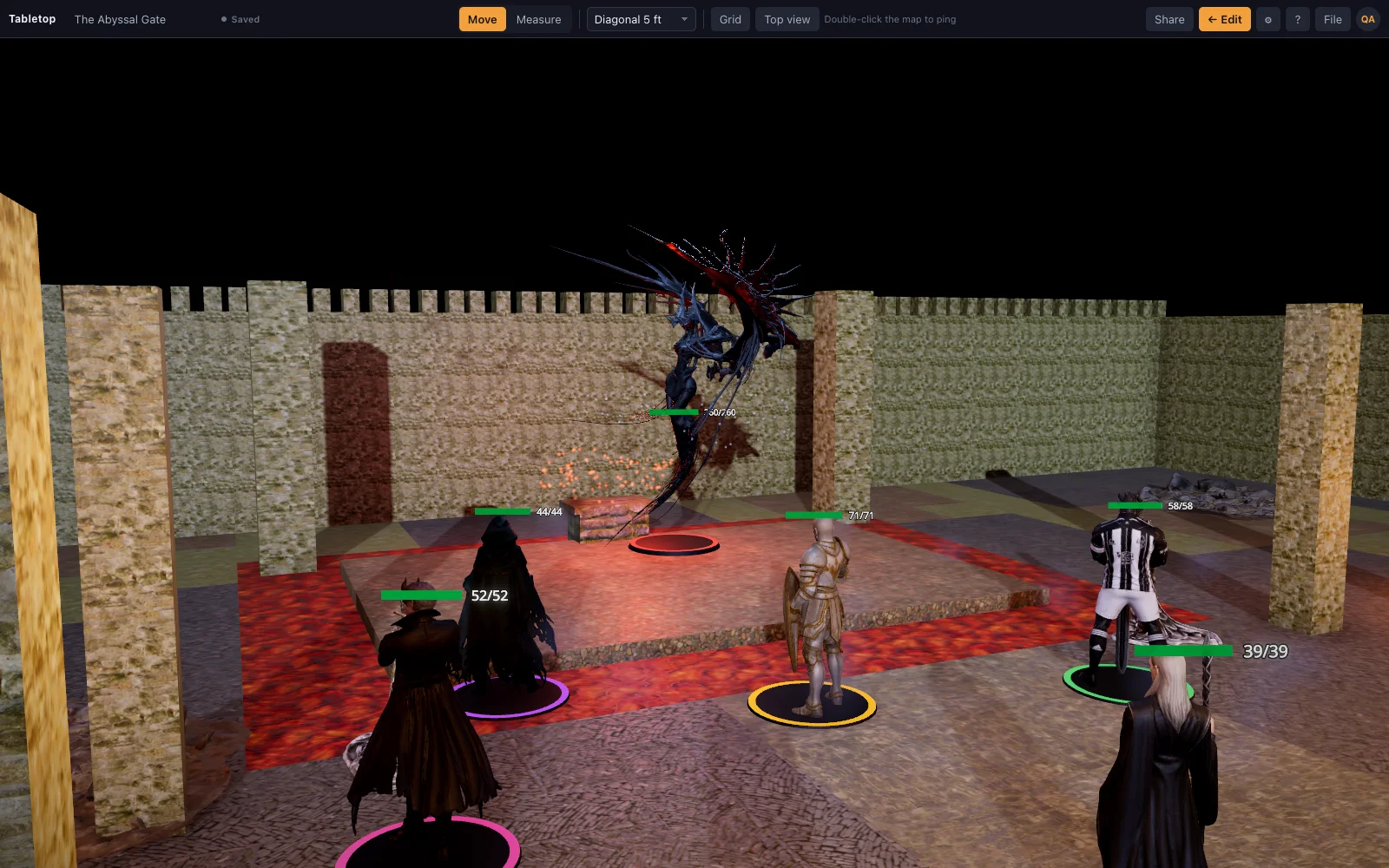
- TerrainTale: 3D in the browser with a realistic library and fog of war; no rules automation.
Best for in-person play on a TV
For a screen lying flat on the table or a projector:
- Arkenforge: a desktop map maker and table built for local, in-person play.
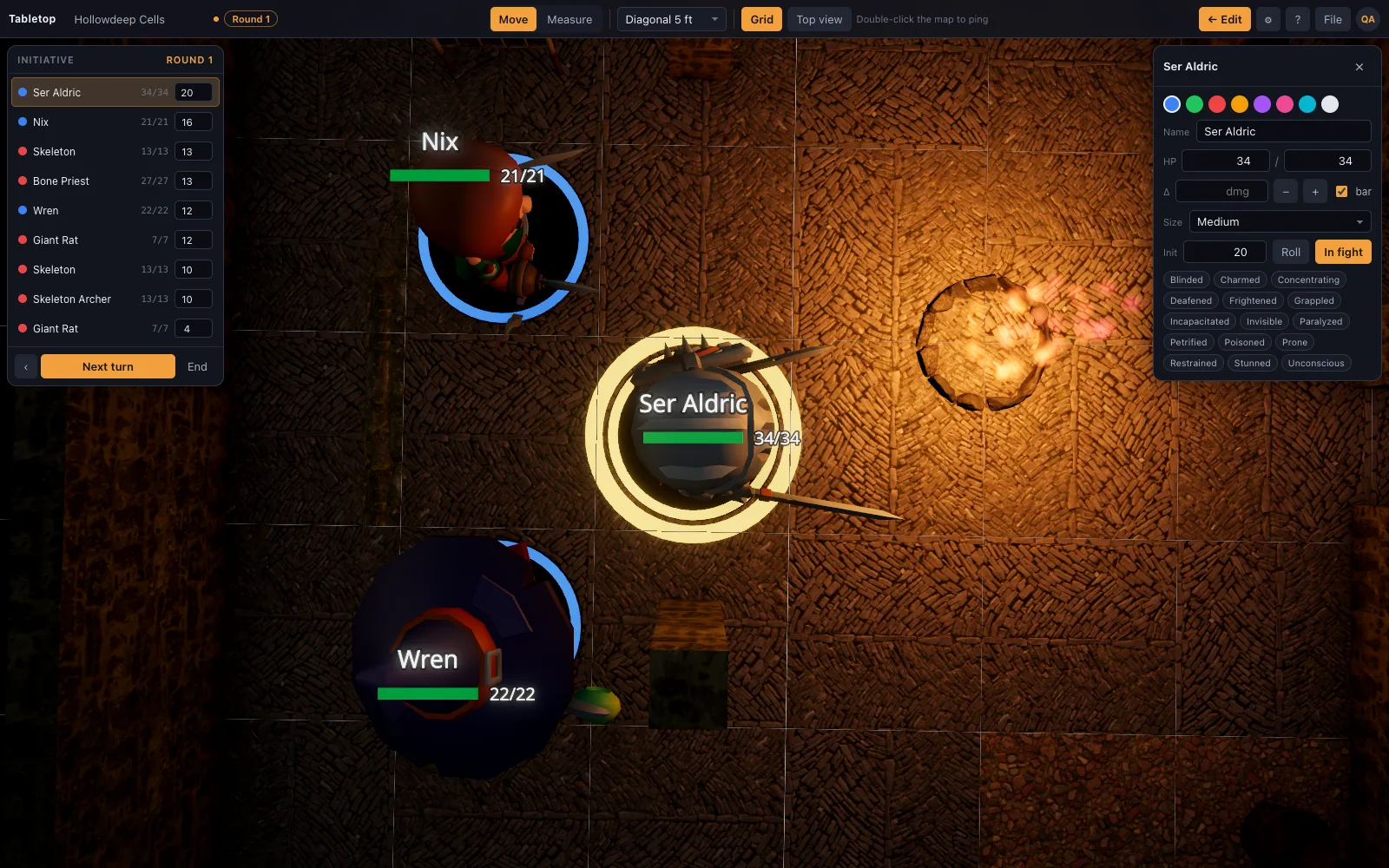
- TerrainTale: a browser play mode with a top-down view and large labels.
- Foundry VTT and Owlbear Rodeo: both used on TVs with a second window for the GM.
Best self-hosted virtual tabletop
For keeping data on your own machine or server:
- Foundry VTT: the best-known self-hosted option.
- MapTool: free and long-running, a Java desktop app.
- TerrainTale: a single Node server you can run yourself.
Best for any system
For games beyond D&D:
- Roll20: sheets for a very wide range of systems.
- Foundry VTT: many community game systems.
- Owlbear Rodeo: system-agnostic by being minimal.
Questions
What is the best virtual tabletop for D&D in 2026?
For automation, Foundry VTT; for ease, Roll20 or Owlbear Rodeo; for a campaign already on D&D Beyond, D&D Beyond Maps; for 3D, TaleSpire or a browser 3D table such as TerrainTale.
What is the best free virtual tabletop?
Owlbear Rodeo and Roll20 both have free tiers, and the Fantasy Grounds software is now free too. TerrainTale's free plan keeps one saved scene.
What is the easiest virtual tabletop for beginners?
Owlbear Rodeo has the least to learn; Roll20 helps new players with built-in sheets.
Which virtual tabletop is 3D?
TaleSpire and Tabletop Simulator on Steam, and TerrainTale in the browser. Foundry can add 3D through community modules.
Which virtual tabletop can I host myself?
Foundry VTT and MapTool are common choices; TerrainTale can also be self-hosted.
Is Sigil still available?
Sigil closes at the end of October 2026. D&D Beyond Maps continues.
Keep reading
Roll20 vs Foundry VTT
Roll20 vs Foundry VTT compared honestly: price, setup, automation, hosting and who each one suits, plus where a 3D browser table fits in.
Foundry VTT vs Fantasy Grounds
Foundry VTT vs Fantasy Grounds: two automation-heavy virtual tabletops compared on price, hosting, official content and learning curve.
Owlbear Rodeo vs Roll20
Owlbear Rodeo vs Roll20 compared: a lightweight shared map against a full browser platform, with prices, features, setup and who each suits.
TaleSpire vs Foundry VTT
TaleSpire vs Foundry VTT compared: a 3D tabletop on Steam against a self-hosted 2D platform with automation.
D&D Beyond Maps vs Roll20
D&D Beyond Maps vs Roll20 compared for running D&D online: free tiers, subscriptions, character sheet links, official content, maps and setup.
TaleSpire vs Tabletop Simulator
TaleSpire vs Tabletop Simulator for running D&D in 3D: a purpose-built RPG table against a physics sandbox.
Free Virtual Tabletop: 3D Maps, No Download, No Seat Licences
A free virtual tabletop in the browser: open a 3D battle map, drag minis, measure in feet, run initiative.
From the blog
Diagonal movement in 5e: three rules, and when to use each
Every diagonal as 5 ft, the 5/10/5 variant, and true distance — how each one plays, which one your table probably wants, and how to stop arguing about it mid-fight.
· 5 min read
Running combat online without slowing the game to a crawl
Why online fights take twice as long as table fights, and eight concrete changes — turn order, telegraphing, pre-rolled initiative, a shared timer — that get the pace back.
· 7 min read
Initiative tracking that stays out of the way
What an initiative tracker has to do (order, current turn, round count, HP) and everything it should refuse to do. Plus how to handle surprise, lair actions and mid-fight arrivals.
· 6 min read
All articles on battle maps, grid rules and running the game
Ready to put a map on the table?
Open the builder and start, no account needed. Sixteen starter scenes are on the welcome screen; sign up free when you want to save one or play it with your group.