A free virtual tabletop, and what free means here
"Free VTT" usually means a free tier with the good parts behind a subscription, or free software you have to host and configure yourself. TerrainTale is a free account with the table in it: the 3D builder, the whole realistic library, play mode with the ruler and initiative, shared rooms, and scene export. The free plan limits two things: it keeps a single saved scene in your library, and it builds from the built-in library rather than your own files. Premium, $6 a month, keeps up to 200 scenes and brings in your own models and token portraits. That is the whole difference, and it is written on the pricing page.
What is included at no cost
The table and everything on it. Premium adds room for more saved scenes and your own files on the table, imported 3D models and pictures as token portraits; the rest is the same on both plans.
- The builder: room tool with seven kits, tile brush, shelf, prefabs, undo everywhere
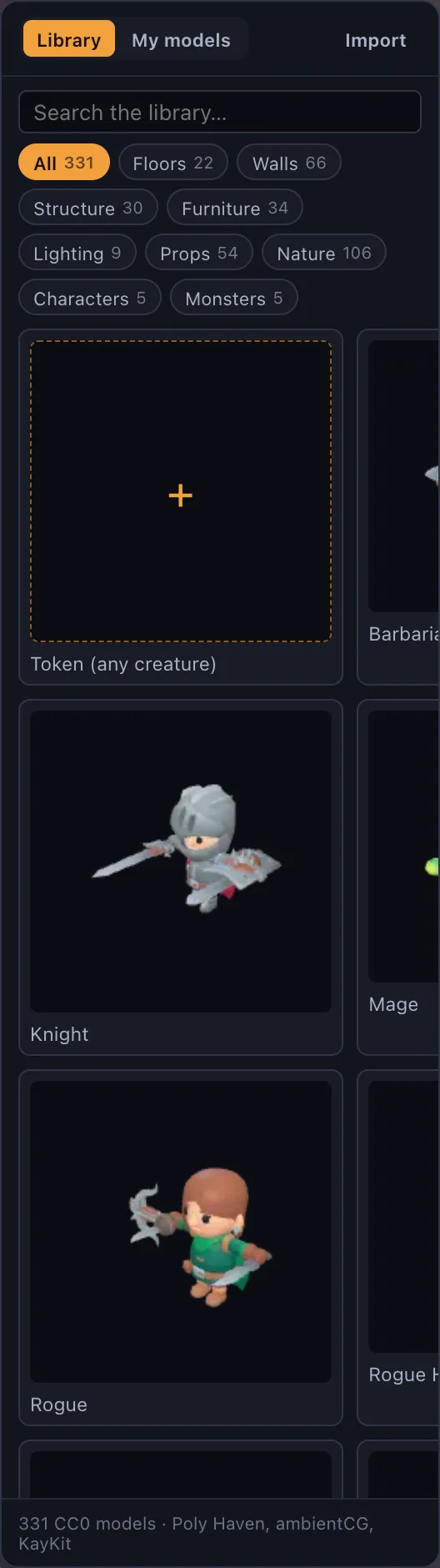
- The library: PBR surfaces, photoscanned props and Meshy-made D&D minis, free on every plan
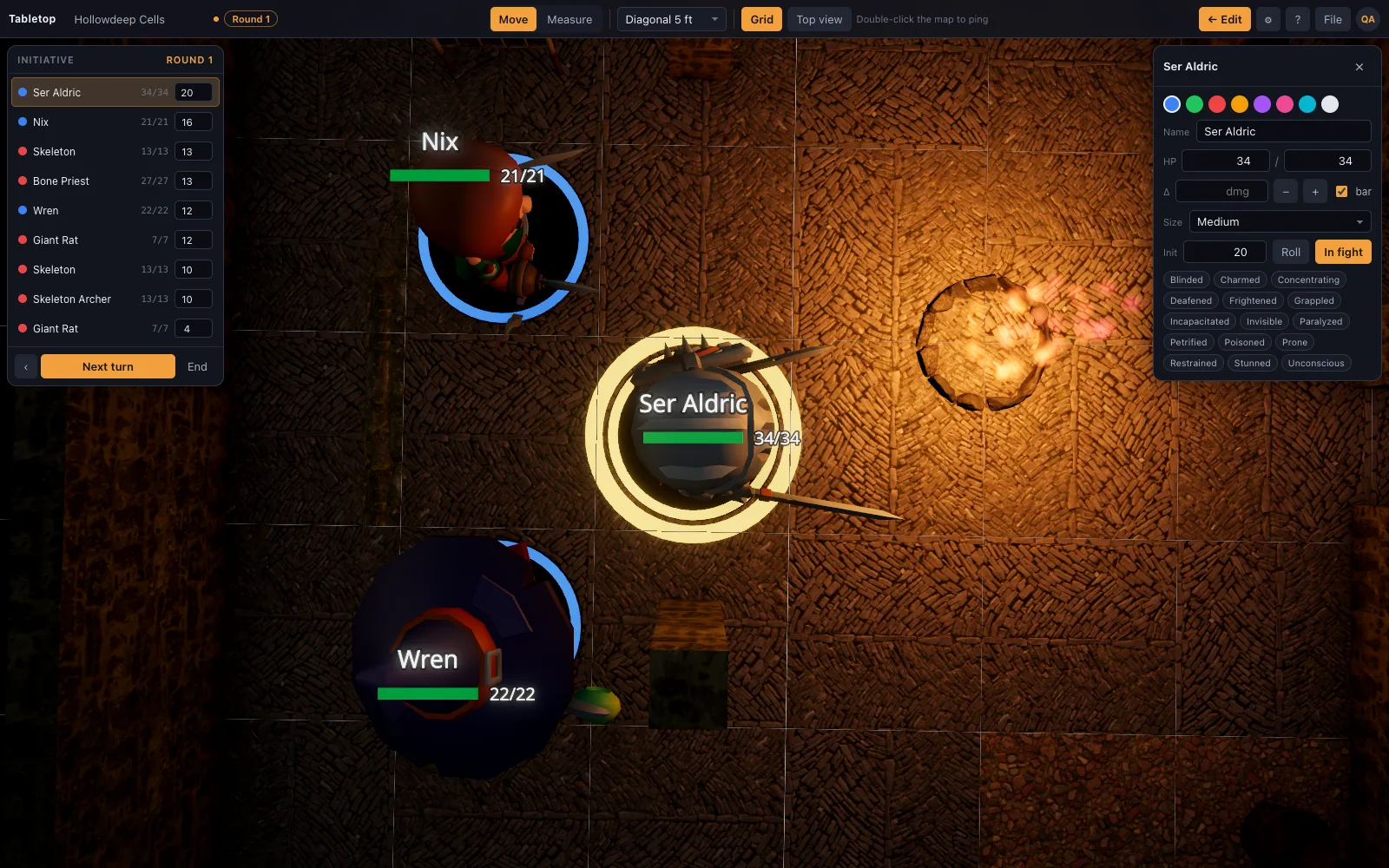
- Play mode: ruler in feet with waypoints and height, initiative, HP, conditions, pings
- Sixteen finished starter scenes on the welcome screen
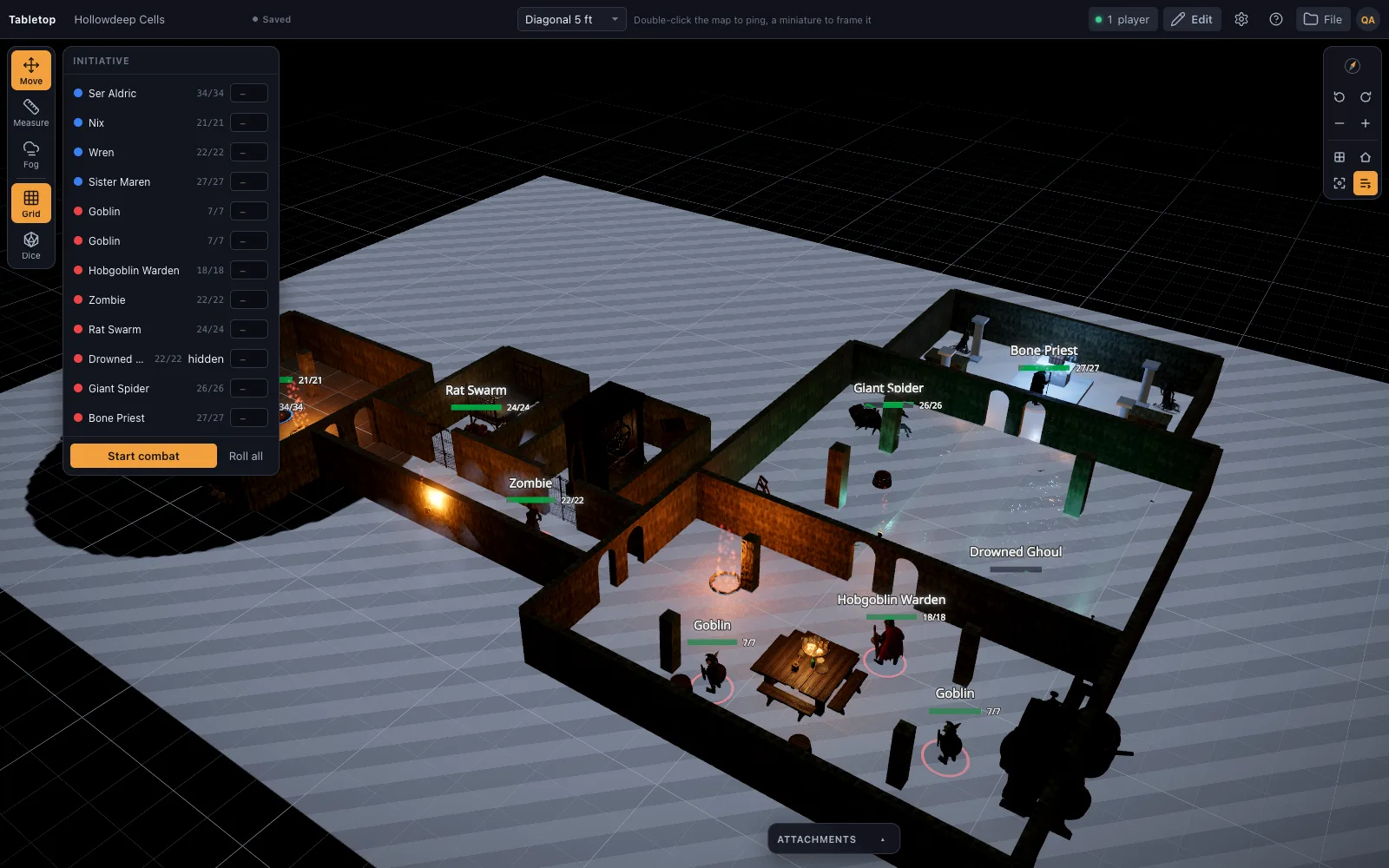
- Shared rooms: players join by link, free, and see the table live
- Standee tokens for any creature; JSON export and import of any scene
- One saved scene in your library at a time (Premium: up to 200)
- The built-in library of thousands of models (Premium: import your own .glb, .obj, .fbx, .stl, and use your own pictures as portraits)
Why it can be free
The library is built from CC0 sources (ambientCG materials, Poly Haven scans) and minis TerrainTale made itself in Meshy, so there is no content to license and no marketplace to run. Models are static files, so the server is a single small Node process that serves pages, signs people in and keeps scene files. What the paid plan pays for is exactly the part that costs something: storing more of your scenes. Players never pay.
Free for the players, too
Players do not need accounts to watch a shared screen: the DM signs in, opens the map on a TV, a projector or a screen share, and drags minis as the players call their moves. To join a shared room and move their own miniatures remotely, a player signs in too, for free; nobody buys a seat and nobody installs a client.
What the free plan does not include
A second saved scene. Build one, play it, export it as JSON if you want to keep it, and start the next; or take Premium ($6 a month, $48 a year) and keep up to 200 in the library. Cancelling never deletes a scene, and refunds are a single email within 14 days.
Beyond that, the app itself has no character sheets, dice automation, compendium or automatic line of sight, on any plan; fog of war is a hand-painted brush on every plan. TerrainTale is the map and the fight on it; the comparison pages say where another tool is the better choice.
Or run your own copy
The server has no native dependencies: one Node process serves the site, the app and the accounts, behind any reverse proxy. A group or a club can host its own instance with its own sign-in options. Scenes export as JSON and import anywhere, with library models fetched automatically.
Questions
Are there hidden costs, tiers or ads?
No hidden ones. Two plans: Free keeps one saved scene and builds from the built-in library, Premium ($6 a month or $48 a year) keeps up to 200 and brings in your own models and portraits. No advertising, and the library is CC0/CC BY so nothing inside the app is for sale.
Do I need an account?
Yes, one free account for the DM. Sign up with an email and password, a one-time email link, or Google, GitHub or Discord where the host has enabled them. Players need nothing.
Will it stay free?
The free plan is how most people use it and it is not going away. The library is CC0/CC BY and the server is open and self-hostable, so whatever happens to the hosted copy a group can always run its own. Scenes are yours as JSON at any time.
Can I use my own models for free?
Importing your own models is a Premium feature: with it, drop any .glb, .obj, .fbx, .stl or other model file on the window, Draco and meshopt included. On the free plan you build from the built-in library of thousands of CC0/CC BY models; using your own pictures as token portraits is Premium as well.
Is the free version limited in map size or scene count?
Not in map size: a 60 by 60 square map runs fine on a discrete GPU. In scene count, yes: the free plan keeps one saved scene in your library, Premium up to 200. Any scene exports as JSON and imports again later, on either plan.
Keep reading
3D Virtual Tabletop (3D VTT): Free, in the Browser
A 3D virtual tabletop that runs in a browser tab: realistic battle maps with walls, light and height, painted-miniature figures, a ruler in feet and initiative.
Owlbear Rodeo alternative
Looking for an Owlbear Rodeo alternative with 3D maps? TerrainTale keeps the simplicity (no rules engine, nothing to install) and adds real miniatures, light and height.
Roll20 alternative
A Roll20 alternative for groups who want a realistic 3D map and none of the overhead: no character sheets, no macros, a ruler in feet, initiative and HP.
Save, Export and Import D&D Scenes as JSON
Scenes autosave to your account and are also plain JSON: export a scene to a file, import one back, or hand a recipe to an AI assistant.
Self-Hosted 3D Virtual Tabletop
Run TerrainTale yourself: one Node process serves the app, the API and the sign-in gate.
Best Virtual Tabletop in 2026: Picks by What Your Table Needs
The best virtual tabletop in 2026, grouped by need: free, automation, beginners, 3D, in-person on a TV, self-hosted and any system.
From the blog
Running a D&D map from a ceiling projector instead of a TV
A projector aimed down at the table skips the size limit of a TV. Mounting height and throw distance, keeping the room dim without losing character sheets, and the mat it needs underneath.
· 5 min read
Boss fight arena design: how to build a battle map for the villain
What a boss battle map needs that an ordinary room does not: a stage for the villain, something to fight over, height, changes the map itself triggers, and floor enough for a Huge creature to move.
· 7 min read
Cave battle maps: building caverns that do not look like rooms
How to make cave and cavern battle maps for D&D that feel organic: irregular chambers, stalagmites as cover, water and rubble as terrain, ledges and pits for height, and light that shapes the dark.
· 6 min read
All articles on battle maps, grid rules and running the game
Ready to put a map on the table?
Open the builder and start, no account needed. Sixteen starter scenes are on the welcome screen; sign up free when you want to save one or play it with your group.