Why a 3D table with no rules engine
Most virtual tabletops grow into rules engines: sheets, macros, compendiums, automation. They are excellent at that, and a great deal of work to run. TerrainTale is the other thing a group needs, taken seriously: the table itself.
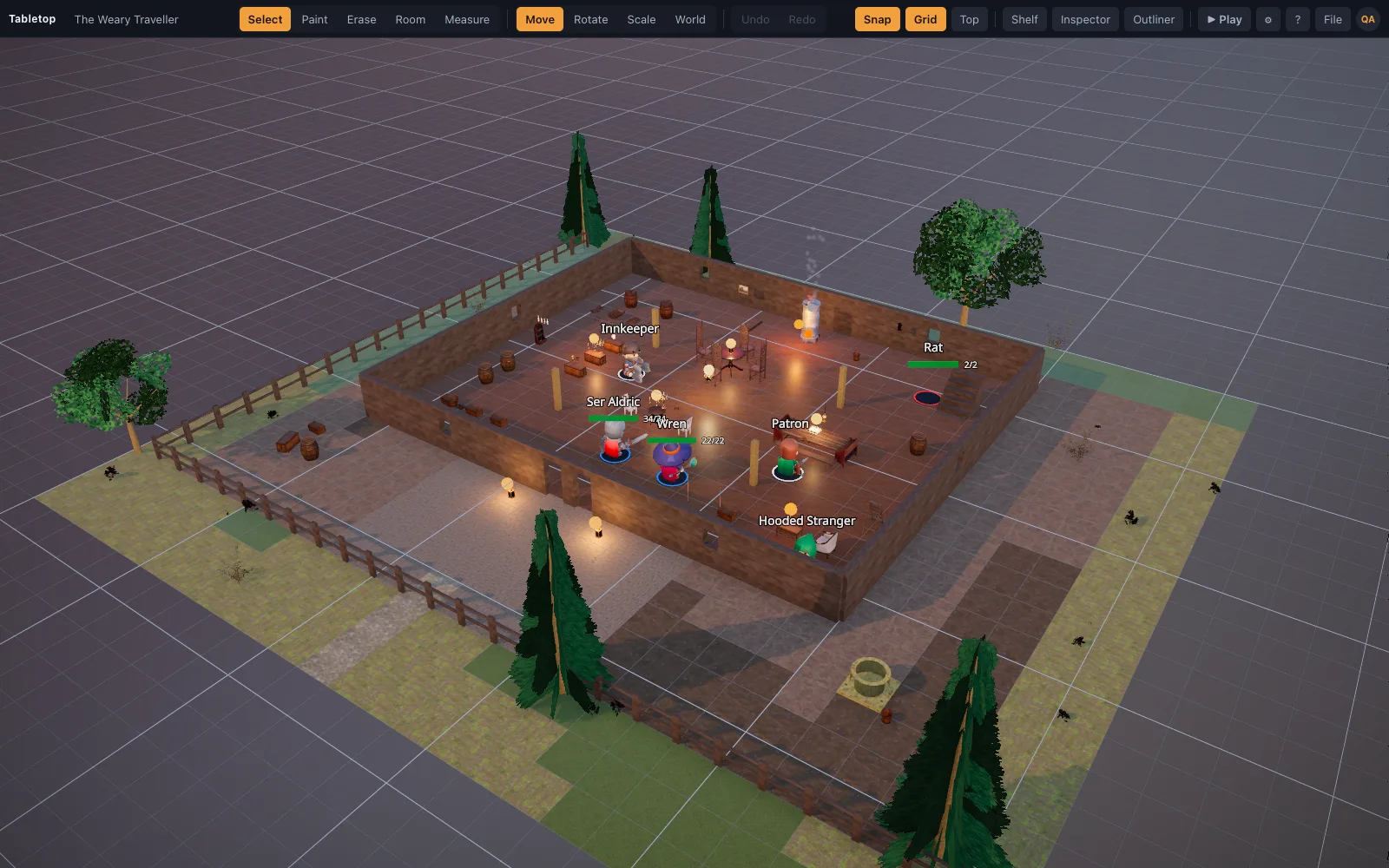
It builds a place that looks like a painted miniature table, puts minis on it, measures their moves in feet, keeps the turn order, and gets out of the way. The rulings stay with the people at the table.
Principles
- Realistic only. Scanned materials, photogrammetry props, realistic D&D minis. No stylised packs mixed in.
- One grid. Every model is authored to the 5-foot cell, so everything fits everything.
- Fast to build. A room in one drag, a scene from a template, a forest from a scatter op.
- Runs on what you have. Quality tiers picked from the GPU; instanced rendering; a web page.
- Open. The library is CC0/CC BY; the app and the server are self-hostable.
Credits
Surfaces are generated from ambientCG materials (CC0). Props are Poly Haven photoscans (CC0). Characters, monsters and furniture were made by TerrainTale in Meshy. Built with three.js, React Three Fiber, React and Zustand.
Some buildings, tents, robots and set pieces are the work of artists on Sketchfab, simplified for the tabletop and used under the Creative Commons Attribution licence (CC BY 4.0):
- 🌴𝓜𝓪𝓻𝓽𝓪𝓻𝓴🌴: Robot heavy yellow
- abhayexe: Asian shop row
- Andrei Milin: Steampunk robot
- Andy Woodhead: Timber house balcony
- Annielighta: Timber town house, Town house row
- ART_LOLL: Scifi soldier
- City Museum Berlin: Thatched house
- Comrade1280: Mech m6k, Mech tl22
- Daniel.Orlando.Tapia: Cyberpunk bus stop
- Den: Round tower
- Doaa Sheha: Mech military
- DoniTodorov: Medieval house small
- eexaw: Wooden windmill
- Elizabeth Watts: Old wooden barn
- exiS7-Gs: Market awning
- Jonas Prunskus: Drone walker
- landout: Tavern table with food
- LucasPresoto: Castle wall with towers
- Opus Poly: Viking longboat
- Peter Nox: Medieval cart
- rakutin: Canvas tent, Merchant tent
- re1monsen: Robotic arm
- Repka788rus: Robot rk11
- Rud_H: Arched wooden door
- Samuel F. Angrick-Johanns (Oneironauticus): Gothic arches
- Shalmon: Neon signs
- Siamak Tavakoli: Scifi monitor, Scifi wall console
- somni: Scifi pipes
- SpatialNeglect: Food stall
- Thangzy: Grindstone
- Thomas Andris: Stone church
- Uğur Yakışık: Castle complete
- Vanuartw: Medieval house tower
- Viktor_: Beer bar counter
- vmatthew: Market stall
- Willy Decarpentrie: Robot biped
- Zeps3D: Robot sweeper
Contact and support
TerrainTale is built and run by one person. Questions, bug reports, billing and refunds all go to [email protected], and a person answers, usually within a day.
It is free to use with one saved scene; Premium ($6 a month or $48 a year) keeps up to 200. That is the whole business model.
Dungeons & Dragons is a trademark of Wizards of the Coast. TerrainTale is not affiliated with or endorsed by it.
From the blog
CC0 assets for D&D maps: where good free models actually come from
ambientCG and Poly Haven explained — what CC0 means for a map you publish, why the minis are made rather than downloaded, and why a library authored to one grid beats a bigger library that is not.
· 6 min read
Self-hosting a virtual tabletop: what it really takes
A realistic account of running your own VTT — the box, the bandwidth, TLS, accounts, backups — and when self-hosting is worth it versus using a hosted table.
· 7 min read
Running combat online without slowing the game to a crawl
Why online fights take twice as long as table fights, and eight concrete changes — turn order, telegraphing, pre-rolled initiative, a shared timer — that get the pace back.
· 7 min read
All articles on battle maps, grid rules and running the game
Ready to put a map on the table?
Open the builder and start, no account needed. Sixteen starter scenes are on the welcome screen; sign up free when you want to save one or play it with your group.