Light is part of the map, not a filter over it
A flat map with a texture looks the same at every hour. TerrainTale lights the scene for real: a sun with shadows, torches you can attach to any lamp, bloom on flame, and a time-of-day slider that walks the sun across the sky, shadows swinging round with it, without changing a single tile.
Day, dusk and night from one map
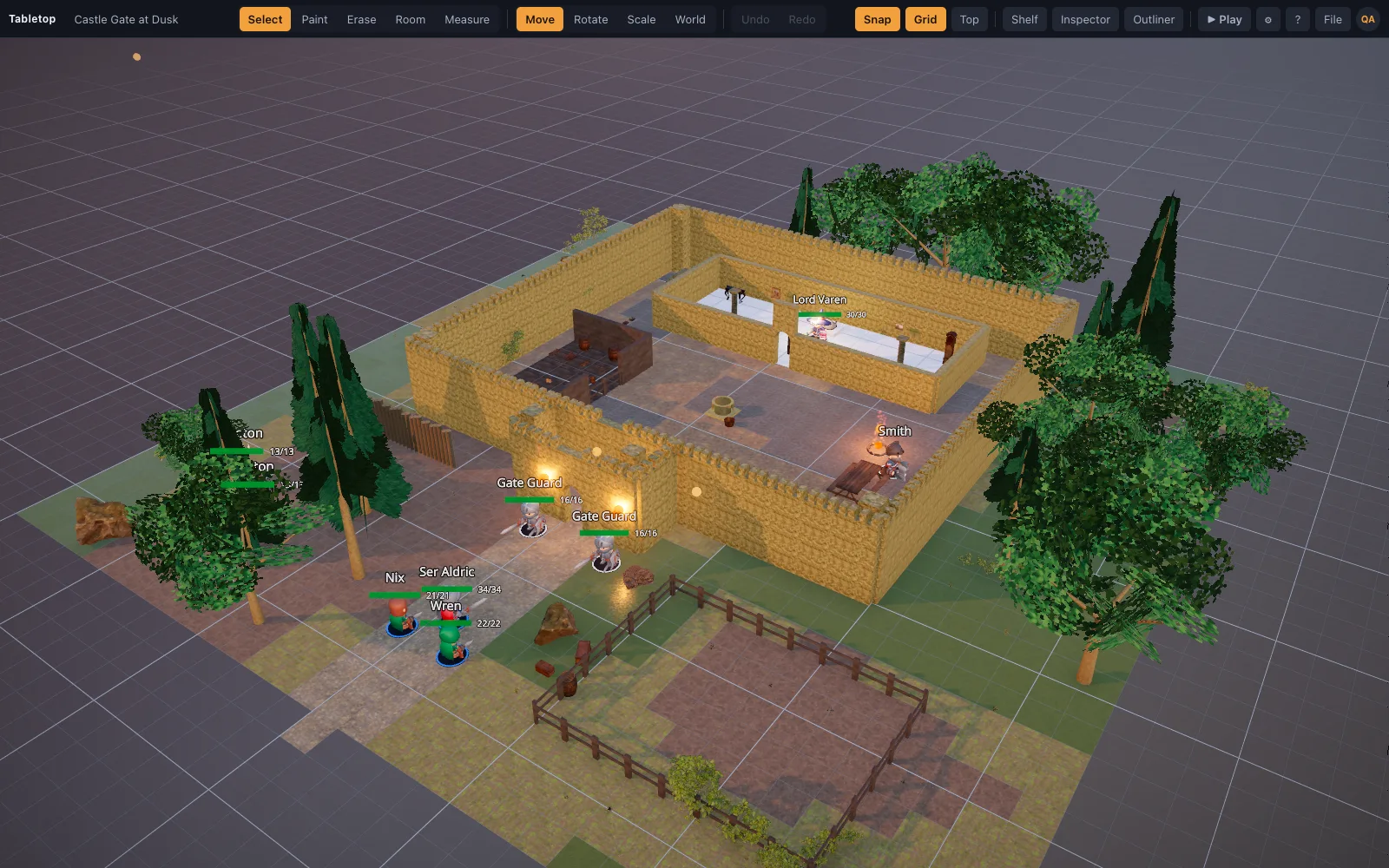
One slider sets the hour. The sun rises in the east, crosses the map and sets in the west, and every wall, tree and miniature throws a shadow that moves with it: short at noon, long and warm at dusk. After sunset a dim moon takes over and the sky, its light and the fog follow the hour. Drag the slider and the tavern that was cheerful at midday becomes a candlelit hideout at night, with no rebuilding. One encounter can carry three moods. Run the castle gate at noon as an approach in plain sight, at dusk as a tense parley with long shadows across the courtyard, and at night as a raid where the braziers are the only pools of light. The tiles, props and minis do not move. In 5e 2024 and PF2e, darkness and dim light change what creatures can see; the hour on the slider helps the table picture that, and the rules stay with the DM.
Torches and bloom
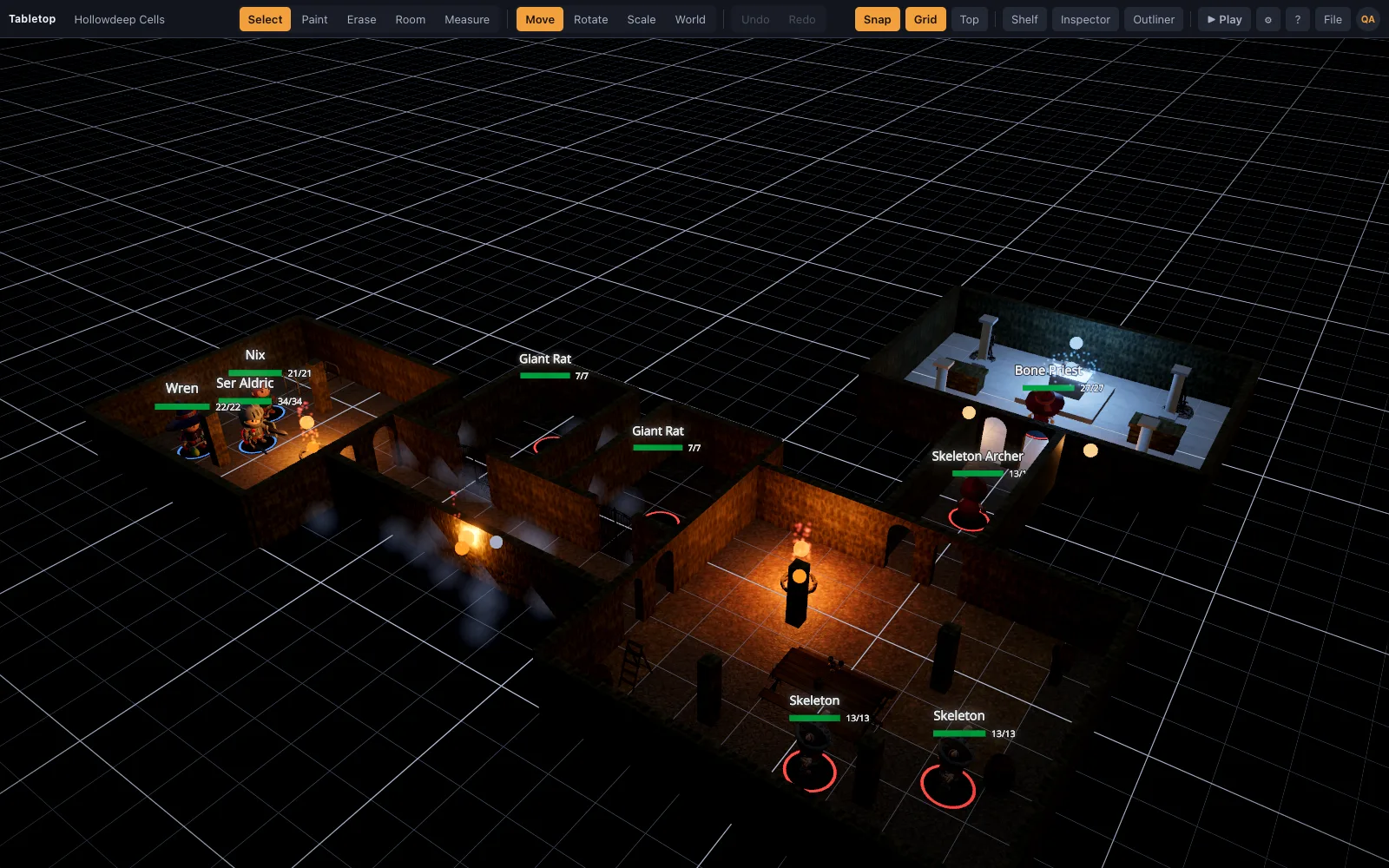
Attach a torch light to any lamp, candle or brazier on the shelf and it lights the corridor around it; flames get bloom so a torchlit dungeon actually reads as lit rather than merely textured. A practical pattern for a dungeon is one torch light every two or three rooms, on a sconce or a brazier, with the corridors between left darker. At night the players then read the map as their characters would, with bright pools around the lights and gloom between them. Lights are scene objects, so between turns you can move, add or remove one to show a lantern carried in or a brazier knocked over.
Scaled to the GPU you have
Quality tiers are picked automatically: integrated GPUs get a lighter lighting path, discrete GPUs get ambient occlusion, MSAA and 4K shadows. The tier is a starting point, not a lock: the quality settings let you lower it on a laptop that runs hot or raise it on a machine with headroom. Effects and shadow resolution are what change. The map, the lights and the time of day are the same scene on every tier, so a player on a tablet and the DM on a desktop look at the same place.
Questions
Can I set a fixed time of day for a scene?
Yes, the hour on the time-of-day slider is part of the scene and is saved with it. A crypt saved at midnight opens at midnight next week, ready for the session.
Do walls actually block light?
Yes, walls and props cast real shadows from the sun and from torch lights, not painted-on shading. Light is not vision, though. Shadows show where light falls, but the app does not compute what a token can see; use the fog brush to hide what the party has not explored.
Will this run on an older laptop?
Yes, the renderer detects the GPU and drops to a lighter lighting path on integrated graphics automatically. If it still stutters, lower the quality setting by hand, close other heavy tabs and plug the laptop into power, since many machines slow the GPU on battery.
Is lighting part of the free plan?
Yes, lighting and the time-of-day slider are part of the whole table on the free plan. Premium changes how many scenes you keep and lets you import your own models. It does not change the renderer.
Keep reading
3D Battle Maps for Tabletop RPGs
Make 3D battle maps in the browser from a realistic, CC0/CC BY library: PBR floors and walls, photoscanned props, trees and lights.
A Realistic 3D Asset Library for D&D Maps
A free library of realistic 3D battle-map pieces: PBR-generated floors and walls, Poly Haven photoscanned props, and D&D minis and furniture made in Meshy.
D&D Map on a TV: Build a Digital Game Table for In-Person Play
How to put a digital D&D battle map on a TV or projector: three hardware setups that work, a cheap computer to drive it, matching the grid to one-inch minis, and a free 3D map in the browser.
D&D Virtual Tabletop in 3D
A 3D virtual tabletop built for Dungeons & Dragons: realistic battle maps, painted-miniature figures, a ruler in feet, initiative and HP.
From the blog
The Darkness spell in 5e: how it works on a grid, who can see, and who gets advantage
How the Darkness spell works in 5e (2024) on a grid: the 15-foot sphere in squares, who is Blinded, attacks into and out of it, Devil's Sight, Blind Fighting, and casting it on an object.
· 5 min read
Dim light in 5e: what gets disadvantage, what does not, and what darkvision fixes
Dim light rules in D&D 5e (2024): disadvantage on Perception that relies on sight, not on attacks; how darkness differs; what darkvision really does; and how to light a map so it shows.
· 4 min read
Lair actions in 5e: what changed in 2024, and how to use the map
How lair actions work in 5e, what the 2024 Monster Manual changed about initiative count 20, and how to write three lair effects that use the terrain on your battle map and move the party.
· 5 min read
All articles on battle maps, grid rules and running the game
Ready to put a map on the table?
Open the builder and start, no account needed. Sixteen starter scenes are on the welcome screen; sign up free when you want to save one or play it with your group.