AI stat block generator

D&D stat block generator

Describe the creature — a hag who trades in stolen names, a clockwork sentinel, the villain your party keeps hearing about — and get a finished 5e stat block in the 2024 Monster Manual layout. The AI writes the monster; the generator does the arithmetic, so the attack bonuses, save DCs, hit points and challenge rating agree with each other.

Try one:
Your first stat block is free, no account needed.

How it works

  1. DescribeA sentence is enough: what it is, what it does, how dangerous it should be. Name a CR if you have one in mind; the generator picks one that fits if you do not.
  2. The AI drafts the creatureConcept, ability scores, traits and the wording of each action come from the model, following the 2024 format rules line for line.
  3. The generator does the mathModifiers, proficiency bonus and XP from the CR, hit points from hit dice and size, every attack bonus, save DC and damage average. Nothing in the block is arithmetic the model did in its head.
  4. Run itCopy the block as Markdown for your notes, print it, or sign up and drop the monster onto a 3D battle map with initiative and HP already tracked.

What you get

A block in the 2025 Monster Manual layout, ready to run: the header, AC and Initiative, HP with its hit dice, the six abilities with modifier and save, the line for each resistance and sense, and the Traits, Actions, Bonus Actions, Reactions and Legendary Actions in the 2024 wording. This one came from the prompt "an undead knight bound to a fiendish contract, CR 6".

What a 2024 stat block contains

The 2024 rules (SRD 5.2, and the 2025 Monster Manual) changed how a stat block reads. Saving throws moved into the ability table, Initiative got its own entry, damage and condition immunities share one line, attacks say "Melee Attack Roll: +5" instead of "to hit", and spellcasting lists spells by uses per day instead of by slot. A line the creature has nothing for is left out rather than filled with a dash. In order:

Name and header
Size, creature type with any tags in parentheses — a class tag like (Paladin) makes the creature count as that class for attunement — and its usual alignment.
AC, Initiative, HP, Speed
Initiative shows the modifier and, in parentheses, the score (10 + modifier) for a Dungeon Master who would rather not roll. HP is an average with the hit dice beside it.
The ability table
Six abilities in two rows of three, each with its score, modifier and saving throw bonus. A proficient save is the modifier plus the proficiency bonus.
Skills, Vulnerabilities, Resistances, Immunities, Gear
Only the lines the creature has. Immunities lists damage types, then a semicolon, then conditions. Gear is what could be taken from the body; without it, a weapon in the block counts as too specialised to loot.
Senses, Languages, CR
Special senses first, passive Perception last. The CR line carries the XP and the proficiency bonus, so nothing has to be looked up mid-fight.
Traits, Actions, Bonus Actions, Reactions, Legendary Actions
Attacks read "Melee Attack Roll: +7, reach 5 ft. Hit: 11 (2d6 + 4) Slashing damage." Saves read "Wisdom Saving Throw: DC 14, each creature in a 15-foot Cone. Failure: … Success: …". Reactions have a Trigger and a Response. Legendary actions cost one use each.
Habitat and Treasure
Where the creature is found and what it hoards, the two tags the 2025 Monster Manual added to every entry.

Ashen Knight of the Burning Compact

Medium Undead (Paladin), Lawful Evil

AC 18Initiative +0 (10)

HP 90 (12d8 + 36)

Speed 30 ft.

Str18+4+4
Dex10+0+0
Con16+3+3
Int10+0+0
Wis12+1+4
Cha16+3+6

Skills Athletics +7, Intimidation +9, Perception +4

Resistances Necrotic

Immunities Fire, Poison; Exhaustion, Frightened, Poisoned

Gear Greatsword, Plate Armor

Senses Darkvision 60 ft.; Passive Perception 14

Languages Common, Infernal

CR 6 (XP 2,300; PB +3)

Traits

Cinder Aura. At the start of each of the knight's turns, each creature within 5 feet of it takes 3 (1d6) Fire damage.

Undead Fortitude. If damage reduces the knight to 0 Hit Points, it must make a Constitution saving throw (DC 5 plus the damage taken) unless the damage is Radiant or from a Critical Hit. On a success, the knight drops to 1 Hit Point instead.

Actions

Multiattack. The knight makes two Ember Greatsword attacks.

Ember Greatsword. Melee Attack Roll: +7, reach 5 ft. Hit: 11 (2d6 + 4) Slashing damage plus 4 (1d8) Fire damage.

Oath of Ash (Recharge 5–6). Wisdom Saving Throw: DC 14, each creature in a 15-foot Cone. Failure: 18 (4d8) Fire damage, and the target has the Frightened condition until the end of its next turn. Success: Half damage only.

Reactions

Parry. Trigger: The knight is hit by a melee attack roll while holding a weapon. Response: The knight adds 2 to its AC against that attack, possibly causing it to miss.

Habitat: Urban Treasure: Armaments
The arithmetic the generator checks

A language model is good at inventing a monster and unreliable at adding numbers. So the model returns the design — scores, hit dice, which saves and skills are proficient, each attack as dice and an ability — and the generator computes everything derived from it:

  • Ability modifier = (score − 10) ÷ 2, rounded down.
  • Proficiency bonus by CR: +2 up to CR 4, +3 at 5–8, +4 at 9–12, +5 at 13–16, +6 at 17–20, +7 at 21–24, +8 at 25–28, +9 at 29–30.
  • XP by CR from the SRD table: CR 1 is 200 XP, CR 5 is 1,800, CR 10 is 5,900, CR 20 is 25,000.
  • Hit die by size — d4 Tiny, d6 Small, d8 Medium, d10 Large, d12 Huge, d20 Gargantuan — and HP = hit dice × (average die + Constitution modifier), rounded down. 12d8 + 36 is 90.
  • Attack bonus = ability modifier + proficiency bonus; damage adds the same modifier. Save DC = 8 + proficiency bonus + ability modifier.
  • Every damage roll in the text gets its average recomputed: 4d8 reads 18 (4d8), never 20.
  • Initiative = Dexterity modifier (plus proficiency for trained creatures); passive Perception = 10 + the Perception bonus, or 10 + Wisdom modifier without the skill.

From stat block to the table

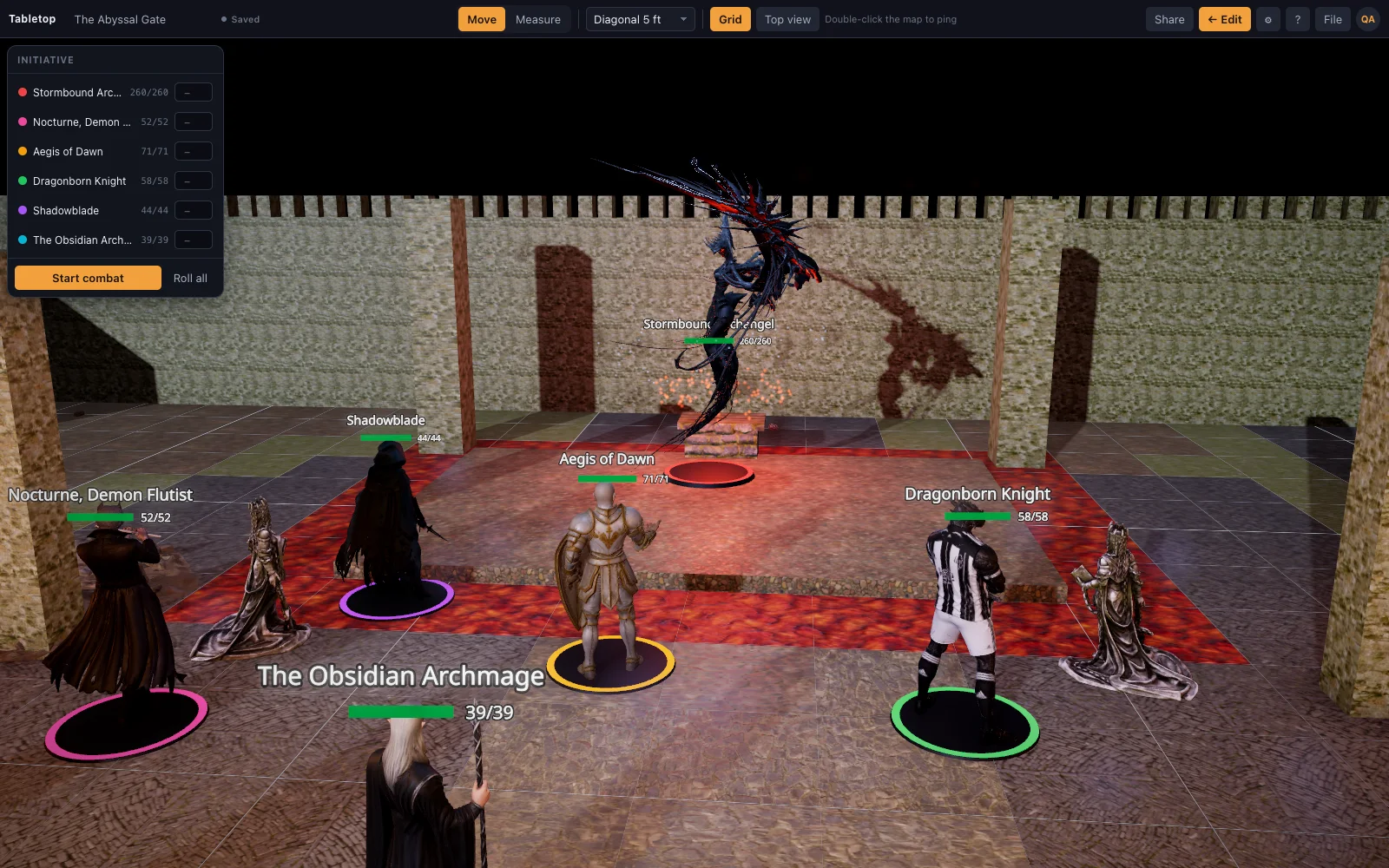
TerrainTale is a free 3D virtual tabletop that runs in the browser. Once the monster exists, the next questions are where the fight happens and who goes first — and those are the questions the table answers.

  • Build the battle map in minutes from realistic scanned materials, or start from a saved scene.
  • Miniatures with HP bars and rings for allies and hostiles; a ruler that counts feet on the grid.
  • An initiative tracker that rolls, orders and advances turns, with the map lighting set to the time of day.
  • Share a link and your players join the same table live, on any OS, with nothing to install.
Play mode at the Abyssal Gate: initiative tracker, a token card for the paladin, HP bars over every mini

Questions

Is the stat block generator free?

Yes. Your first stat block needs no account at all. After that, a free TerrainTale account generates as many as you like; the paid plan is about saving more scenes on the 3D table, not about stat blocks.

Which rules does it use, 2014 or 2024?

The 2024 rules, in the format of the 2025 Monster Manual as published in the System Reference Document 5.2: Initiative in the header, saves in the ability table, "Attack Roll" and "Saving Throw" wording, spells by uses per day. It does not produce 2014-style blocks.

Does it balance the challenge rating?

It aims for the numbers published creatures have at a CR — armor class, hit points, attack bonus, save DC and damage per round — and computes every derived number so the block is internally consistent. Treat the CR as a strong starting point and adjust after the first fight, the way you would with any homebrew.

Can I use the stat blocks in my game, or publish them?

The creature is yours. The format follows SRD 5.2, which is released under the Creative Commons Attribution 4.0 licence; if you publish, credit the SRD as the licence asks. Do not paste in names or text from published adventures and expect to republish those.

Can I edit the result?

Copy it as Markdown and change anything; the layout is the one used by most homebrew tools and wikis. If the design is off rather than the numbers, describe the change and generate again — "the same knight, but CR 9 and mounted".

Why does the second stat block need an account?

Each generation costs us a model call. One is free so you can see what it makes; a free account is enough for the rest, and it gives you the 3D table to run the monster on.

What can I ask for?

Monsters, NPCs with class levels (say "Humanoid (Wizard)" and the block gets a Spellcasting action), animals, constructs, undead, boss monsters with legendary actions. Name a CR, a size, a fighting style or a lair and the draft follows it.

Ready to put a map on the table?

Sign up in a minute, no card needed. Five starter scenes are waiting on the welcome screen.