CC0 assets for D&D maps: where good free models actually come from
The free-asset problem is not scarcity. There are hundreds of thousands of free 3D models. The problem is that almost none of them are the same scale, the same style, or licensed in a way you can rely on when you publish a map.
· 6 min read · TerrainTale
What CC0 actually means
CC0 is a waiver: the author gives up copyright as far as the law allows. No attribution required, commercial use fine, modification fine, redistribution fine. It is the only license that lets a virtual tabletop ship an asset library without the user needing a lawyer for a Patreon map pack.
Attribution is still good manners, and this site gives it — but it is manners, not a condition.
The three sources worth knowing
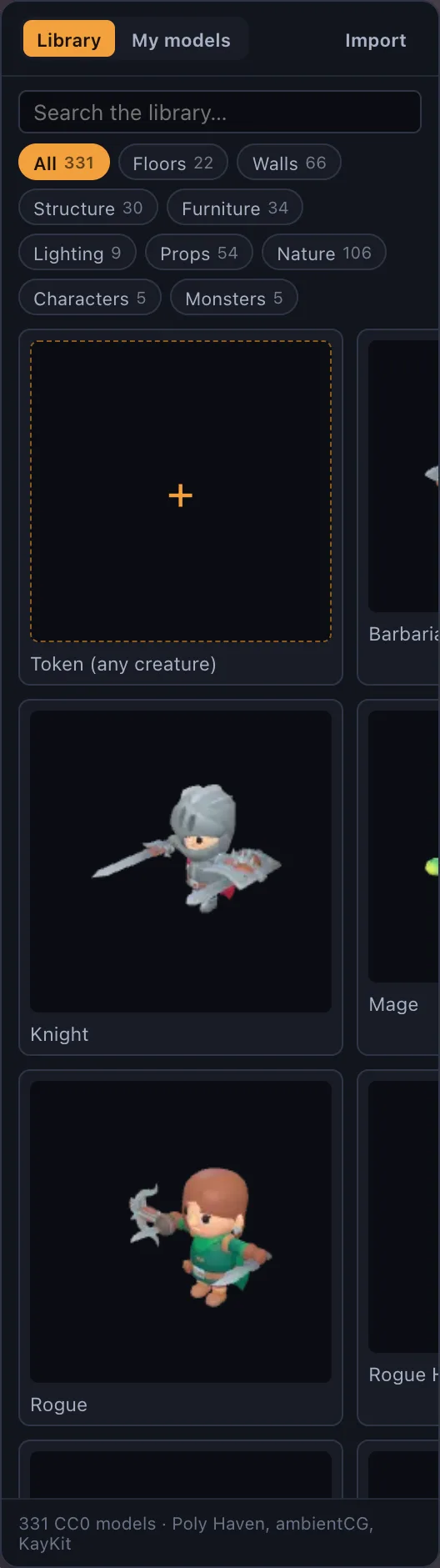
ambientCG publishes CC0 PBR materials — the scanned stone, plaster, timber and dirt that make floors and walls look like surfaces rather than colours. Poly Haven publishes CC0 photoscanned props and HDRI environments, which is where believable barrels, crates, furniture and rock formations come from. Characters are the hardest part: there is no CC0 library of realistic D&D minis worth having, so TerrainTale makes its own in Meshy, in one art direction, and ships them with the app.
Between them you can build almost any interior or exterior a campaign needs without a single asset of uncertain provenance.
Why the grid matters more than the count
A library of 20,000 models at random scales is worse than 200 authored to a 5-foot cell. In the first, every placement is a resize; in the second, a floor tile is a square, a wall is an edge, and a door fits an opening. Consistency compounds: everything fits everything, and a map built from two packs looks like one place.
The same applies to style. Mixing photoscanned rock with stylised low-poly barrels reads as a bug even to people who cannot say why.
Preparing assets yourself
If you bring your own: set the scale so one cell is 5 feet, put the origin at the base centre, face the model down the same axis as the rest of your library, and compress textures. Ninety percent of "this model looks wrong" is origin and scale.
- Origin at the base, centred.
- One cell = 5 feet, always.
- A consistent forward axis.
- Compressed textures and merged materials — a map has hundreds of these.
What CC0 does not cover
A waiver covers copyright, not trademarks and not likenesses. A CC0 model of a beholder is still a beholder, and the name and the creature design belong to somebody. The same goes for logos, book layouts and anything that reads as another game's branding. If you are publishing a map pack, the safe line is simple: the geometry and textures are yours to use, the names and the monsters are not.
The other thing a waiver cannot promise is that the uploader had the right to waive. Sticking to a handful of established, curated sources is the whole of due diligence for a hobby project, and most of it for a commercial one.
Why a curated library beats a marketplace
A marketplace optimises for choice; a table needs coherence. Every asset in a curated library has been through the same pipeline — same scale, same origin convention, same texture budget, same naming — which is why a room assembled from six of them looks assembled rather than collected. That pipeline is invisible work, and it is most of what separates a library you build with from a folder you search through.
It also keeps the download honest. Compressed geometry, shared materials and sensible texture sizes are what let a browser hold a whole dungeon at sixty frames a second on a laptop, and none of that survives contact with an uncurated pile of free models.
- One pipeline: same scale, origin, axis and texture budget.
- Shared materials, so a hundred barrels cost about one barrel.
- A size budget per asset, because it all arrives over a network.