Moving through allies and enemies in D&D 2024
You can move through an ally's space, a Tiny creature's space, an Incapacitated creature's space, and the space of any creature two or more sizes larger or smaller than you. You cannot move through an enemy of about your size at all. Every one of those spaces is Difficult Terrain, so each 5-foot square costs 10 feet of movement, and you can never willingly end your move inside another creature's space. That is the whole rule in the 2024 Player's Handbook; the rest of this post is how it plays out in a crowded corridor.
· 5 min read · TerrainTale
What the 2024 rule actually says
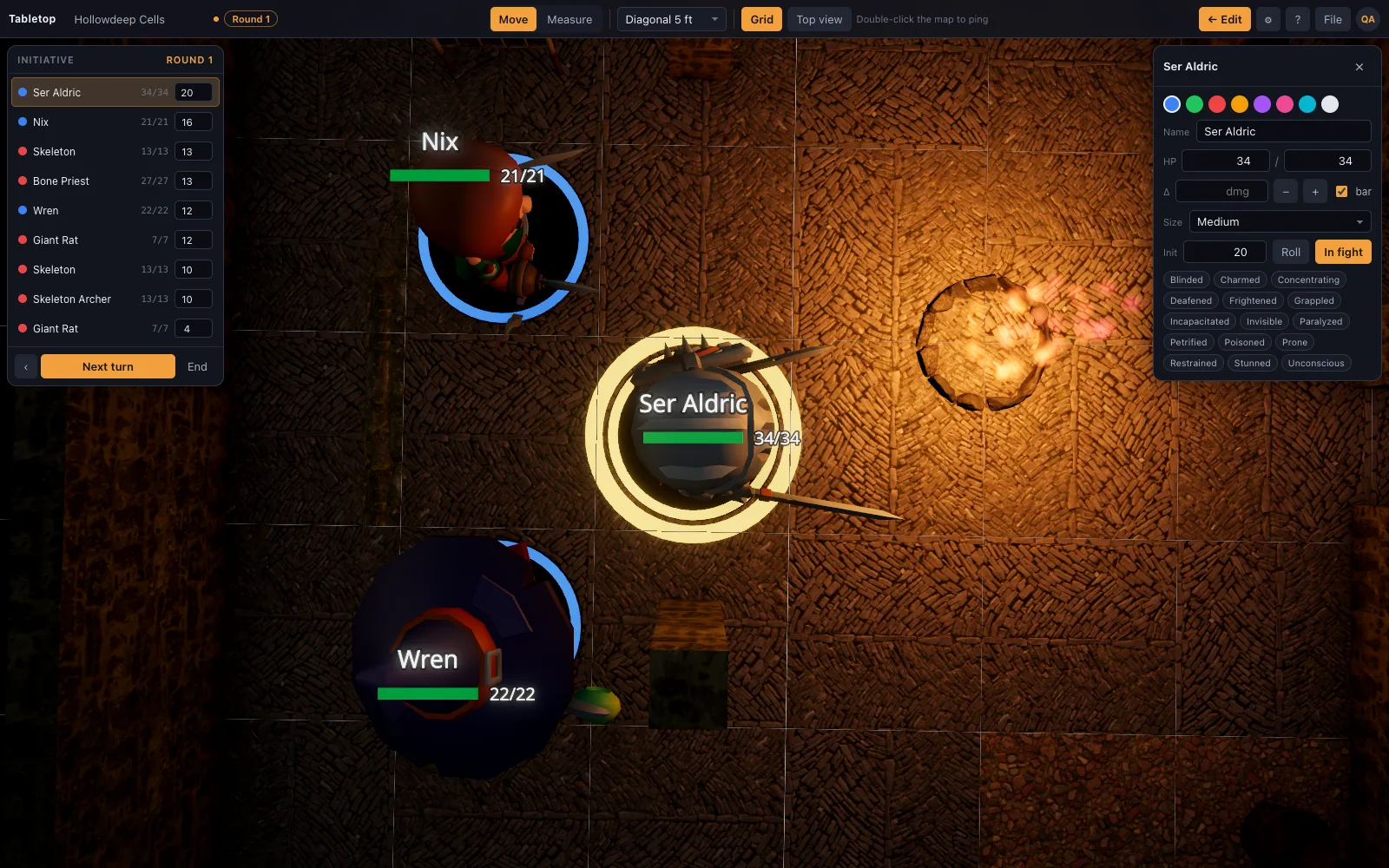
The rule sits under Moving Around Other Creatures in the 2024 Player's Handbook. It makes no difference whether the creature is friend or foe for the Difficult Terrain part: another creature's space always costs an extra foot for every foot you move through it. What changes with allegiance is whether you may enter at all. An ally is fine. An enemy blocks you unless the size gap is two steps or more, the enemy is Tiny, or it has the Incapacitated condition.
The 2014 rules were close but narrower. They let you through any nonhostile creature, and through a hostile one only with the two-size gap; the Tiny and Incapacitated exceptions are new in 2024, and they matter more than they look. A paralysed ogre, a stunned bandit or a sleeping guard no longer walls off a doorway.
- Ally of any size: you may pass through.
- Enemy two or more sizes larger or smaller: you may pass through.
- Tiny or Incapacitated creature, friend or foe: you may pass through.
- Every occupied square costs 10 feet instead of 5.
- You cannot willingly end your move in an occupied square.
Counting it on a square grid
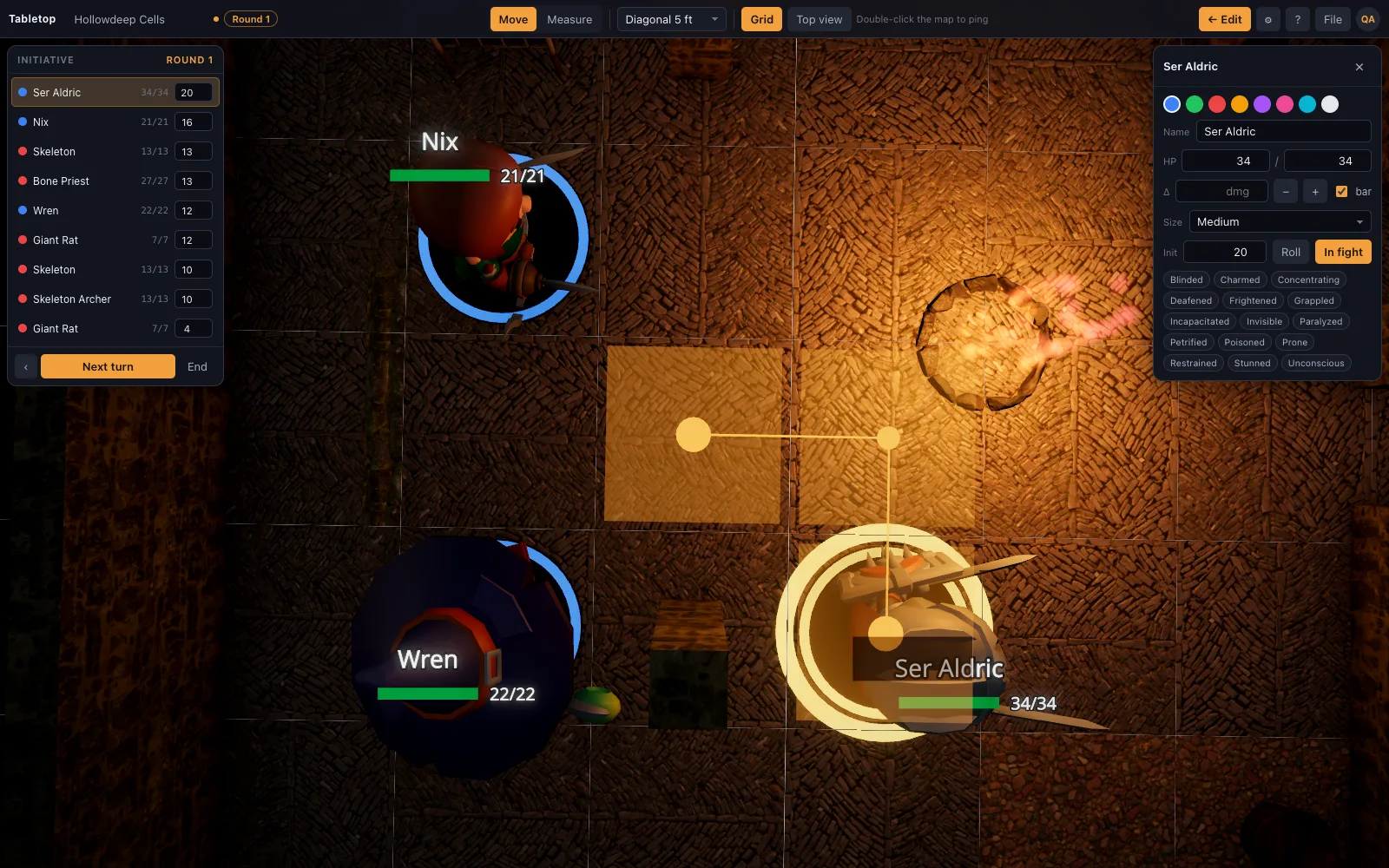
Take a fighter with Speed 30 in a 5-foot-wide corridor. Two allies stand in the next two squares and an ogre waits beyond them. The fighter moves one clear square for 5 feet, through the first ally for 10 and through the second for 10, which is 25 feet spent to travel three squares. The last 5 feet puts the fighter in the square in front of the ogre with nothing to spare. Without the allies in the way, the same distance would cost 15 feet and leave room to back off afterwards.
Diagonals do not change the principle. Whichever diagonal rule the table uses, an occupied square is doubled on top of it. If the square is also rubble or shallow water, the cost does not stack: Difficult Terrain is Difficult Terrain, and a square costs 10 feet no matter how many reasons it has for being difficult.
Size makes the difference against enemies
The two-size rule is why a halfling can duck between the legs of a Large troll, or a Medium rogue can squeeze past a Huge giant, while a human cannot shoulder past an orc. Sizes run Tiny, Small, Medium, Large, Huge and Gargantuan, so Small and Large are two steps apart and Medium and Huge are two steps apart. Medium to Large is only one step, so no passage. Check the actual token footprint too: a Large creature fills 2 by 2 squares, which means passing through it costs 20 feet in a straight line, not 10.
Some features rewrite the rule. The 2024 halfling's Halfling Nimbleness lets them move through the space of any creature a size larger than theirs, which covers every Medium enemy. Anything else, such as an attempt to barge through, is a Shove or a Grapple, not a movement choice.
Why you cannot stop there
The rules say you cannot willingly end your move in another creature's space, and that applies to allies too. It stops a party stacking into one square behind the cleric, and it is the reason the fighter in the corridor example has to spend exactly the right amount of movement. If a player's move would end mid-ally, they either stop one square short or push on through.
Forced movement is where tables need a ruling. If a shove, a spell or a collapsing floor leaves two creatures sharing a square, the rules do not name a precise fix. A clean table ruling is that the creature who arrived moves to the nearest unoccupied square of its choice, and nobody takes damage for it. Decide this once, before it happens mid-fight.
Opportunity attacks along the way
Passing through a large enemy's space is legal, but it does not hide you from that enemy. Leaving its reach still provokes an Opportunity Attack unless you took the Disengage action, and moving through its space almost always means leaving its reach on the far side. Squeezing past a troll to reach the wizard behind it is a strong play, but it usually costs a claw.
Moving through an ally's space never provokes by itself; only leaving an enemy's reach does. So the corridor shuffle, where the wounded fighter steps back through the cleric so the cleric can take the front, is safe as long as the fighter disengages first or was not in an enemy's reach to begin with.
Keeping it honest on a virtual table
The arguments about this rule come from counting, not from the rule. On a map with minis snapped to 5-foot squares and a ruler that reads in feet, the DM can point at the occupied squares, double them, and add. In TerrainTale a token's size can be set to its creature size, so a Large troll's base really does cover 2 by 2 squares and the price of passing through it is visible before anyone commits.