Improvised weapon damage in D&D 2024: the 1d4 default and what the environment does
An improvised weapon deals 1d4 damage of a type the DM thinks fits, whether it is a tankard, a chair or a broken bottle. If it resembles a real weapon, a table leg like a club or a kitchen knife like a dagger, the DM can treat it as that weapon, with that weapon's damage and properties. Thrown, it has a range of 20/60 feet. That is the entire 2024 rule and it is unchanged from 2014 except in one detail about proficiency. The interesting part is everything the rule leaves to the DM: the boiling oil, the collapsing balcony and the fire pit somebody is about to be pushed into.
· 6 min read · TerrainTale
The rule as written
The 2024 Player's Handbook puts improvised weapons in the equipment chapter. Any object you can hold in one or two hands can be one: broken glass, a table leg, a frying pan, a wagon wheel. The attack is a melee or ranged weapon attack, it uses Strength for a swing or a throw, since an improvised weapon has no Finesse property unless it counts as a Finesse weapon, and it deals 1d4 plus the modifier. A weapon thrown without the Thrown property, a longsword hurled across the bar, is an improvised weapon too and does 1d4, not its usual die.
The 2024 text tidied the proficiency question. You do not add your Proficiency Bonus to an improvised weapon attack unless the object counts as a weapon you are proficient with or a feature gives you the proficiency, which Tavern Brawler does. In 2014 the proficiency line was the same in substance but scattered, and the Tavern Brawler feat gave proficiency along with a Constitution or Strength increase and a grapple as a bonus action; the 2024 Origin feat version gives proficiency with improvised weapons, a 1d4 plus Strength Unarmed Strike with a reroll of any 1 on its die, and a 5-foot push once per turn on an Unarmed Strike hit. The grapple is gone.
When is an improvised weapon really a weapon?
The resemblance clause is the DM's main tool and worth using generously. A table leg is a club: 1d4 bludgeoning, Light, so a brawler can swing two. A fireplace poker is a club or, ruled kindly, a mace at 1d6. A meat cleaver is a handaxe, a pitchfork is a trident, a barrel stave is a club, a chain is a flail if the DM is feeling generous and a whip if not. Once an object is a weapon, everything that follows applies: the character adds proficiency if they have it with that weapon, the weapon's mastery works for a class that has Weapon Mastery with it, and the damage type is fixed.
The objects that stay at 1d4 are the ones no weapon resembles: a tankard, a stool, a ledger, a candlestick. Keep them at 1d4 even when the player argues the candlestick is heavy. The point of the flat die is that grabbing what is nearest is always possible and never better than the sword on your belt; the reward for improvising is reach, surprise or a damage type the monster is weak to, not a bigger number.
Damage the environment deals
Once the thing doing damage is not held by anyone, it is not an improvised weapon and the Player's Handbook stops helping. The Dungeon Master's Guide has an Improvising Damage table for this, scaled by how deadly the hazard should feel, and it is the right reference for a shove into the fire or a rope bridge that gives way. The steps below are that table's, with the guide's own examples; between steps, pick the lower one for a hazard a character walked into and the higher for one they were thrown into.
Falling has its own rule and does not use the table: 1d6 bludgeoning per 10 feet fallen, to a maximum of 20d6, and the creature lands Prone unless it avoids the damage. Fire from a spell uses the spell. Everything else is a ruling, and the honest way to run it is to say the number before the player decides, so that pushing the cultist into the brazier is a choice and not a gamble.
- 1d10: burned by coals, hit by a falling bookcase, pricked by a poison needle.
- 2d10: struck by lightning, stumbling into a fire pit.
- 4d10: hit by falling rubble in a collapsing tunnel, stumbling into a vat of acid.
- 10d10: crushed by compacting walls, hit by whirling blades, dunked in a vat of lava.
- 18d10: submerged in lava, hit by a crashing flying fortress.
- 24d10: tumbling into a vortex of fire on the Elemental Plane of Fire.
A working table for the common cases
For the hazards that come up in an ordinary tavern, street or castle fight, the table below is what we use, built from the guide's steps and the falling rule. Each is a Dexterity saving throw for half where the victim could dodge, and no save where they were held or shoved into it. Adjust the DC by who caused it: 10 for something that just happens, 13 for a trap, or the attacker's spell save DC or 8 plus Strength modifier plus proficiency for a shove.
Two notes on shoving. The 2024 Unarmed Strike lets any character push a target 5 feet on a hit if it is no more than one size larger, with a Strength or Dexterity saving throw against 8 plus Strength modifier plus Proficiency Bonus, and Tavern Brawler adds a push with no save to an Unarmed Strike hit. Five feet is one square, so the brazier, the pit and the window have to be exactly adjacent to the target for the shove to work, which is a map question before it is a rules one.
- Thrown chair, stool or crate: 1d4 bludgeoning, range 20/60, an improvised weapon.
- Pushed into a hearth or brazier: 1d10 fire, Dexterity save for half if the victim was not held.
- Boiling oil or a pot off the stove, one square: 2d10 fire, Dexterity save for half.
- A shelf or beam pulled down on one square: 2d10 bludgeoning, Dexterity save to avoid, and the square becomes Difficult Terrain.
- Falling masonry from a wall the fighter breaks: 4d10 bludgeoning in a 10-foot line, Dexterity save for half.
- Thrown through a window to the street: 1d6 per 10 feet plus 1d4 slashing, Prone on landing.
Putting the objects on the map
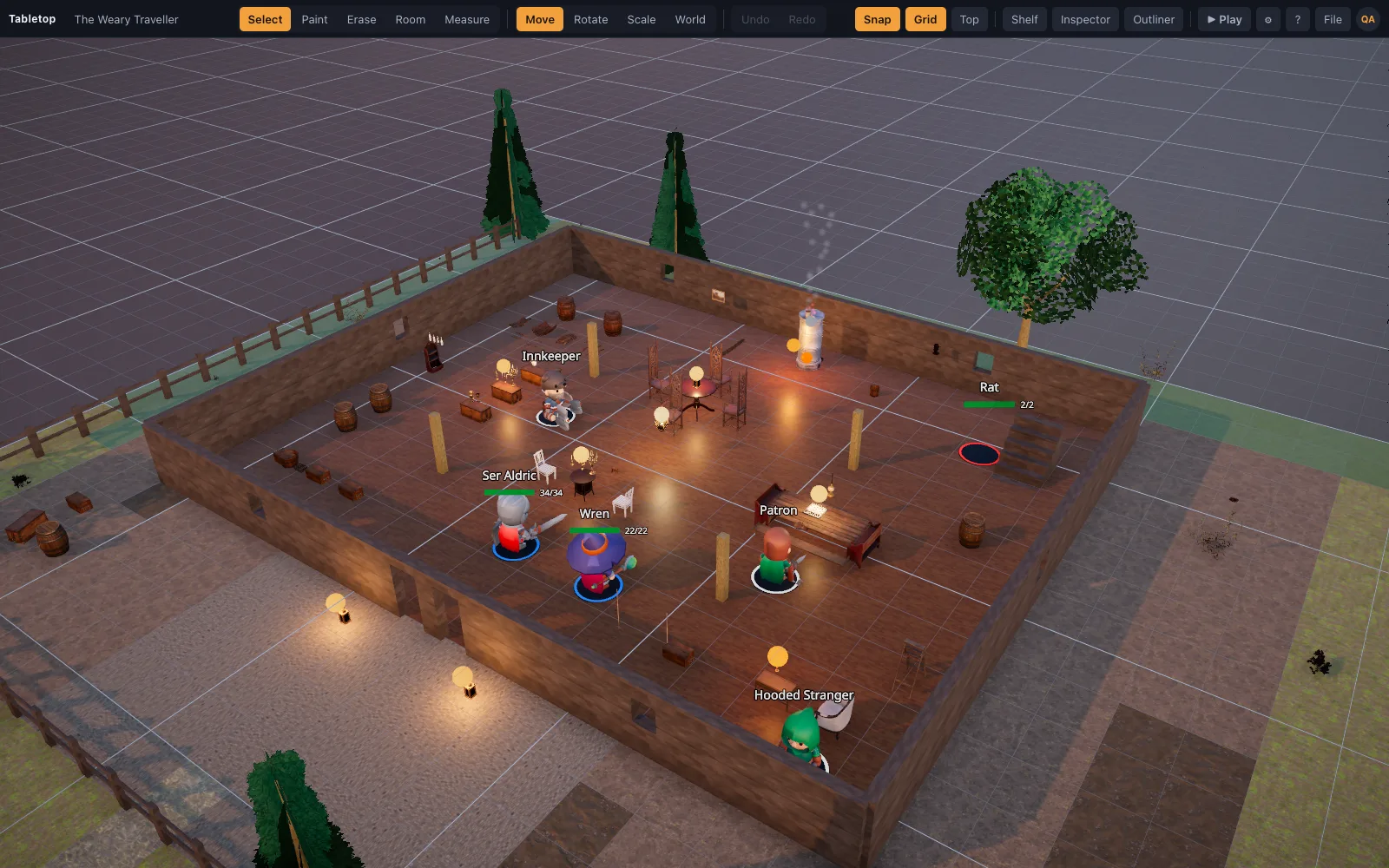
A brawl is only as good as the objects in it. When you build a tavern scene, put the hearth, the bar, a stair and at least one heavy thing that can fall within reach of where the fight will start, and mark the spaces that hurt: a hearth square that deals 1d10 fire to anyone who ends a turn in it, a barrel stack that can be pulled down on the 2 by 2 behind it. Then tell the players what they see. Improvised weapons only happen when the DM says there is a chair.
On a 3D table the objects are already there; the shelf has a height, the balcony is 10 feet up, and the hearth glows. A DM running the fight tracks the hazard squares by remembering them, since the app has no rules engine, and uses the ruler to check the fall from the balcony: 10 feet, 1d6, and the goblin lands Prone in the ale.