The 5-foot square, and why every grid rule comes back to it
Almost every grid rule in fifth edition is one rule wearing different hats: a square is five feet. Once that is the unit, creature size, reach, movement, area of effect and difficult terrain all fall out of it — and a map that is not built on it makes every one of them a judgement call.
· 6 min read · TerrainTale
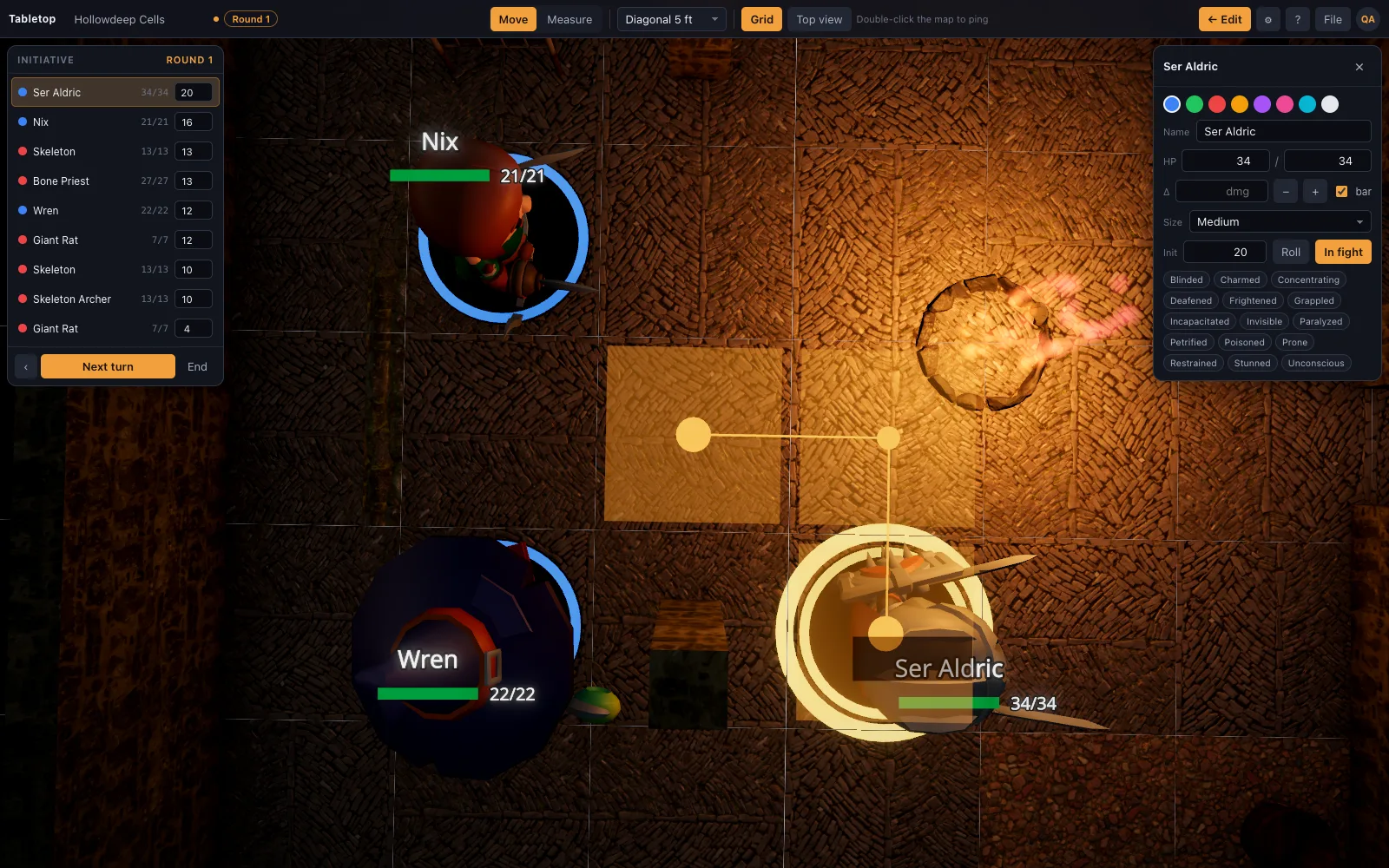
Sizes are squares
A Medium or Small creature occupies one square. Large takes two by two, Huge three by three, Gargantuan four by four. Tiny creatures share a square. That is the whole table, and it is why a miniature should be authored so its base is exactly one cell — an ogre that is "about one and a half squares" makes every adjacency question a negotiation.
- Tiny — two per square
- Small and Medium — one square
- Large — 2×2
- Huge — 3×3
- Gargantuan — 4×4
Reach and adjacency
A 5-foot reach hits the eight squares around you, diagonals included. A 10-foot reach with a polearm covers the ring beyond that. Because reach is measured in squares, a Large creature threatens from any of its four squares — the practical reason big monsters feel bigger on a grid than in narration.
Difficult terrain and squeezing
Difficult terrain doubles the cost of entering a square: rubble, undergrowth, shallow water, a body. Squeezing into a space one size too small also costs double and gives the squeezer disadvantage on attacks and Dexterity saves, while attacks against it get advantage. Both are cheap ways to make a map matter without adding a monster.
Why the map has to be authored to the cell
If floor tiles, wall segments, doorways and character bases are all built to the same 5-foot cell, a wall lands on an edge, a door sits in an opening, and a mini stands in a square. Nothing has to be nudged. If they are not, you spend the session resolving "am I in cover?" by eye.
This is the reason the whole TerrainTale library — floors, walls, props, characters — is authored to one grid, and why the ruler reports feet rather than arbitrary units.
Cover, and the only two numbers you need
Cover is measured square by square, and it comes in two useful grades. Half cover — a low wall, a barrel, another creature — gives plus two to armour class and Dexterity saving throws. Three-quarters cover, such as an arrow slit or a portcullis, gives plus five. Total cover means no line of effect at all, and no attack.
The practical test on a grid is whether a line drawn from any corner of your square to any corner of the target's square passes through an obstruction. That corner rule is what makes a grid worth having: it converts an argument into a look.
- Half cover: +2 AC and Dex saves.
- Three-quarters cover: +5 AC and Dex saves.
- Total cover: no attack, no targeted spell.
- Corner-to-corner is the test — check it once and move on.
Areas of effect on squares
Spell areas are where grid precision pays off most, because a 20-foot radius is four squares out from a point, and where that point sits changes which four creatures are in it. Put the origin on a corner rather than a square centre and the same fireball covers a tidy 4×4 — a habit worth adopting at the table because it removes half the arguments about partial squares.
Cones and lines are easier: a 15-foot cone is three squares deep and three wide at the far end, and a 30-foot line is six squares. Templates that snap to the grid mean the caster sees the area before committing, which is faster and fairer than resolving it afterwards.