Climbing rules in 5e combat: what it costs, when to roll, and fighting from a ledge
Climbing in combat has one rule and two rulings. The rule: each foot you climb costs 1 extra foot of movement, so a 30-foot speed climbs 15 feet. The first ruling: a surface that is slippery or short of handholds can call for a DC 15 Strength (Athletics) check, and a plain wall or ladder does not. The second: what happens when someone hits, shoves or grapples you halfway up is not in the book, and your table should decide before the rogue is dangling.
· 5 min read · TerrainTale
What does climbing cost in 5e?
Under the 2024 rules, while climbing, swimming or crawling each foot of movement costs 1 extra foot, or 2 extra feet in difficult terrain. A creature with a Climb Speed that uses it ignores the extra cost. So a fighter with a 30-foot speed can climb 15 feet in a turn and do nothing else with their movement, or move 10 feet to the wall and climb 10 feet up it. Dashing doubles the budget: 60 feet of movement climbs 30 feet. The 2014 rule was the same, so nothing changes here between editions except that the 2024 text is one paragraph instead of three.
Climbing is movement, not an action, so you can climb and attack in the same turn if the movement budget covers it. Climbing 10 feet to a ledge and attacking the archer standing on it is a legal turn for a 30-foot creature: 20 feet of movement for the climb, 10 feet to close, then the attack.
- Each foot climbed costs 1 extra foot of movement (2 extra in difficult terrain).
- A Climb Speed removes the extra cost.
- Dash doubles the budget, so 30-foot speed climbs 30 feet in a turn with Dash.
- Climbing is movement, so attacking after a climb is fine if the feet are there.
When do you ask for an Athletics check?
The 2024 rule says a climb up a slippery surface or one with few handholds might, at the DM's option, require a DC 15 Strength (Athletics) check. The word to hold onto is might. A ladder, a rope with knots, a rough stone wall, a cliff with obvious ledges: no check, it just costs the movement. A wet castle wall, a smooth marble pillar, an ice face, a rope with a creature shaking it: DC 15. The check is for surfaces that are genuinely hard, not for every wall, and asking for it every time turns climbing into a lottery nobody enters.
What a failed check means is up to you, and the fair default is that the climber makes no progress this turn rather than falls. Falling on a failed check is a harsh table; save it for a second failure or for a surface you described as dangerous. Under the 2014 rules the Player's Handbook left the DC to the DM and the Dungeon Master's Guide offered a range of suggested DCs by surface; the 2024 Player's Handbook keeps just the DC 15 for hard surfaces, and a DM who wants a ladder of DCs for easier and harder walls can still set one.
What does a ledge give you?
Nothing in the rules, and a great deal on the map. There is no higher ground bonus in 5e, 2014 or 2024. What a ledge gives a creature is reach that the creature below does not have, cover from the edge, and a space attackers must climb into. A creature 10 feet up on a ledge is out of reach of a longsword from below (a Medium creature's reach is 5 feet in any direction, including up) and inside the reach of a glaive or pike. Ranged attackers below shoot it normally, and if it lies Prone behind the lip it has three-quarters or total cover from below, which is the archer's trick on any wall.
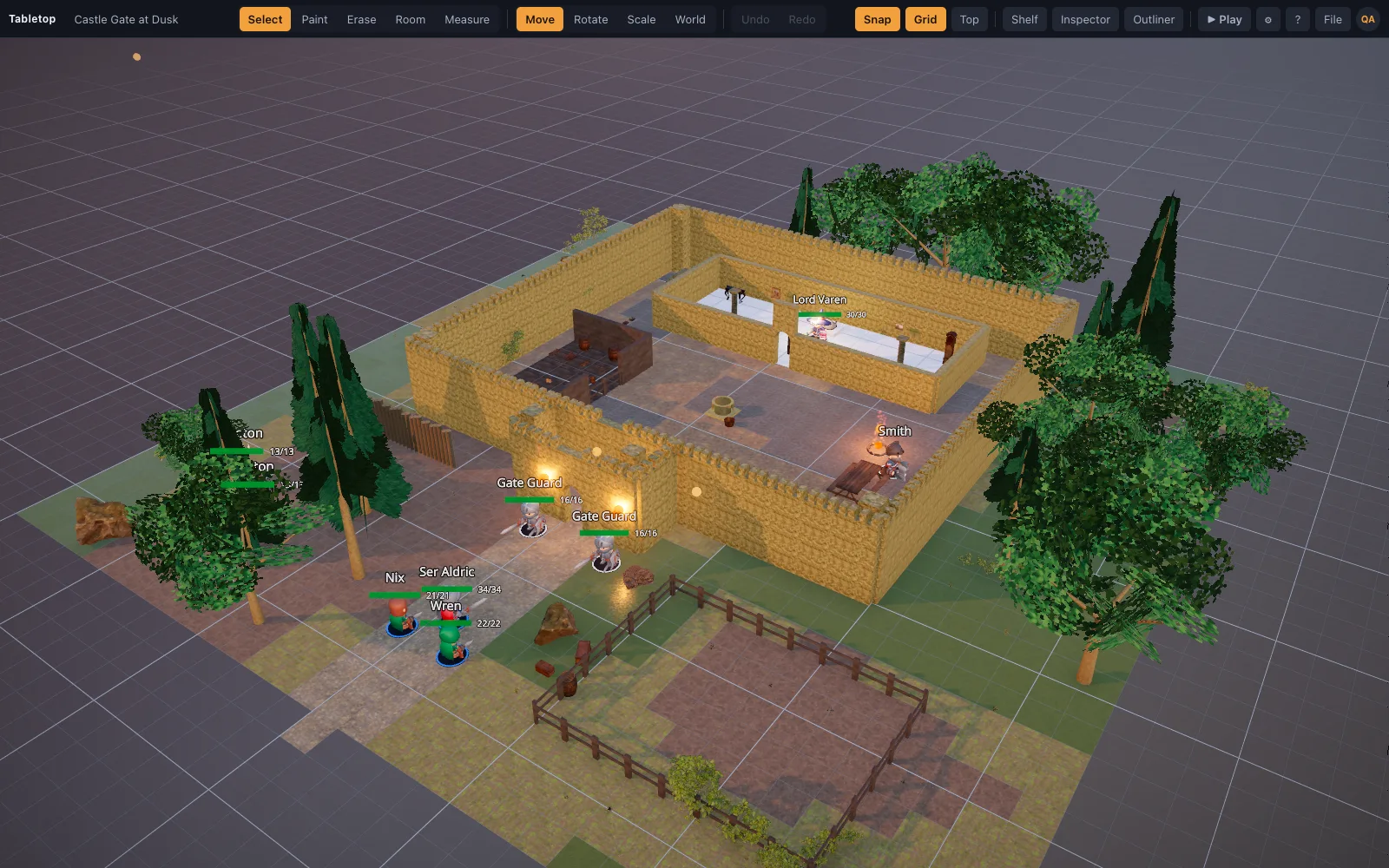
The creature on the ledge can also fight the climber. A creature that is climbing is not Prone, not Restrained and has no rules penalty to its AC, so it is attacked normally; the only thing the rules do not say is what a hit does to its grip, which is the next section. In 3D these questions are visual: the ledge is at a height, the reach is a distance, and the ruler settles who can hit whom.

What happens when a climber is hit, shoved or grappled?
Nothing automatically. Taking damage does not make a climber fall in 5e; there is no rule for it, and adding a save on every hit makes climbing unplayable. The things that do end a climb are the ones that move the climber: a shove (the 2024 Unarmed Strike's Shove option pushes 5 feet or knocks Prone on a failed Strength or Dexterity save against DC 8 plus the attacker's Strength modifier and proficiency bonus), the Push weapon mastery, thunderwave, a grapple that pulls, and any effect that reduces speed to 0 or imposes Prone while the climber has nothing to lie on.
A pushed or Prone climber falls: 1d6 bludgeoning per 10 feet, maximum 20d6, and lands Prone unless they took no damage. A fair house rule that many tables use is a DC 10 Strength (Athletics) or Dexterity (Acrobatics) check to hold on when hit for damage above a threshold (say 10 or more), but that is a ruling, not the rule, and a table that uses it should say so before the first climb of the campaign. The 2014 rules were the same: no fall on damage, a fall on being moved.
Running it on the map
The three numbers to have ready are the wall's height, the surface's difficulty and the drop. Write the height on the map in feet or, on a 3D table, build it at that height and let the ruler read it. Say whether the surface is a check or not before anyone starts climbing, so the player deciding whether to climb is making an informed decision. And say what a fall costs from the top, because a 20-foot wall is 2d6 and a 40-foot cliff is 4d6, and that number is what makes the shove at the top a real threat.
On the ship-deck and tower maps the blog has covered, the climb is the whole fight: rigging and stairs are the routes, and the creature on the ledge is holding a choke point that costs everyone 2 feet per foot to reach. The rule is simple enough to run in your head; the map is what makes it worth running.