Invisible creatures on a grid: the 2024 rules and how to run them without cheating
An invisible creature in D&D 2024 is not a creature nobody can find. It is a creature that attacks with advantage, is attacked with disadvantage, cannot be targeted by anything that needs to be seen, and whose square everyone usually still knows. The trick to running one is keeping those four facts apart, and the trick to running one fairly on a grid is deciding, before the fight, how its position is tracked and when the players learn it.
· 5 min read · TerrainTale
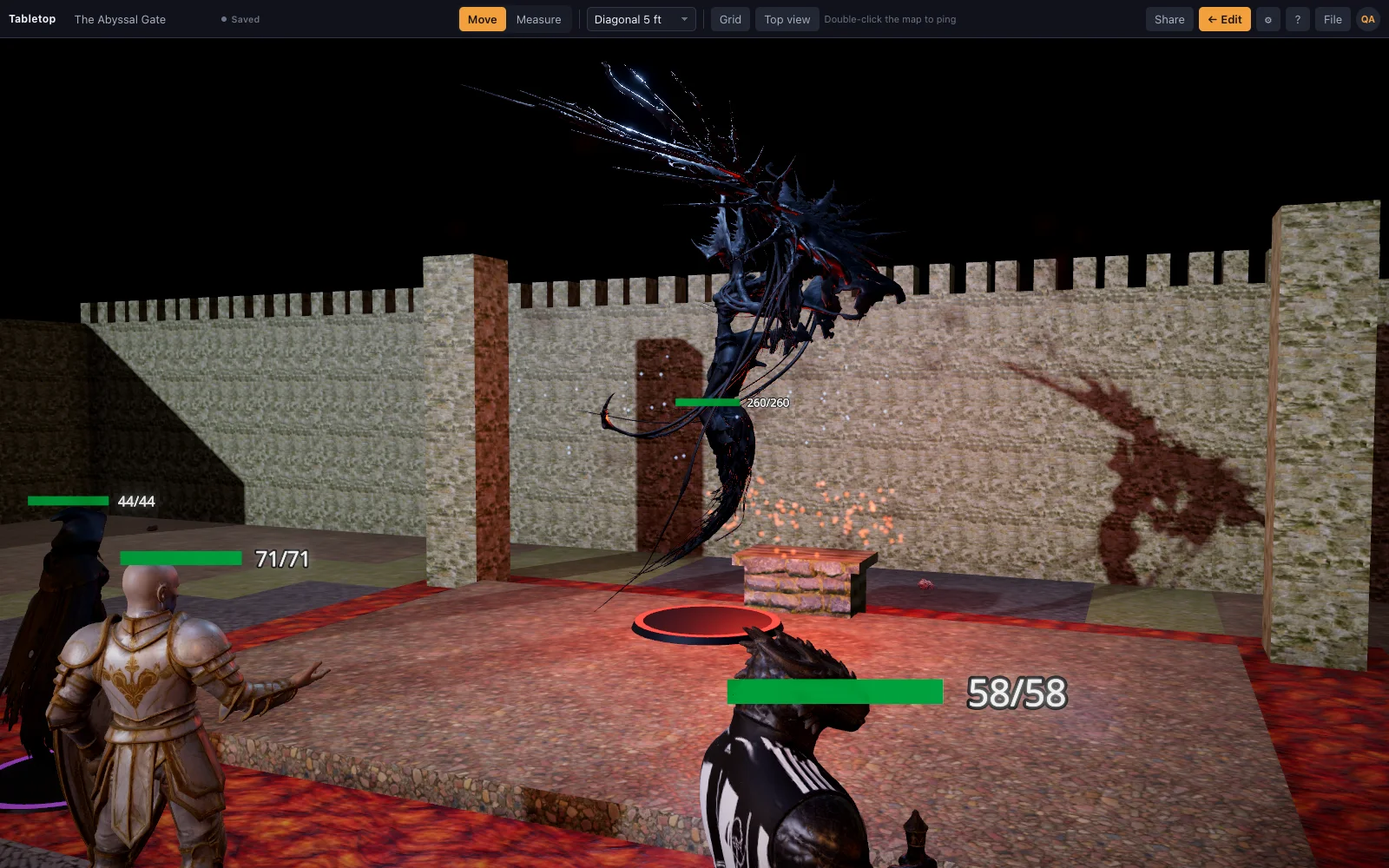
What does the Invisible condition actually do in 2024?
The 2024 Rules Glossary gives the Invisible condition three effects. Surprise: if you are Invisible when you roll Initiative, you have Advantage on the roll. Concealed: you are not affected by any effect that requires its target to be seen, unless the effect's creator can somehow see you, and your equipment is concealed with you. Attacks affected: attack rolls against you have Disadvantage and your attack rolls have Advantage, and a creature that can somehow see you (with Blindsight, Truesight, see invisibility or the like) ignores both.
What the condition does not say is that nobody knows where you are. That is the 2024 change worth a sentence: the 2014 condition text said an invisible creature's location could be detected by noise or tracks it made, and the 2024 text moves that idea into the Hide action and the Unseen Attackers rule instead. The result is the same at the table. An invisible creature that walks, breathes and swings a sword is unseen but not hidden, and its square is known to anyone paying attention.
- Advantage on Initiative if Invisible when rolling it.
- Cannot be targeted by effects that need the target to be seen.
- Attacks against it have Disadvantage; its own attacks have Advantage.
- None of it applies against a creature that can somehow see it.
Invisible is not hidden
Hidden is a separate state with its own rule. To Hide in 2024 you take the Hide action, succeed on a DC 15 Dexterity (Stealth) check, and must be Heavily Obscured or behind Three-Quarters or Total Cover and out of every enemy's line of sight. On a success you gain the Invisible condition until you are found, make a sound louder than a whisper, attack or cast a spell with a Verbal component. So a hidden creature is Invisible, but an Invisible creature is not automatically hidden: the invisibility spell gives the condition and nothing else, and the creature's position stays known unless it also Hides.
Whether an invisible creature standing in the open can take the Hide action is the one genuine grey area. The action asks for cover or obscurement and to be out of line of sight, and the glossary says that if you can see a creature you can discern whether it can see you. A reasonable ruling, and the one most tables use, is that a creature nobody can see is out of everyone's line of sight and may Hide anywhere, with the DC 15 Stealth check standing in for the noise it makes. Rule it either way, but rule it once and say it.
Attacking a square you cannot see into
The Unseen Attackers and Targets rule handles the guess. When you attack a target you cannot see, you have Disadvantage on the roll, whether you are guessing its location or can hear it but not see it. If the target is not in the square you attacked, you miss. When a creature cannot see you, you have Advantage against it, and if you are hidden when you attack you give away your location whether the attack hits or misses.
Two table decisions follow. First, when an attack against the wrong square misses, the DM says it misses and nothing more; the player learns the square was empty only if you decide they do, and telling them is the generous reading. Second, area effects do not care about sight: fireball, thunderwave and the cleric's spirit guardians all work on an invisible creature in the area, which is why a party that has lost track of the stalker should be reaching for those rather than guessing with a sword.
Tracking an invisible enemy on the map
The fair way to run an invisible creature has three parts. Decide its square every turn and write it down, even when the players cannot see it; the DM who keeps the stalker in their head is the DM who moves it wherever is convenient. Tell the players its square whenever the rules say it is not hidden: it attacked, it walked through the mud, the wizard hit it with faerie fire, or it simply never took the Hide action. And when it is hidden, let the Search action find it: a Wisdom (Perception) check against the Stealth total it rolled, which is a number you have on paper, not a feeling.
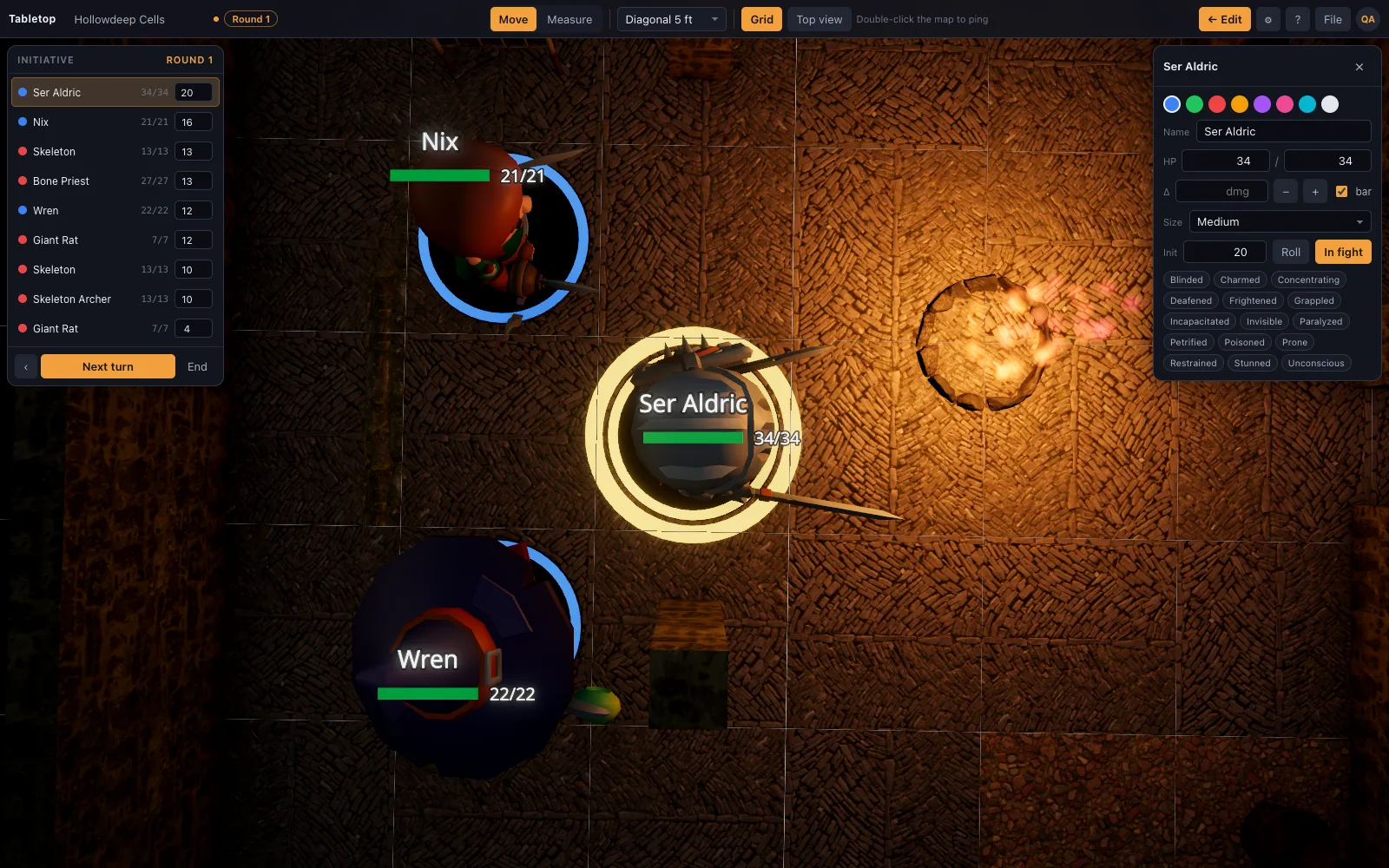
On a physical grid the usual trick is a blank token or a coin for the known square and nothing at all for the hidden one. On a virtual table the same job is a mini the DM can see and the players cannot. In TerrainTale a mini flagged as hidden is drawn ghosted on the DM's screen and not sent to the players' browsers at all, so its square is tracked precisely and revealed with one click the moment it attacks. Under the 2014 rules the same procedure works; the difference is only that 2014 invisibility said in the condition itself that noise and tracks reveal a position, where 2024 leaves that to the Hide rule.
Making the fight good rather than frustrating
An invisible enemy is frustrating when the players have nothing to do about it and satisfying when they have four things. Give them the square when the rules give it (which is most of the time). Let the environment betray it: dust, water, snow, a doorway it must pass, the bell rope it brushes. Reward the right tools: see invisibility, faerie fire, a familiar's Blindsight, the barbarian's Reckless Attack that cancels the Disadvantage, area spells. And give the creature a reason to come into the open, because an invisible stalker that never engages is not an encounter, it is weather.
Run it that way and the rules do the rest. Advantage and Disadvantage keep the invisible creature dangerous, the known square keeps the players in the fight, and the one Hide check per turn is the only die the DM rolls in secret.