Line of sight rules in 5e: seeing, targeting and corners on a battle map
There is no line of sight rule in 5e, and that surprises people. What the 2024 rules have instead are two separate questions. Can you target it, which is a question about cover: a creature behind total cover cannot be targeted by an attack or a spell that needs a clear path. And can you see it, which is a question about obscurement and light: a creature in darkness or fog is heavily obscured, and you are effectively blinded when trying to see it. Line of sight on a battle map is the habit of answering both by tracing a line from your square to theirs.
· 5 min read · TerrainTale
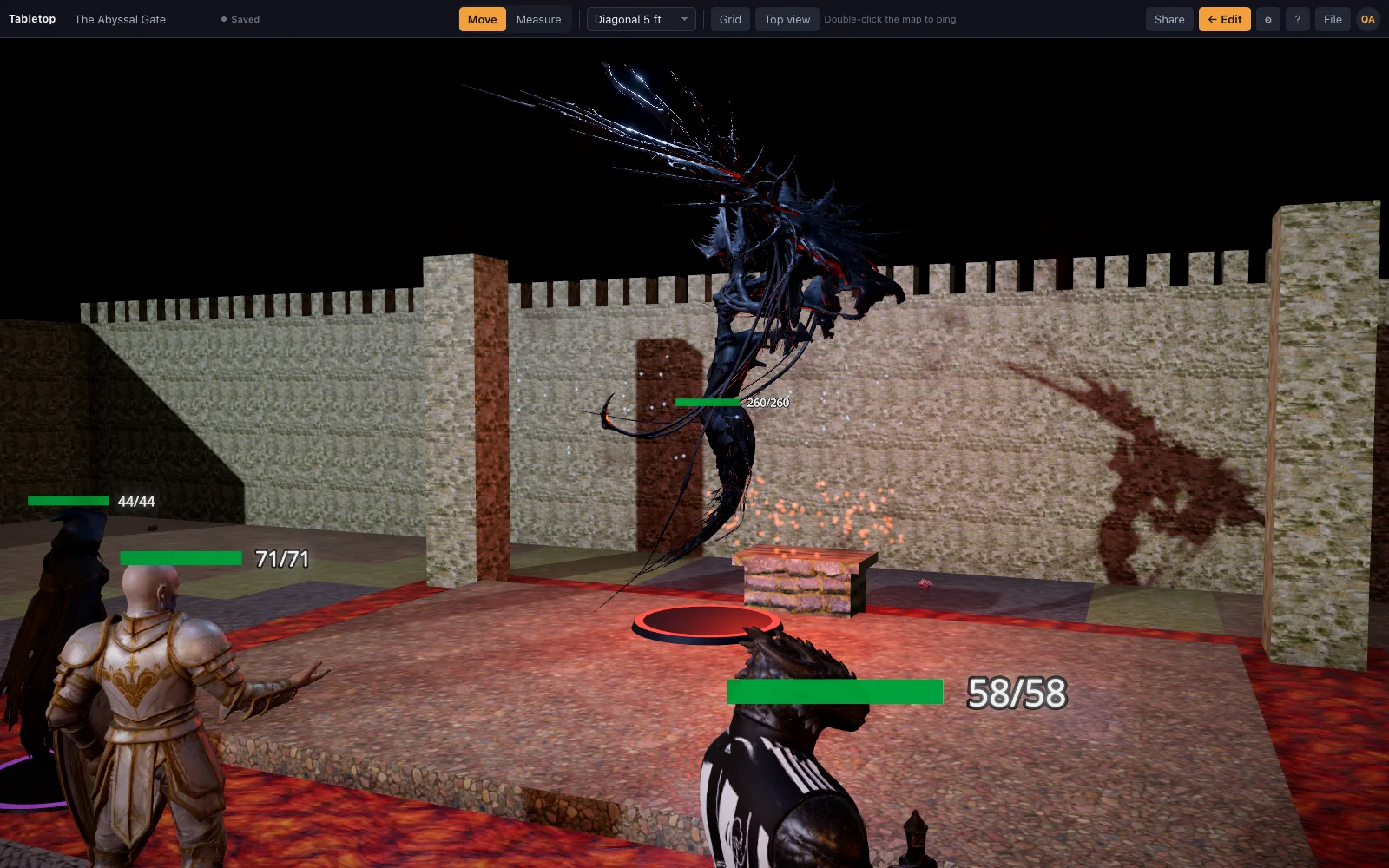
Targeting: is there a clear path?
To target something with an attack or most spells you need a clear path to it, which means it is not behind total cover. Total cover is being completely concealed by an obstacle: a closed door, a solid wall, the far side of a pillar. Half cover, plus 2 to AC and Dexterity saving throws, and three-quarters cover, plus 5, come from obstacles that block part of the creature. A table, an arrow slit, another creature between you.
The Dungeon Master's Guide offers a corner method for deciding cover on a grid, and most tables that use a grid adopt it. Pick one corner of the attacker's square and trace lines to every corner of the target's square. If nothing blocks any line, no cover. If one or two lines are blocked, half cover. If three or four are blocked, three-quarters cover. If all of them are, total cover, and the target cannot be chosen at all. It takes ten seconds and ends most arguments about the edge of a doorway.
Seeing: obscurement is not cover
Cover is about a physical obstacle. Obscurement is about whether you can see. A lightly obscured area, dim light, patchy fog or moderate foliage, gives Disadvantage on Wisdom (Perception) checks that rely on sight and nothing else; you can still attack into it normally. A heavily obscured area, darkness, thick fog or dense foliage, means you are effectively blinded when you try to see something in it.
Being unable to see a target does not stop you attacking it. It gives you Disadvantage on the attack roll, and you must guess the square if you do not know where it is. It also means you cannot cast spells that require you to see the target, which is the phrase to check in the spell text: Hold Person needs a creature you can see, Fireball needs a point you can see, Thunderwave needs neither. A wall of fog blocks Hold Person but not a fireball lobbed blind into it.
The two questions can have different answers for the same square. A goblin standing in darkness on the far side of a table has half cover from the table and is heavily obscured by the dark. The table adds 2 to its AC; the darkness gives your attack Disadvantage.
- Lightly obscured: Disadvantage on sight-based Perception checks only.
- Heavily obscured: you are effectively blinded for things in it.
- Attacking an unseen target: Disadvantage, and you must pick the right square.
Corners, pillars and doorways
Corners are where the corner method earns its keep. A creature one square around a corner is usually reachable from some squares and not others; the attacker who steps one square sideways often turns three-quarters cover into half cover, and that step is the tactical content of a corridor fight. A pillar of one square in an open room gives half cover to a creature directly behind it and none to one a square to the side.
Doorways cut both ways. A creature standing in a doorway has no cover from the room in front of it and gives cover to everyone behind it. A creature pressed against the wall beside the door is at total cover from the room and steps into the doorway to attack, then steps back, which provokes nothing because nothing is adjacent. That is the correct use of a door and a good reason to put one on every map.
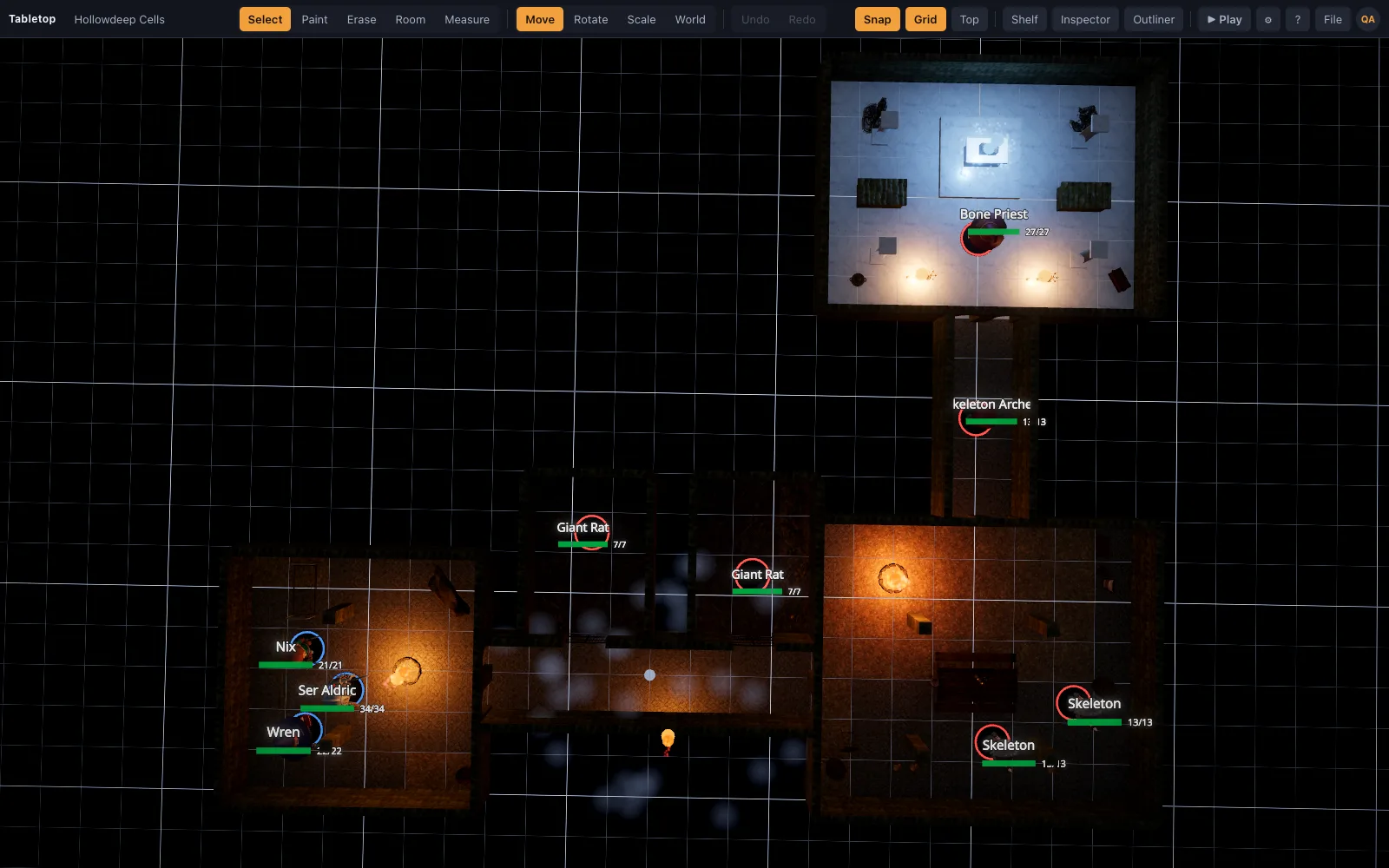
Height, and looking from the token's eye level
On a flat map, line of sight is a line on the floor. Add a balcony and the line has a slope, and things change. An archer on a 10-foot ledge sees over a 5-foot wall that blocks the ground-level fighter. A prone creature behind a low wall is hidden from the ground and exposed from above. A chandelier hides nothing from below and a lot from the gallery.
This is the case where a 3D map answers a question a 2D one cannot. TerrainTale lets you put the camera at any angle including eye level, so the DM can look from the archer's position and see whether the parapet, the pillar or the crowd is in the way. Torches and candles cast real shadows, which makes the obscurement question visible too: the square beyond the torchlight is dim and the corridor beyond that is dark. There is no automatic vision calculation; the map shows what is there and the DM rules.
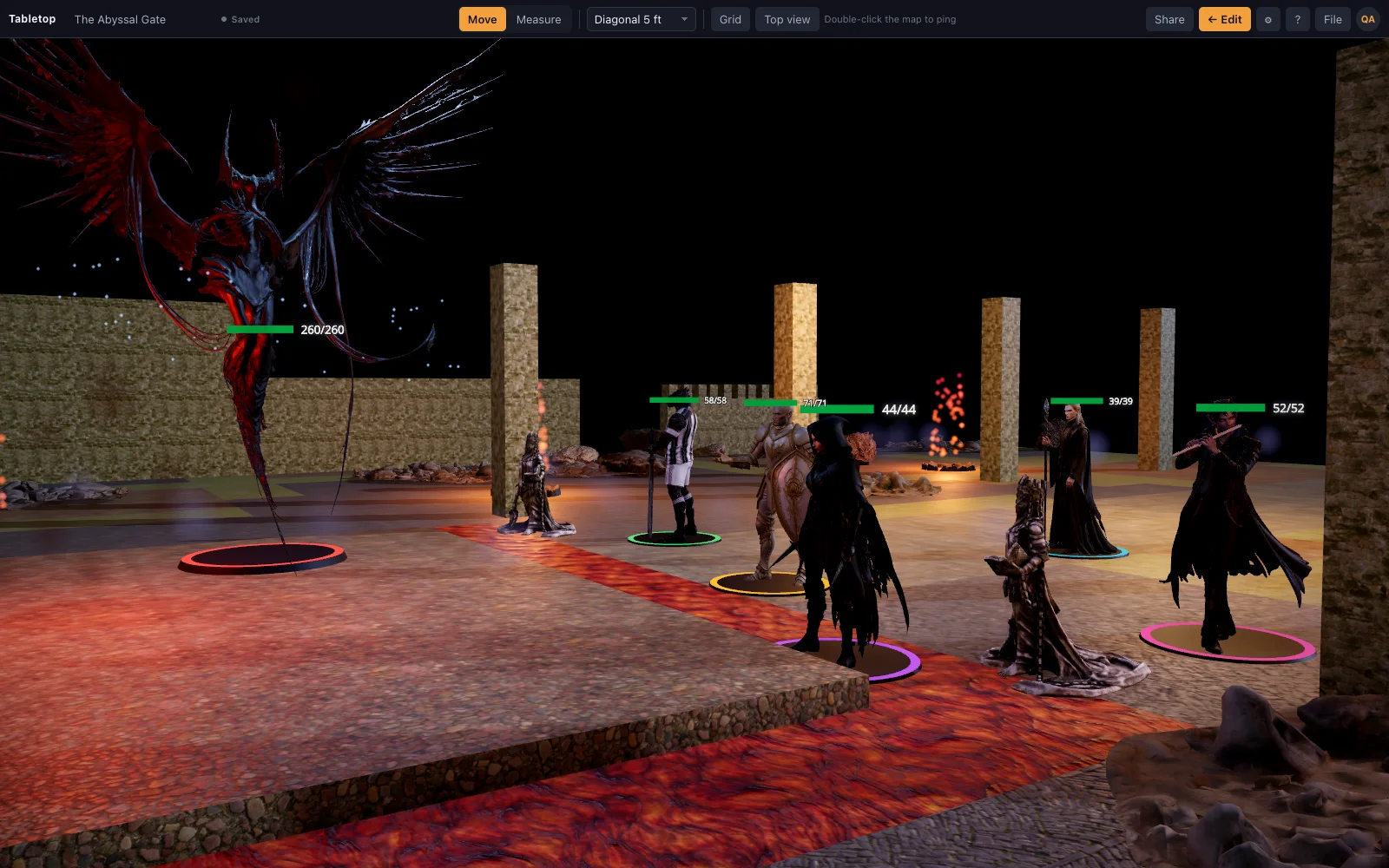
Hiding and the 2024 rule
Line of sight matters for hiding, and the 2024 rule is stricter than the 2014 one. To take the Hide action you must be heavily obscured or behind three-quarters or total cover, out of any enemy's line of sight, and you must succeed on a DC 15 Dexterity (Stealth) check. Succeed and you have the Invisible condition until you are found, make noise, attack or cast a spell with a verbal component. In 2014 the DM decided whether hiding was possible with no fixed DC and no listed conditions, so an older table will find the 2024 version both clearer and harder.
On the grid, out of line of sight means no enemy can trace a clear line to your square. A rogue behind a pillar from every goblin can hide; a rogue behind a pillar from three of four cannot, and the fourth is the one to move.
A short procedure for the DM
When a player asks whether they can hit something, run three checks in order. First, is there any line from the attacker's square to the target's square that passes only through open space; if not, total cover, no. Second, how many of the four corner lines are blocked; that sets half or three-quarters cover. Third, is the target in dim light, darkness or fog; that sets Disadvantage. Say the result as a number: plus 2 to its AC and Disadvantage on your roll.
The procedure is the same in 2014 and 2024. What changed in 2024 is the Hide action, the wording of the Blinded condition, and the ease of judging it when the map has height.