Lighting and vision: making darkness do tactical work
Light is the cheapest tactical terrain in the game and the most commonly wasted. Most maps are lit for the screenshot: evenly, brightly, from nowhere. Lit for play, the same map asks the party three questions before the first round.
· 6 min read · TerrainTale
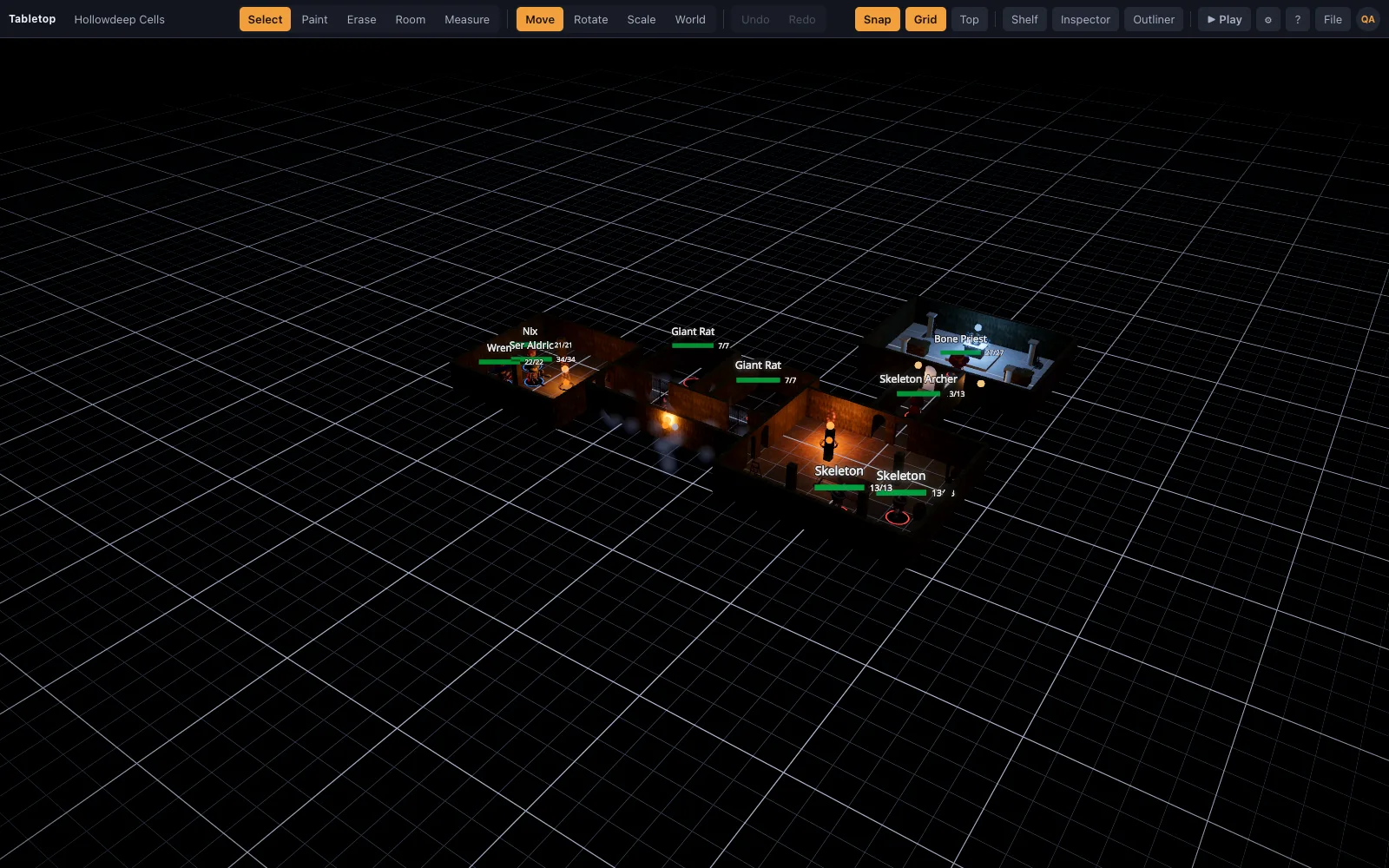
Three states, two consequences
Bright light is normal sight. Dim light is lightly obscured — disadvantage on Wisdom (Perception) checks that rely on sight. Darkness is heavily obscured: effectively blinded, which means attackers have disadvantage and anyone attacking you has advantage. That is the whole system, and it is enough to change how a room plays.
Light sources have ranges, and ranges matter
A torch is 20 feet bright and 20 more dim. A lantern is 30 and 30. A Light cantrip is 20 and 20. Because those are four-square and six-square radii, a corridor lit by torches every 40 feet has dark bands between them, and the party has to decide whether to move through one.
- Torch — 20 ft bright, 20 ft dim
- Hooded lantern — 30 / 30
- Light cantrip — 20 / 20
- Campfire — around 20 / 20 and it does not move
Darkvision is not daylight
Darkvision turns darkness into dim light within range, which means disadvantage on sight-based perception, and no colour. A party that assumes darkvision solves lighting will walk a dwarf into an ambush; a DM who says "you see it in grey, and not well" reintroduces the tension without changing a rule.
Light as level design
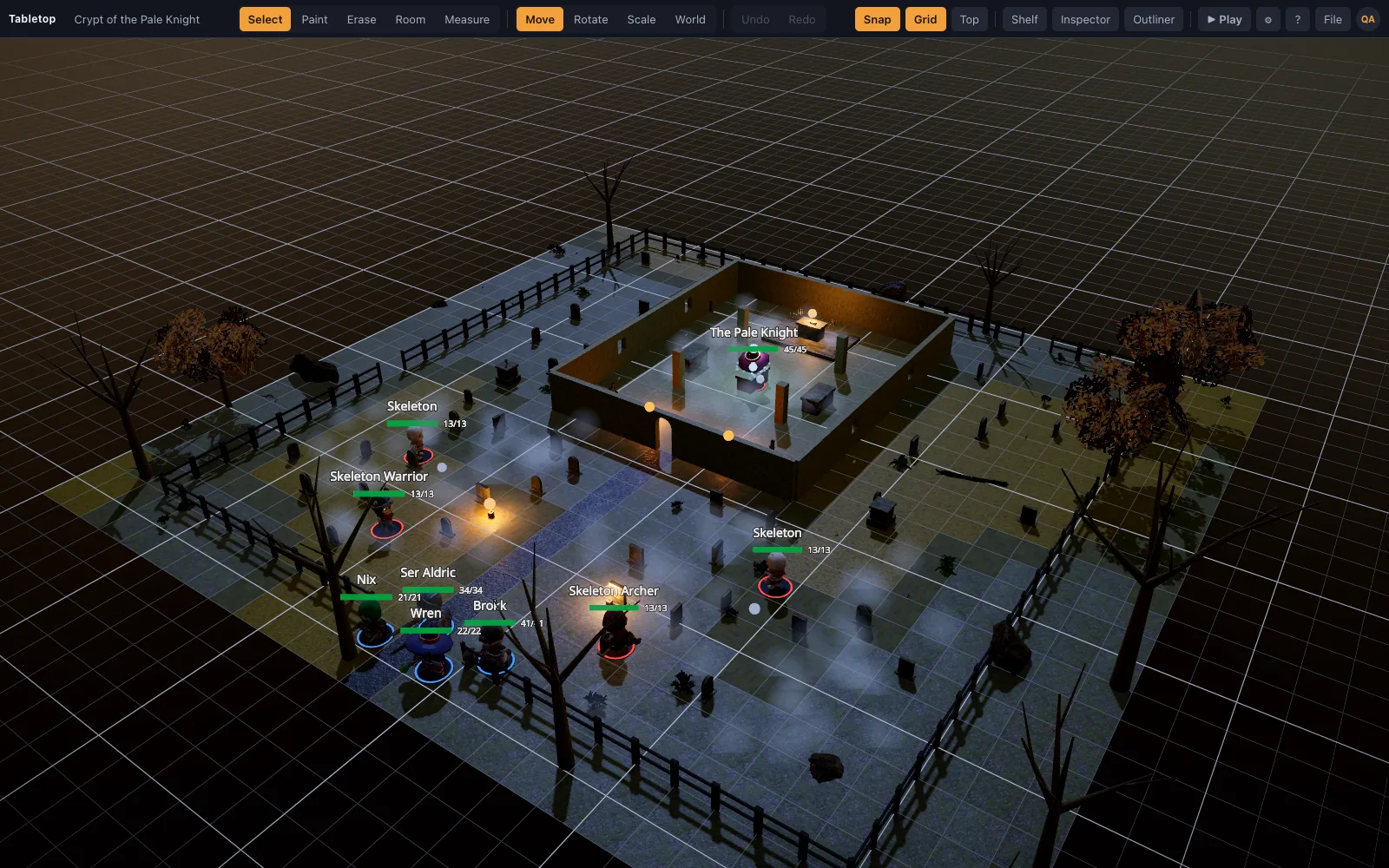
Players move toward light. Put a torch where you want the fight, and leave the flank dark for whatever is flanking them. A hearth in a tavern, a shaft of moon in a crypt, one working lamp in a warehouse — each one is a decision about where the encounter happens.
In a 3D table this is literal: place the light entity, let it cast, and the dark squares are dark on everyone's screen at once.
Give players light sources with costs
A torch occupies a hand, burns for an hour, and announces the party to everything in the room. Those three costs are what make light a decision rather than a setting. The moment the party has permanent, free, hands-off light, every dark corridor is just a corridor.
Practical answers players reach for — a hooded lantern that can be shuttered, a Light cantrip on a thrown stone, darkvision plus a single torch at the back — are all good play, and each one is a small tactical commitment you can build encounters around.
- A torch is a hand, an hour and a signal to everything nearby.
- A shuttered lantern lets the party choose to be unseen.
- Light on a thrown object is the oldest trick and still the best.
- Enemies that douse lights turn a fight into a different fight.
Lighting a map so it reads at a glance
Aim for three tiers of brightness in any room: a bright pool where the action is, a dim ring around it, and darkness at the edges. Flat lighting makes a 3D room look like a floorplan; a single bright light with nothing else makes it look like a stage. Three tiers is what reads as a place.
Warm sources (fire, candle) against a cool ambient (moon, gloom) does more for atmosphere than any number of extra props, and it costs two light entities.