Squeezing in D&D 2024: the rule that became Difficult Terrain, and what to do about the missing penalties
In the 2024 Player's Handbook there is no squeezing rule. The index sends you to Difficult Terrain, whose glossary entry lists a narrow opening sized for a creature one size smaller than you among the things that make a space cost 1 extra foot per foot. That is the whole 2024 treatment: an ogre in a 5-foot corridor moves at half speed and suffers nothing else. Under the 2014 rules the same ogre also had Disadvantage on attack rolls and Dexterity saving throws, and attacks against it had Advantage. Most tables did not notice the change, still play the 2014 version, and should decide which they are using before the next Large monster reaches a door.
· 5 min read · TerrainTale
What the 2024 rules actually say
The 2014 Player's Handbook had a paragraph headed Squeezing into a Smaller Space: a creature can squeeze through a space large enough for a creature one size smaller, every foot costs 1 extra foot, it has disadvantage on attack rolls and Dexterity saving throws while in the space, and attack rolls against it have advantage. The 2024 book has no such paragraph. The Rules Glossary's Difficult Terrain entry lists six things that make a space cost double, and one of them is a narrow opening sized for a creature one size smaller than you; the movement cost survived and the combat penalties did not.
Whether that was a decision or an omission is not documented. A D&D Beyond forum thread on the subject, titled Really disappointed there is no squeezing rule in 5e2024, leans toward an accidental loss during the consolidation of movement rules into Difficult Terrain, and notes that the glossary still defines a creature's space as the area it needs to fight effectively, which implies a creature in less space should fight worse. No errata has restored the penalties as of September 2026. The rule as printed is: half speed, nothing else.
Which spaces count as one size too small
Sizes go Tiny, Small, Medium, Large, Huge, Gargantuan, and on a 5-foot grid a Small or Medium creature takes one square, a Large one 2 by 2, a Huge one 3 by 3, a Gargantuan one 4 by 4 or more. A narrow opening sized for the next size down is Difficult Terrain: a 1-square corridor for a Large ogre, a 2-square corridor for a Huge giant. The 2024 text says nothing about openings two sizes too small; the 2014 rule implied they were impassable, and that remains the sensible reading, since a Huge creature cannot fit a 5-foot door under any edition.
Medium creatures meet the rule in Small spaces: a 2.5-foot crawlspace, a sewer pipe, the gap between a portcullis and the wall. Small and Medium creatures both occupy a 5-foot square, so the map cannot show those spaces by the grid alone; mark them on the tile, or give them a low ceiling in 3D. Tiny creatures are the ones that get through everything, which is why a familiar scouts the crawlspace and the fighter waits.
- A 1-square gap: Difficult Terrain for Large, closed to Huge and above.
- A 2-square gap: normal for Large, Difficult Terrain for Huge, closed to Gargantuan.
- A marked crawlspace or pipe: Difficult Terrain for Medium, normal for Small and Tiny.
- A low ceiling: a table ruling, best stated before the ogre ducks under it.
The cost, and how it stacks
Difficult Terrain is 1 extra foot per foot, and the 2024 glossary says a space is Difficult Terrain if it contains any of the listed things, not each of them, so a narrow opening full of rubble costs the same as a narrow opening: every foot costs 2. That is a change from 2014, where squeezing through difficult terrain cost 3 feet per foot. A Large creature with a Speed of 40 gets 20 feet, four squares, through a 1-wide corridor on a full move, and a Dash gives it four more. With the default rule that every square is 5 feet, a corner square costs 10 like any other.
Because there is no combat penalty, the 2024 squeeze is purely a movement tax. An ogre that pushes into a 5-foot doorway to reach the wizard arrives a turn later than it would in the open and then fights at full strength, and a Fireball down the corridor gives it its normal Dexterity save. If that feels wrong at your table, it is because it is the 2014 rule you remember, and that is the case for the house rule below.
Squeezing versus moving through a creature
A second rule looks alike and is separate. Under 2024's Moving around Other Creatures, you can move through the space of an ally, a Tiny creature, an Incapacitated creature, or any creature at least two sizes larger or smaller than you; any other creature's space is closed to you. Another creature's space is Difficult Terrain unless it is Tiny or your ally, and you cannot willingly end your move in an occupied space. A Medium fighter cannot pass through a Large ogre's square, but a Tiny sprite can, and a Medium rogue can walk under a Gargantuan dragon at double cost.
The two rules combine at chokepoints. A Large creature in a 10-foot corridor fills it wall to wall, so Medium characters cannot pass at all; the same creature in a 5-foot corridor is moving at half speed and still blocks it, because its square is still a hostile creature's space. The way past is not through the creature but around it, or over it in a room with a balcony, which is one reason to build the fight somewhere with a second level.
A house rule that keeps the squeeze tactical
If you want the old behaviour, write down the 2014 paragraph and use it: while in a space one size too small, a creature has Disadvantage on attack rolls and Dexterity saving throws, and attack rolls against it have Advantage, for as long as it stays there. It is short, it is the rule most players already assume, and it makes size into terrain the party can use. Apply it to the party's own Large summons and mounts as well as the monsters, and say it once at the start of the campaign rather than at the door.
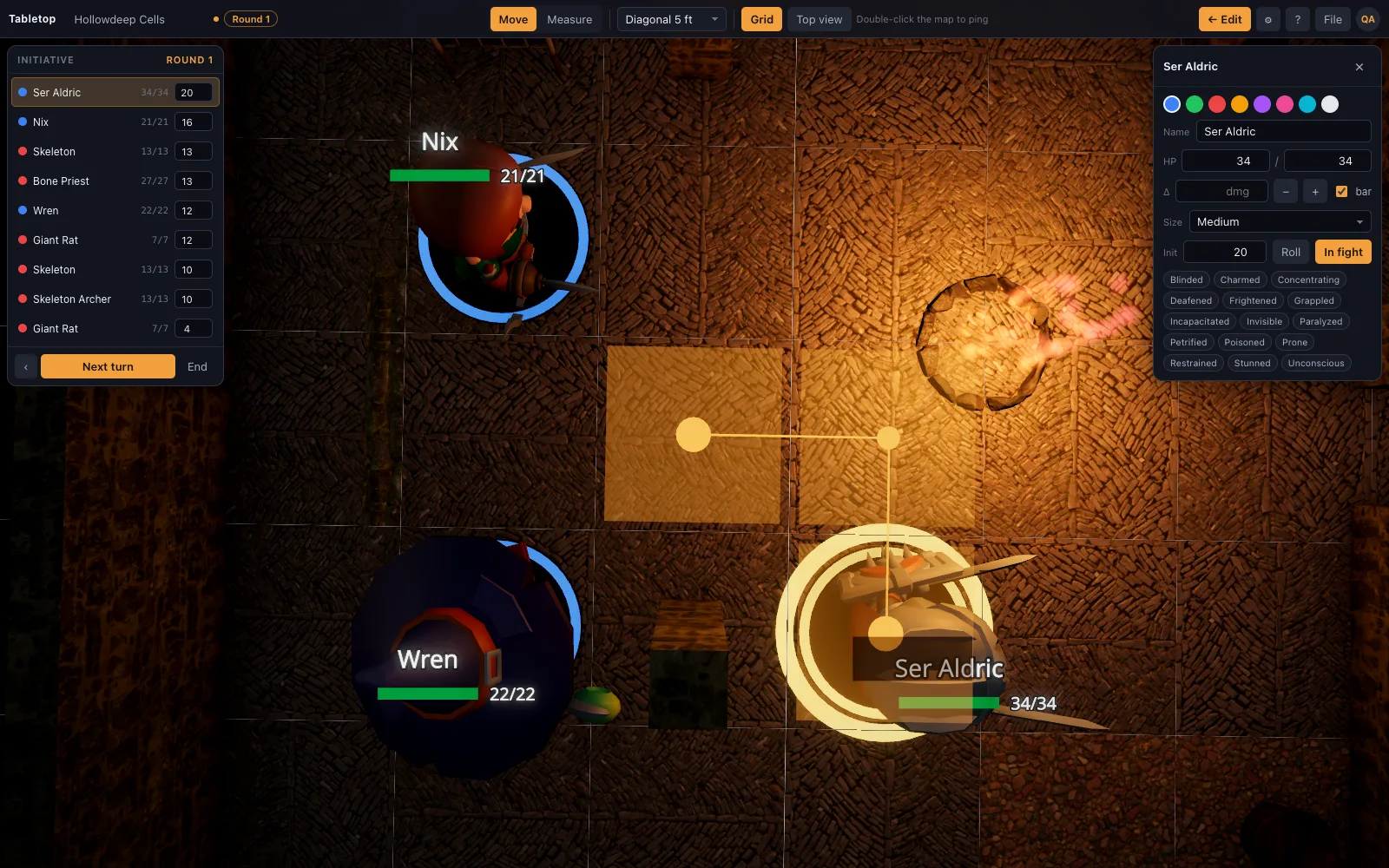
The best squeezes on a map are the ones the monsters cannot take. Party-sized doorways in a giants' hall, a crack in a cavern wall the ogres are one size too big for, a sewer pipe the Large owlbear cannot follow into: under either edition these turn size into a route only one side has. Draw them as a wall with a 1-square gap and say the size out loud when the players look at it. On a 3D table, a Large token set to its creature size covers 2 by 2 squares, so a corridor one square wide shows the squeeze the moment the mini stops fitting, and the ruler that counts the extra feet does the arithmetic while the player decides whether the detour is shorter.