AI-generated battle maps: what works, what does not, and why
Ask an image model for a dungeon map and you get a beautiful picture with walls that do not close, a grid that drifts, and a staircase leading into rock. It looks like a map. It is not a map, because a map is a set of facts about where things are.
· 7 min read · TerrainTale
Why picture generation fails at maps
An image model draws what maps look like, not what maps mean. Nothing in the process holds a wall to a grid line, keeps a door in an opening, or knows that a 5-foot square has to stay 5 feet across the whole image. The result is unusable the moment a mini has to stand somewhere specific.
The failures are structural, not a matter of prompting harder: no closed rooms, drifting grids, doors in walls that are not there, and shadows that imply light sources the map does not have.
What a language model is actually good at
Composition. Given a library of assets and a grammar for placing them, an assistant is very good at deciding that a castle gate wants a gatehouse, two flanking towers, a courtyard and a well, and at writing that down precisely. It is the taste and the layout that transfers, not the pixels.
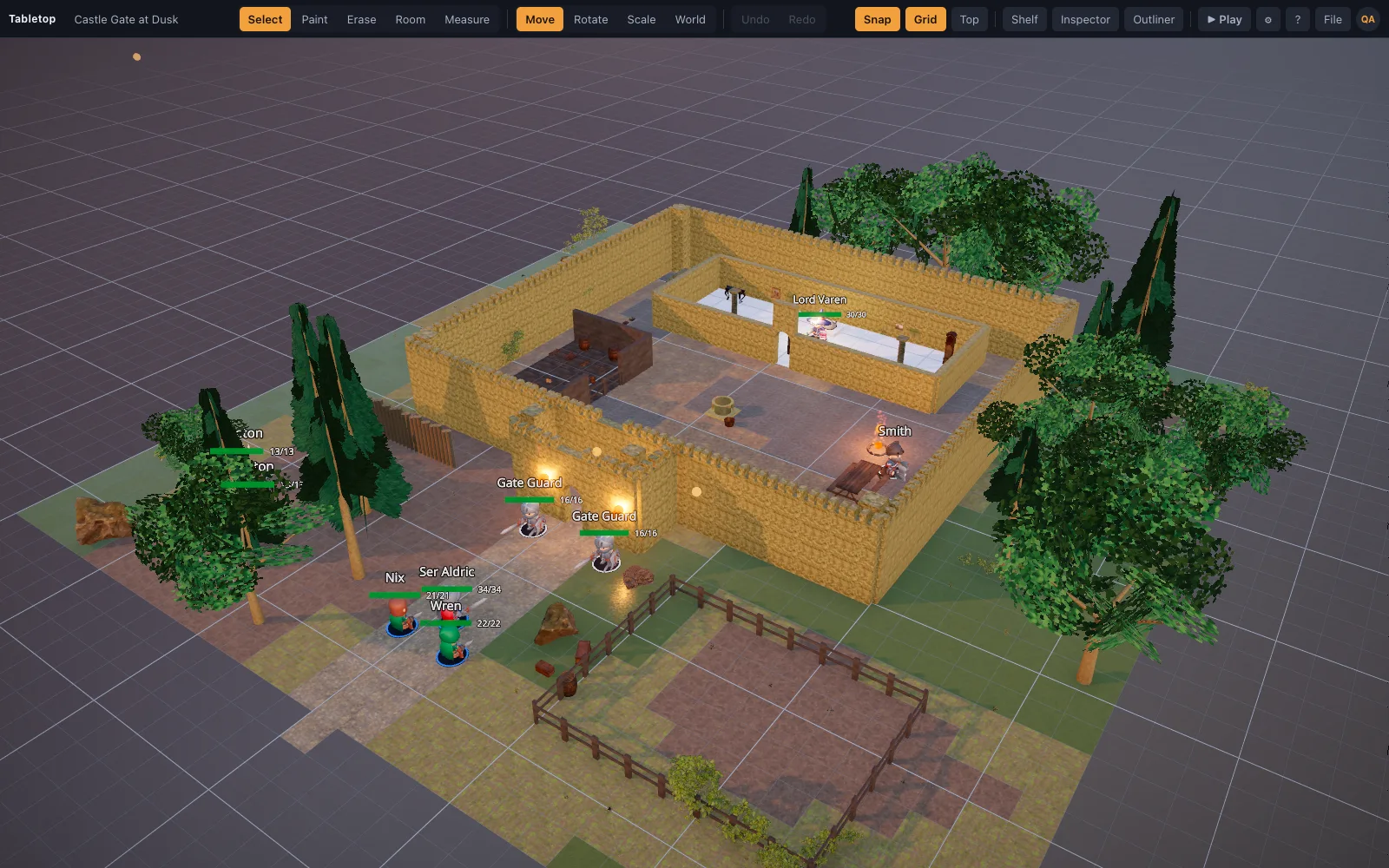
That is the idea behind scene recipes: a small JSON format with rooms, floors, walls, openings, props and lights. The assistant writes the recipe; a tested, pure builder expands it into grid-correct geometry. Floors tile, walls meet, openings land on edges — because code guarantees it, not because a model got lucky.
The division of labour that works
Let the model choose and arrange. Let the builder guarantee correctness. Let the DM edit. Each part does the thing it is reliable at, and the failure mode of the whole is "the composition is a bit odd", which you fix with two drags, instead of "the geometry is broken", which you cannot fix at all.
- Assistant: what goes where, and why.
- Builder: the grid, the tiling, the wall joins, the openings.
- You: the two things you would have changed anyway.
Writing a good prompt for a scene
Say the place, the mood, the light, and the fight. "A ruined watchtower on a cliff at dusk, half collapsed, for an ambush by four bandits with archers on the parapet" produces a usable recipe. "Make a cool map" produces a room.