Monk 3D model
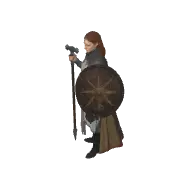
Monk from the D&D Characters pack in TerrainTale's library. Drop it on the grid as a token; in play mode it carries HP, conditions and an initiative slot.
- Folder
- Character miniatures
- Pack
- D&D Characters
- Author
- TerrainTale, generated with Meshy AI
- Licence
- Included with TerrainTale for use at the table
- Size
- 2.5 ft by 2 ft, 6 ft tall (covers about 1 by 1 squares)
- Format
- GLB (binary glTF 2.0)
- File size
- 1.5 MB
This model is part of TerrainTale's own library: free to place on any table in the app, not offered as a download.
About this model
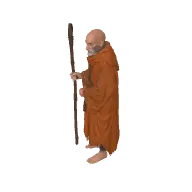
A barefoot monk in a long saffron robe, head shaved and grey-bearded, leaning lightly on a tall wooden staff. The posture is calm and slightly stooped. The figure stands about 6 ft tall on a footprint of roughly 2.5 by 2 ft, sitting inside one square.
The monk can be a party martial artist, a mountain abbot or a pilgrim met at a crossroads shrine. It suits monasteries, temple courtyards and long dusty roads. Monks move quickly across a map, so give the board open floor and a few ledges or steps worth leaping, and track hit points and conditions on the token.
Ideas for the table
- An elderly monk sits in the middle of a mountain path and will only let travellers pass who can knock his staff from his hand.
- Bandits seize a monastery, and the last monk free leads the party through the kitchen garden to the bell tower.
- A pilgrim monk shares the party's campfire and quietly disarms the assassin who arrives at midnight.
From the blog
Creature sizes on a grid: how many squares each token takes
Tiny to Gargantuan, in squares: the space each D&D creature occupies on a 5-foot grid, what reach means for a Large monster, how squeezing works, and how to size tokens in a VTT.
· 6 min read
Difficult terrain: what it costs, how to mark it, and when to use it
How difficult terrain works in D&D 5e — double movement cost, stacking with diagonals, climbing, swimming and crawling — and how to mark it on a battle map so nobody has to ask.
· 6 min read
Flanking in 5e: how the optional rule works and whether your table should use it
The DMG's optional flanking rule explained: what counts as opposite sides on a square grid, why it hands out advantage too freely, and the alternatives DMs use instead.
· 6 min read
All articles on battle maps, grid rules and running the game
Ready to put a map on the table?
Open the builder and start, no account needed. Sixteen starter scenes are on the welcome screen; sign up free when you want to save one or play it with your group.