5e vs Pathfinder diagonal movement, and the rule in between
A square grid has one honest problem: a diagonal step and a straight step cover different real distances, and every ruleset picks its own way to paper over that. There are three common answers, and a table that has never picked one is quietly playing a fourth rule — whatever the DM does under pressure.
· 5 min read · TerrainTale
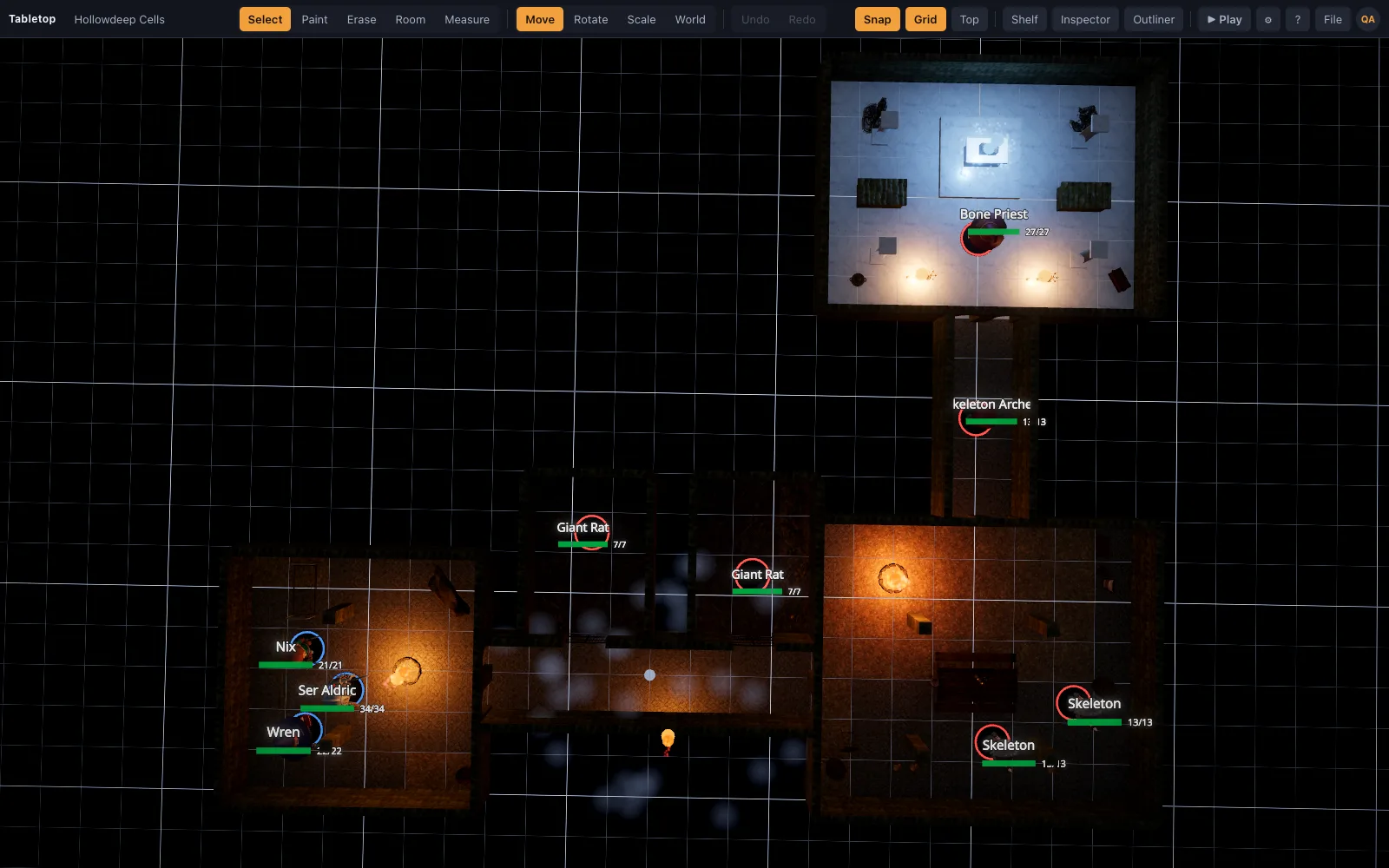
Rule one: every diagonal costs 5 ft (5e default)
D&D 5e's default treats every square moved, diagonal or straight, as 5 feet. It is the simplest rule to run at the table because there is nothing to alternate and nothing to calculate — count the squares crossed and multiply by five. Its cost is that it slightly overstates the efficiency of moving diagonally, since a true diagonal step covers about 7 feet, not 5.
For most groups, especially ones with new players, this is the right default: it never requires a pause to remember which step is which, and the overstatement rarely changes a tactical decision.
Rule two: the 5/10/5 pattern (DMG variant, Pathfinder)
The alternative in the Dungeon Master's Guide, and the default in Pathfinder, alternates the cost of diagonal steps: the first diagonal in a move costs 5 ft, the second costs 10 ft, the third back to 5, and so on. Over a long move this averages close to the true diagonal distance without needing a square-root calculation at the table.
It rewards a table that already tracks movement carefully — a rogue kiting around a room, an archer circling for an angle — because the alternating cost actually changes whether a particular path is worth taking. It costs a little more attention per turn than the flat 5e rule.
Rule three: true (Euclidean) distance
True distance measures the straight-line distance between two points regardless of the grid, the way you would with a real tape measure over a real battlefield. It is the most physically accurate of the three and the one that matters most in 3D, where a diagonal can also be a climb — the true distance to a ledge combines the horizontal and vertical legs honestly rather than approximating either one.
Its downside is the same as its strength: it is the hardest of the three to eyeball without a tool doing the counting, which is exactly why it tends to show up on tables that measure digitally rather than with a paper grid and a ruler.
Picking the rule, in practice
Because the diagonal rule is a setting rather than a separate tool, changing it does not mean re-learning the ruler — pick every-diagonal-5-ft for the simplest table, 5/10/5 for a table that plays the DMG variant or Pathfinder and wants the alternating pattern honored automatically, or true distance for a table that wants the number to be exactly right, especially with height involved. Set it once and every measurement on the map follows it from then on.
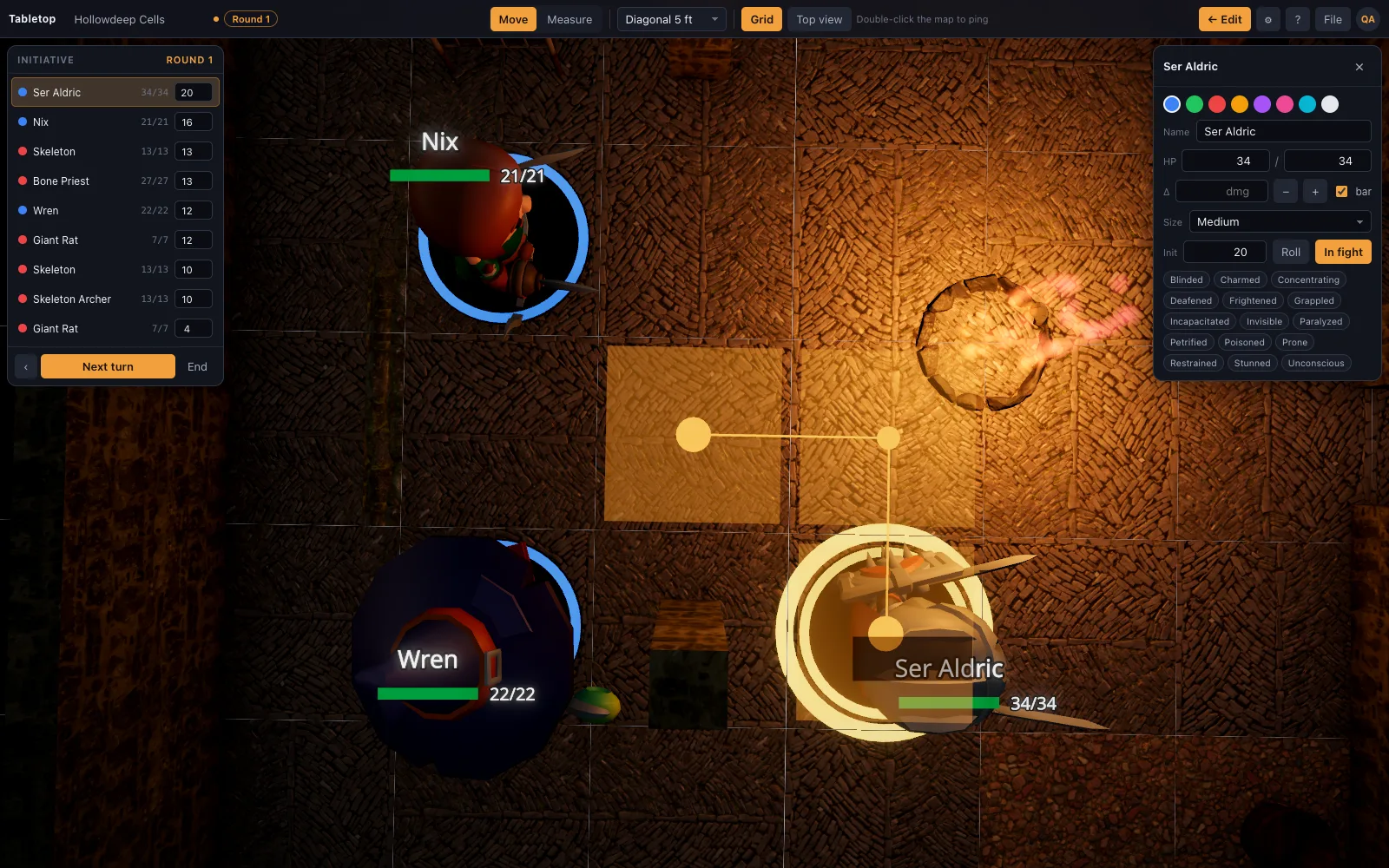
A DM switching rules mid-campaign
It's common for a table to start on the 5e default because it's the easiest to explain to new players, then want the DMG's alternating rule once combat gets more tactical and positioning starts to matter — flanking around a diagonal, threading between two enemies, closing at an angle instead of straight on. Switching later doesn't cost anything beyond the conversation of agreeing to change it; there's no separate tool to relearn, no old measurements that become wrong retroactively, just a different number on the next drag.
The same goes the other way: a table running the 5/10/5 or true-distance rule for a tactically dense dungeon crawl might drop back to flat 5e counting for a looser, roleplay-heavy arc where nobody's counting squares that closely anyway. The rule is meant to serve the table, not the other way around.