Light sources in 5e: torch, lantern and candle radius on the grid
A torch gives bright light for 20 feet and dim light for 20 feet more, which on the grid is 4 squares of bright and 4 more of dim in every direction, and it burns for an hour. A hooded lantern is 30 and 30, a bullseye lantern a 60-foot cone with 60 more of dim, a candle 5 and 5, and the Light cantrip matches a torch. Dim light is lightly obscured; darkness is heavily obscured. Darkvision turns dim light into bright and darkness into dim, in shades of grey, out to its range, and no further. Those numbers are the whole of running a night fight, once you draw them.
· 5 min read · TerrainTale
Every light source in feet and squares
The 2024 Player's Handbook lists the same light sources as 2014 with the same radii, so this table holds for either edition. A square is 5 feet, so divide by five. The bullseye lantern is the odd one: a 60-foot cone rather than a radius, which is 12 squares long and 12 wide at the far end, and it lights nothing behind the person holding it.
- Candle: bright 5 feet, dim 5 more. One square and one square. Burns 1 hour.
- Torch: bright 20 feet, dim 20 more. Four squares and four. Burns 1 hour.
- Lamp: bright 15 feet, dim 30 more. Three squares and six. Burns 6 hours on a pint of oil.
- Hooded lantern: bright 30 feet, dim 30 more. Six squares and six. Hood down, dim light 5 feet.
- Bullseye lantern: bright 60-foot cone, dim 60 more. Twelve squares out.
- Light cantrip: bright 20 feet, dim 20 more, for 1 hour. Daylight: bright 60, dim 60, for 1 hour.
Bright, dim and dark: what each does
Bright light is the default; you see normally. Dim light is a lightly obscured area, and the only effect is Disadvantage on Wisdom (Perception) checks that rely on sight. You can still attack into dim light without penalty and target spells into it. Darkness is a heavily obscured area, which means you are effectively blinded when trying to see anything in it: attack rolls against a creature you cannot see have Disadvantage, and spells that need a target you can see cannot be cast at it.
The practical consequence is that a torch-bearer standing in the open can be seen from far beyond their own light. A torch shows the party to every creature with eyes within a few hundred feet, and shows the party only what stands within 8 squares of them. The lantern is a beacon as well as a lamp, and the party that carries one into a night ambush has volunteered to be the target.
Darkvision: what it does and does not do
Darkvision with a range of 60 feet, the common value, lets a creature see in dim light within 60 feet as if it were bright, and in darkness as if it were dim, in shades of grey without colour. It does not let a creature see in darkness as if it were lit. Darkness within darkvision range is dim, which is lightly obscured, so the dwarf watching the dark treeline has Disadvantage on the Perception check to notice the wolves, not an automatic success.
Beyond the range, darkness is darkness, and a creature with 60-foot darkvision cannot see the archer at 70 feet at all. The other limit is light itself: a creature with darkvision that stands next to a torch sees by the torch within the torch's radius and by darkvision beyond it, so the torch does not blind it, but it does not help it either. Most monsters have darkvision. The party's humans usually do not, and that asymmetry is the entire tactical content of a night fight.
Running a night fight on the grid
Draw the light first. Mark the 4-square bright ring and the 4-square dim ring around every torch, and remember that the torch moves with the hand that holds it. Anything outside the rings is dark, which for the humans is invisible and for the elves is dim out to 12 squares. Then place the enemies where the party cannot see them and let the party's light give them away. A wolf pack circling at 10 squares is in darkness for the fighter and in dim light for the ranger, so the ranger calls the positions and the fighter swings at Disadvantage until the wolves come into the ring.
Two rules keep it honest. A creature that attacks from darkness at a target it can see, because the target stands in torchlight, has Advantage as an unseen attacker, and gives away its position when it attacks. And a creature that moves into the bright ring is visible to everyone, so the wolves that close to bite lose the advantage they had at range. The fight has a rhythm: the enemy is dangerous while outside the light and ordinary once inside it.
- Torch ring: 4 squares bright, 4 more dim, moving with the bearer.
- Humans: nothing beyond the dim ring.
- 60-foot darkvision: dim out to 12 squares, nothing beyond.
The map does the drawing for you
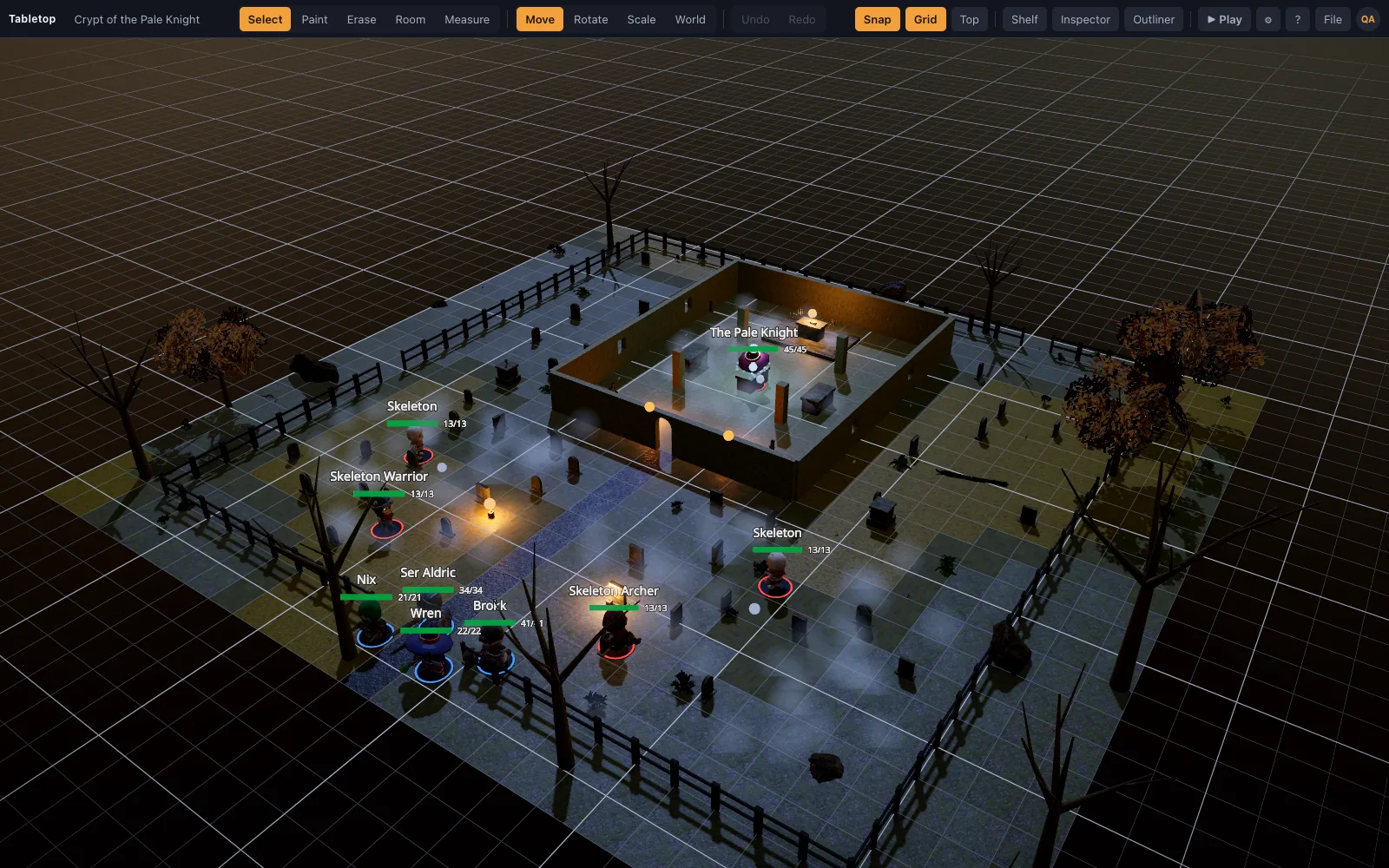
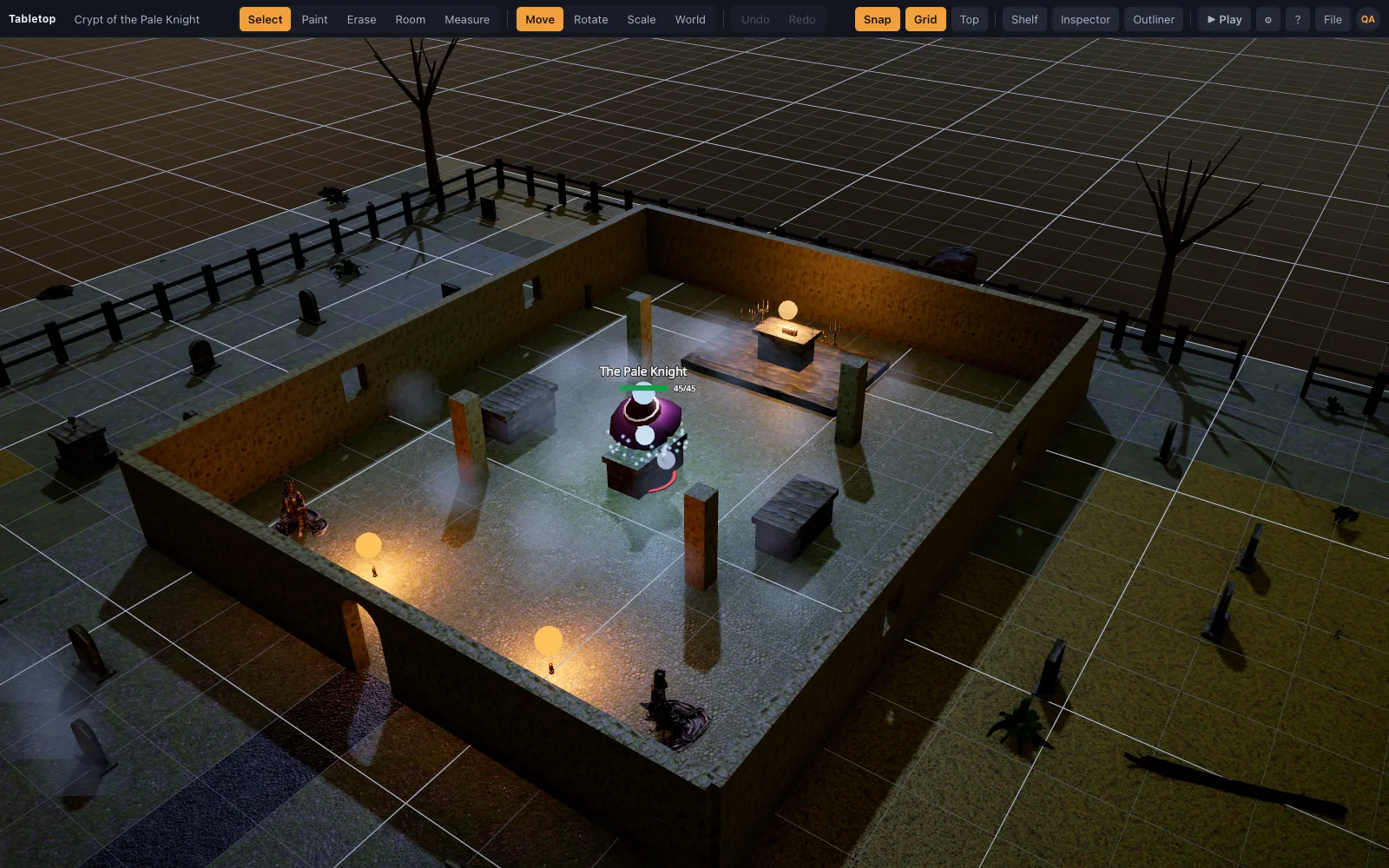
On paper, tracking three torches and a lantern across a moving fight is a chore, and most tables give up and treat the whole map as lit. On a 3D map with real light it is nothing to track. TerrainTale's torches and candles are light sources that cast shadows, so the bright pool around the campfire and the dark beyond the trees are simply visible; the DM places a torch and the map shows what it lights. There is no vision calculation and no fog of war; the DM still rules who sees what, but the question is answered by looking rather than by measuring.
That is most useful for the dim band, the ring where darkvision creatures see and humans do not. The camera at eye level from the fighter's mini shows a black treeline; from the elf's it shows grey shapes. The players see the difference, and the difference is the encounter.
Spells and the light they make
Light and Daylight are the bread and butter. Light on a stone thrown into the dark corridor is the cheapest reconnaissance in the game and lasts an hour. Daylight is 60 feet of bright light and 60 more of dim, which is a 24-square radius that turns a night fight back into a day one, and it also dispels magical darkness of 3rd level or lower. Faerie Fire outlines everything in a 20-foot cube so that attacks against those creatures have Advantage and they cannot benefit from being Invisible, which is the answer to the enemy that hides in the dark. Dancing Lights makes up to four lights that each shed dim light in a 10-foot radius and can be moved, which is four 2-square pools the party can send ahead.
The spell that changes the shape of a night fight most is Darkness, which snuffs the torches in a 15-foot sphere. Darkvision does not see through magical darkness. A party with a warlock who has Devil's Sight can fight inside it while nobody else can, and that is a table's most reliable way to make the night belong to the players for once.