Cave battle maps: building caverns that do not look like rooms
Caves are the map that most often comes out wrong. A dungeon is rooms and corridors and everyone can draw one; a cave is a rectangle with wobbly walls unless you make some deliberate decisions. The decisions are small: irregular chambers instead of rooms, height instead of doors, and light that ends before the walls do. Get those three and a cave map plays like a cave.
· 6 min read · TerrainTale
Chambers, not rooms
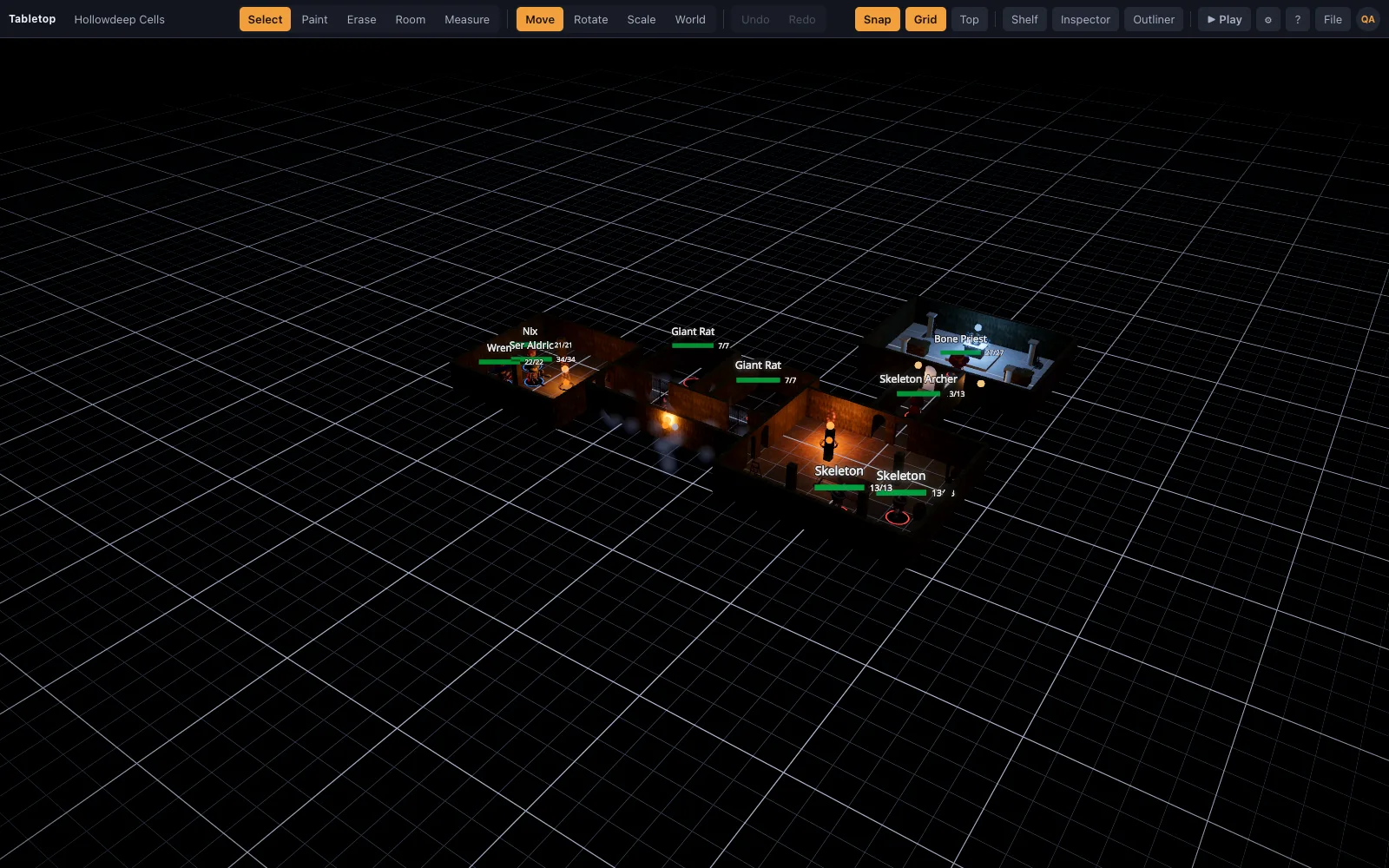
A cave chamber is a blob, not a box. On a grid, that means the walls step in and out by a square or two on every side, corners are cut, and the chamber narrows to a throat before opening into the next one. The simplest method is to draw the room as a rectangle first, then bite squares out of its corners and edges until nothing is straight for more than four squares. Widen the middle, narrow the ends.
Passages between chambers should vary in width: 1 square where the party has to go single file, 3 squares where two monsters can come at once. Never draw two passages the same width and length in a row.
Stalagmites, rubble and water
Three kinds of ground make a cave. Stalagmites and boulders are the cover and the obstacles: a stalagmite is a single square of solid stone, waist to head high, so it is half or three-quarters cover and blocks movement. Rubble and scree are difficult terrain, and a slope of it is where the fight slows down. Water is the third: a shallow stream is difficult terrain, a pool is swimming, and an underground river is a way out or an unexpected way in.
Place them in clusters, not scattered evenly. A field of stalagmites on one side of a chamber and an open floor on the other gives the party a choice about where to fight; a uniform sprinkle gives them arithmetic.
- Stalagmite or boulder: 1 square, blocks movement, half cover behind it.
- Scree and rubble: difficult terrain, mark with a distinct floor material.
- Shallow water: difficult terrain; deep water: swimming, and a swim speed for whatever lives there.
- Pit or chasm: a hole in the floor is the cheapest hazard in the game.
Height does what doors do in a dungeon
Dungeons control the flow of a fight with doors. Caves do it with height: a ledge 10 feet up that the archers hold, a chimney the goblins climb faster than the party, a lower level reached by a slope where the water is. Even one ledge running along one wall of the main chamber changes a fight, because it creates a place worth reaching and a climb to reach it.
This is where a 3D table earns its keep. On a flat map a ledge is a line and a number written beside it; in three dimensions it is a ledge, and the ruler measures the climb. In TerrainTale the Cave kit in the room tool builds the chambers and the ruler counts height in feet, so a 10-foot ledge is a real 10 feet when the rogue asks whether the dagger reaches.
Light that ends before the walls
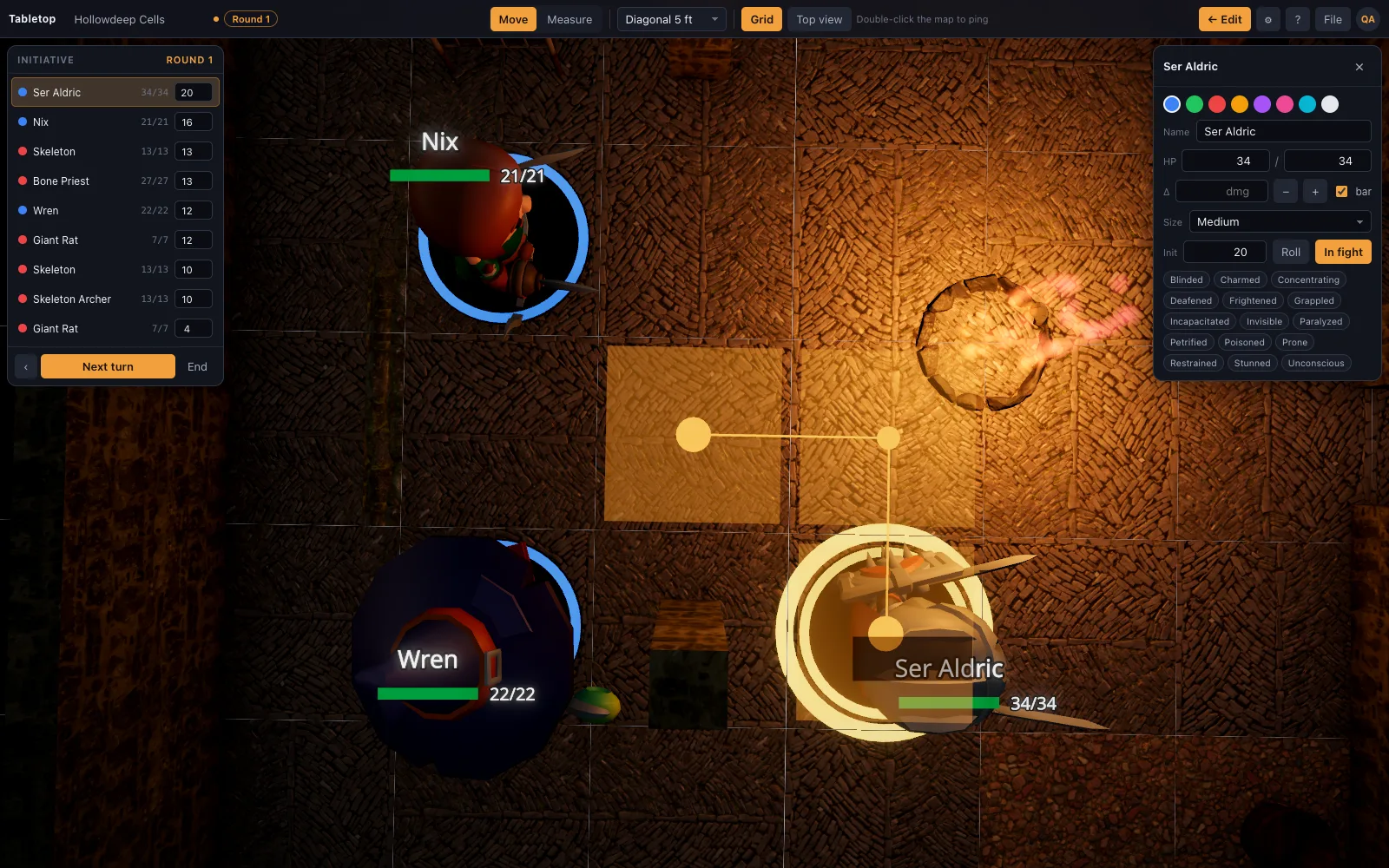
A cave is the one place where the party's torch is the only light, and the map should reflect it. Do not light the chamber; light the party. Their torches make a 20-foot bright radius and 20 more feet of dim, and beyond that is darkness the humans cannot see into. Give the monsters darkvision and the darkness a shape: glowing fungus in one alcove, a shaft of daylight from a crack above, a fire the goblins left. Those few fixed lights tell the party where the room is even when they cannot see its walls.
In 3D this is physically true: the light on the table stops where the light stops. Players will hold torches up to see round corners, which is exactly the behaviour a cave should produce.
Who lives here
Caves suit monsters that use the terrain: goblins on the ledges, a bear in the dead end, kobolds who know the crawlspaces, oozes in the water, giant spiders on the ceiling. Give each creature one terrain feature it uses well and the map will run the encounter. The party will learn to read a cave by the second fight: high ground means archers, water means something swims, and a narrow throat means whatever is behind it wanted to be hard to reach.