Diagonal movement in 5e: three rules, and when to use each
Diagonals are the only piece of grid maths a table argues about twice. The rules are simple; the trouble is that groups often use two of them at once without noticing.
· 5 min read · TerrainTale
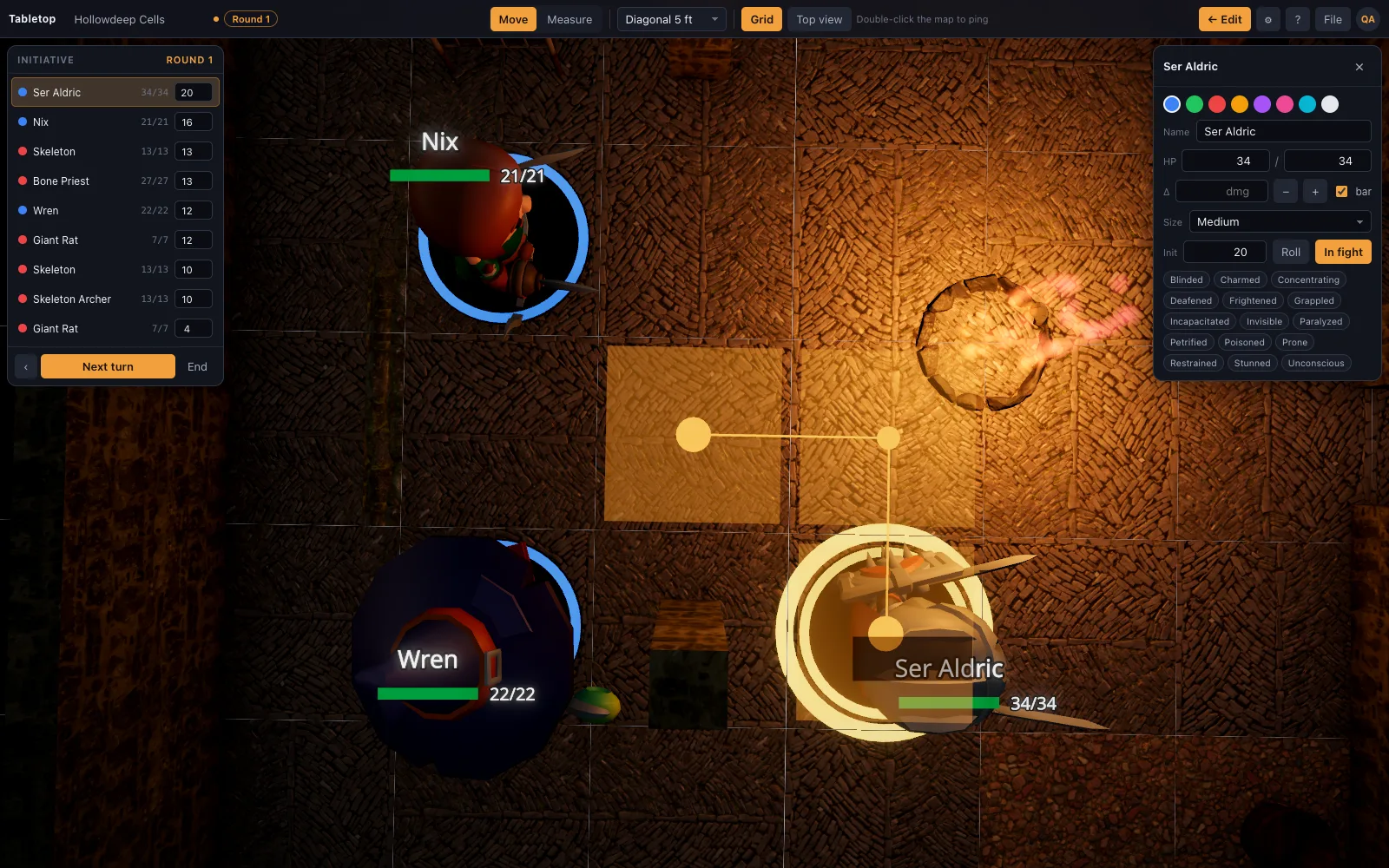
Every diagonal as 5 feet — the default
The Player's Handbook counts every square as five feet, diagonal or not. It is fast, it never needs a calculator, and it means a 30-foot move reaches 6 squares in any direction, including corners. The cost is geometric: moving diagonally is strictly better, so tactically minded players zigzag.
For most tables this is the right trade. Speed at the table beats fidelity to Pythagoras.
5/10/5 — the DMG variant
The first diagonal costs 5 feet, the second costs 10, the third 5, and so on. It approximates real distance closely enough that nobody notices the error, and it removes the zigzag incentive. It is also what Pathfinder uses, so half your players may already know it.
The cost is bookkeeping: someone has to remember whether this is an odd or even diagonal. A ruler that tracks it for you removes the entire objection.
True distance
Measure the straight line and charge what it costs. Correct, and slow enough by hand that it is really only viable when the tool does it. If your table plays with a virtual ruler, it is a perfectly reasonable choice and makes ranged play feel precise.
Pick one before session one
Say which rule you use at session zero, then let the tool enforce it. TerrainTale's ruler has all three as a setting, counts squares while a mini is dragged, and reports feet with the diagonal rule applied, so the answer arrives before the argument does.
What each rule does to play
Under the flat rule a 30-foot move reaches every square within six steps, which makes the reachable area a square rather than a circle — a rogue can cross a room corner to corner surprisingly fast, and ranged attackers are easier to close on than the fiction suggests. Under 5/10/5 that same area becomes a rough circle, which slows flankers and makes staying at range viable.
The effect on spell areas is larger still. A 20-foot cube is unaffected; a 20-foot radius under the flat rule catches corners it geometrically should not. If your table has an evoker who cares, 5/10/5 is the kinder rule.
- Flat 5 ft: fastest, favours melee and diagonal movement.
- 5/10/5: near-accurate, favours ranged play, needs tracking.
- True distance: exact, only practical with a tool doing the maths.
Settling it mid-fight without stopping the fight
When a disagreement happens anyway, rule in the player's favour, note it, and move on. Diagonals are worth at most one square of difference and never worth three minutes of table time. Then fix it properly between sessions by changing the setting, so the same argument cannot recur.