Initiative tracking that stays out of the way
Initiative trackers fail in one of two directions. Either they are a sheet of paper that nobody can see, or they are a combat management suite with eleven columns that the DM operates instead of running the game. The useful middle is small.
· 6 min read · TerrainTale
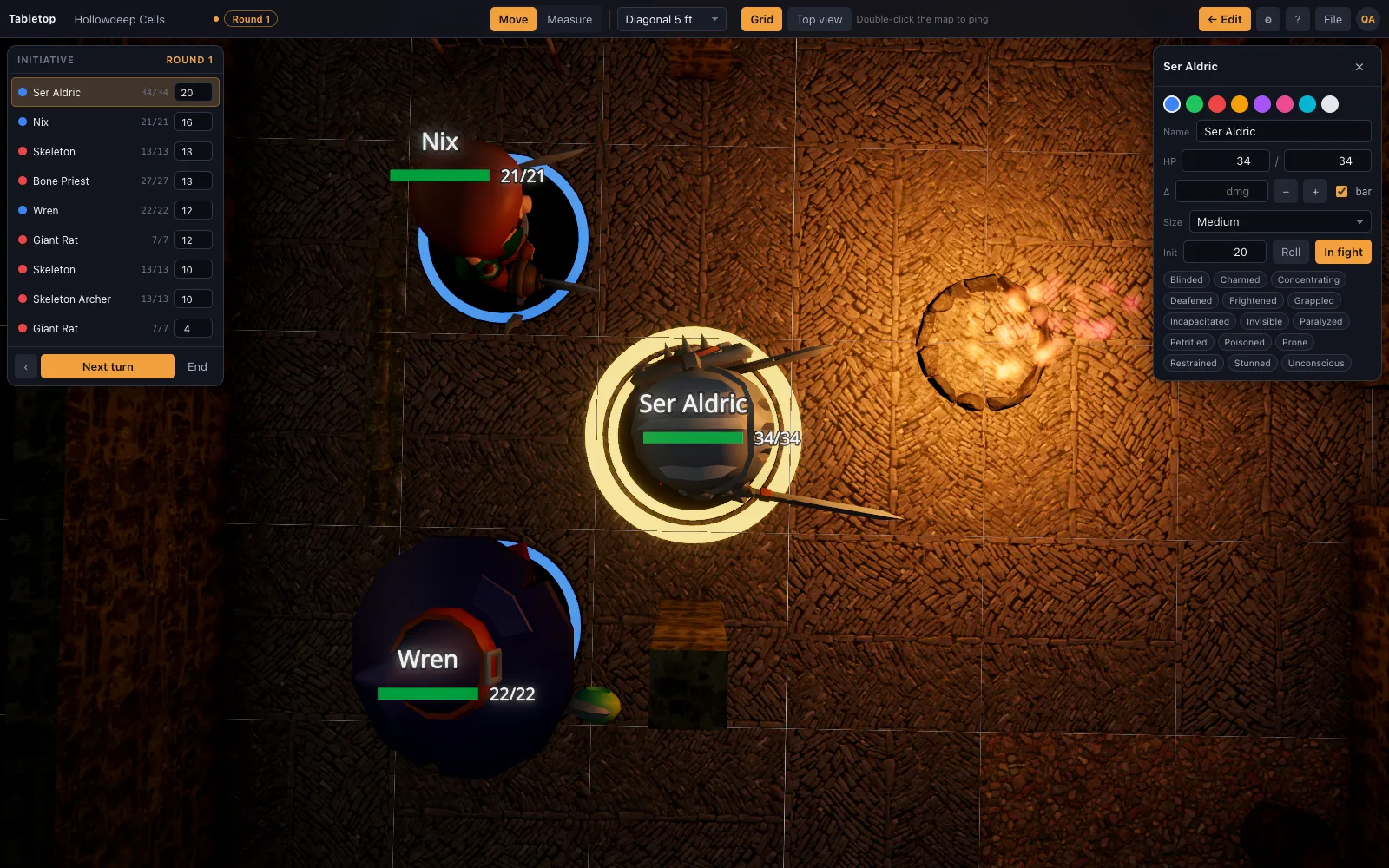
The four things it must do
Show the order. Show whose turn it is, unmistakably. Count rounds, because half the spells in the game are measured in them. And hold hit points where damage can be applied in one click.
That is the list. Anything else is a feature that will be used once and then navigated around for a year.
- Order, visible to everyone at once.
- Current turn, marked on the map as well as in the list.
- A round counter — concentration and durations live and die on it.
- HP with quick damage and heal, on the token, not in a submenu.
Roll it or type it
Some tables roll every monster individually, some roll one number per group, and some let the DM assign. A tracker should accept a typed number as readily as a rolled one, because the fastest initiative is often the one the DM decides.
Group initiative for identical monsters is the single biggest speed-up in a fight with eight goblins.
Surprise, arrivals and lair actions
Surprise is a skipped first turn, not a separate round — keep it in the same order. Reinforcements get inserted at their rolled number and act from the next round. Lair actions sit at initiative count 20, losing ties, and are worth a permanent entry in the list so they are never forgotten.
What it should refuse to do
It should not roll your attacks, apply your conditions, or decide whether your concentration broke. Once a tracker owns the rules, every disagreement becomes a support question instead of a ruling, and the DM stops being the authority at their own table.
Conditions belong on the miniature
A condition tracked in a list is a condition that will be forgotten. Prone, restrained, blinded, concentrating — put them on the token where the token is, and the player whose turn it is sees them without asking. This is the single highest-value thing a tracker does beyond ordering turns, and it is also the one most often buried two menus deep.
Durations are the other half. Almost everything that expires does so at the end of someone's turn, so a round counter plus a note on the token covers ninety-five percent of cases without any automation at all.
- Show conditions on the base, not in a side panel.
- Concentration marked visibly — it is the most-forgotten rule in the game.
- Note the round a duration ends, not how many rounds are left.
Running big fights without losing the thread
Past about ten combatants, order alone stops being enough. Group identical monsters onto one initiative entry and resolve them together; it converts eight goblin turns into one goblin turn and removes seven context switches. Name them for what they do — "archer left", "archer right" — rather than numbering them, because players remember roles and never remember goblin four.
And keep the list visible to the players. A tracker only the DM can see is a tracker that generates the question it exists to answer.