Session prep in thirty minutes: what to do and what to skip
Prep expands to fill the week available. It should not: a session that runs for three hours needs about thirty minutes of preparation, and the extra four hours most DMs spend go into material the players never reach.
· 6 min read · TerrainTale
Minutes 0–5: what happened, and what wants to happen
Read your notes from last session. Write one line for each thread the players left dangling, and one line for what the world does next whether or not they are involved. That second line is the whole difference between a reactive world and a queue of quests.
Minutes 5–15: five beats, not a plot
Write five things that could happen, in no fixed order — a discovery, a complication, a fight, a face, and a choice. A list of beats survives player improvisation; a plot does not. If the players skip three of them, they are still there next week.
- A discovery — something that changes what they know.
- A complication — a cost or a clock.
- A fight worth mapping.
- A face — one NPC with one want.
- A choice with no clean answer.
Minutes 15–25: two maps
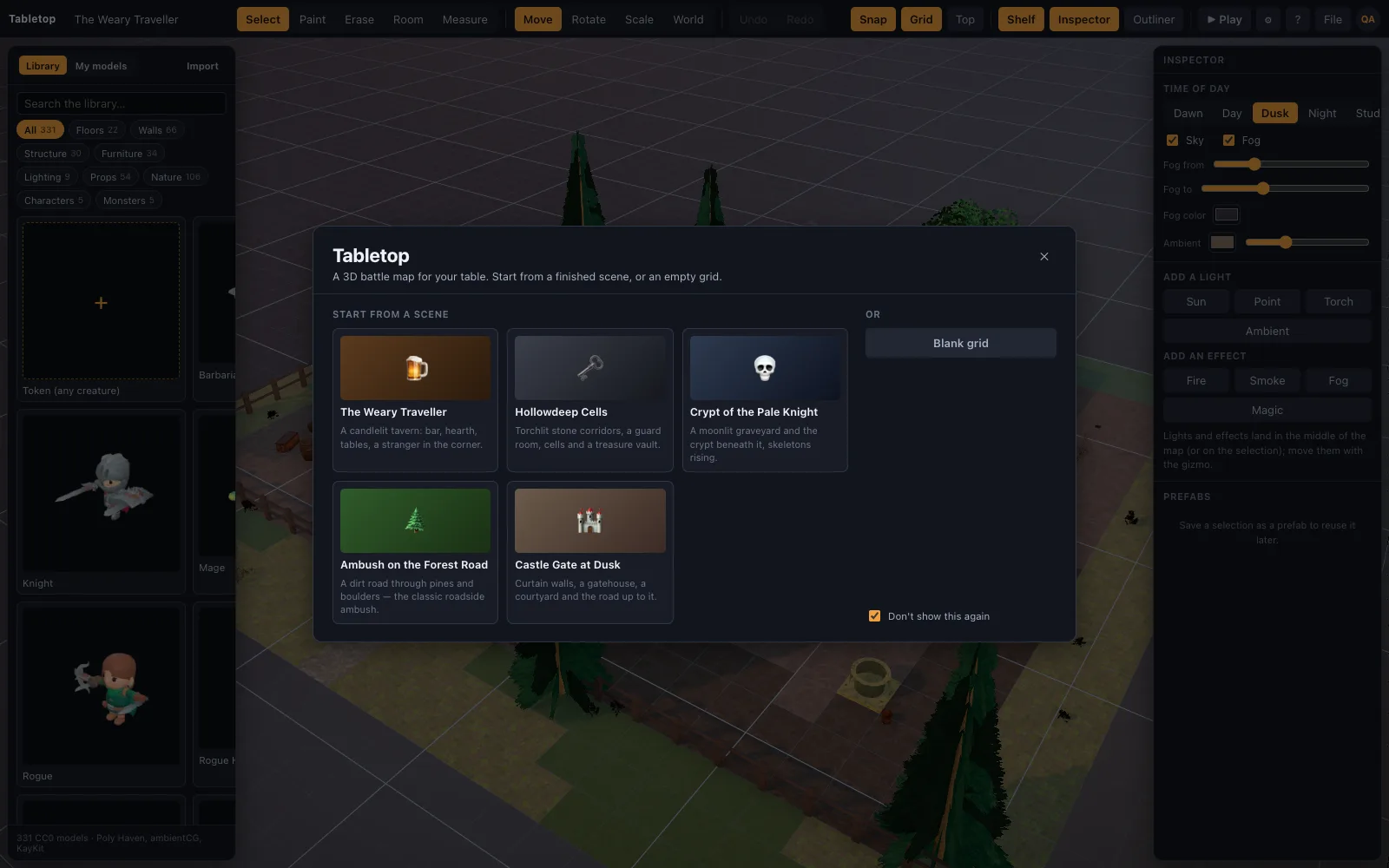
Prep the fight you are fairly sure will happen and one generic backup — a room, a road or a cave. With a room tool and a starter scene, both are a few minutes. Do not build the dungeon they might reach in three weeks.
Minutes 25–30: names, numbers, secret
Three NPC names you can say out loud without wincing. The stat blocks for tonight, open in tabs. And one secret about the world that you will let slip if the pace sags. That last one is the highest-value item on the list and takes ninety seconds.
What to deliberately not prep
Do not write dialogue; you will not use it and it makes NPCs sound rehearsed. Do not draw a map the party has no reason to reach this week. Do not balance an encounter to three decimal places — pick a monster count, watch the first two rounds, and add or remove one. Do not write a plot with a required ending, because the players will find the other one.
Every hour spent on those four is an hour not spent on the five beats, and the five beats are what the session is made of.
- No scripted dialogue — one want per NPC is enough.
- No maps for hypothetical locations.
- No exhaustive encounter maths; adjust live.
- No fixed outcome, ever.
Prep that pays off across a campaign
Some prep compounds, and it is worth doing on the weeks you have time. A list of twenty names by culture. Six reusable maps — a room, a road, a cave, a tavern, a cellar, a camp. A page of rumours you can hand out anywhere. A folder of three stat blocks reskinned for every tier. None of this expires, and each one shaves minutes off every future Tuesday.