Building a caravan ambush battle map: wagon spacing, high ground and where the bandits stand
A caravan ambush is a road fight with furniture. Three or four wagons strung along a track give cover, high ground and things to protect, and the trees or rocks on either side give the attackers somewhere to come from. The map is 30 by 12 squares of road, the wagons take 2 by 4 each with a 2-square gap between them, the oxen stand two squares ahead of each wagon, and the bandits start 60 feet out in cover on both sides. Get those distances right and the fight is fair; get them wrong and the party either never reaches the archers or is dead before it acts.
· 6 min read · TerrainTale
Laying out the road and the wagons
Draw the road first: a strip 3 squares wide, 15 feet, along the long axis of a 30 by 12 map, with a verge of 1 square on each side and cover beyond that. A cart road is Difficult Terrain only where it is churned, so keep the surface clear and put the mud in one 3-square stretch where a wagon has bogged. Curve the road once so that the lead wagon cannot see the rear one, which is what makes the ambush work: the bandits hit the middle and the escorts at the ends have to come back through the gap.
A wagon is Large or Huge on the grid: 2 squares wide and 4 long including the shafts, with a bed 2 by 3 that stands 3 to 4 feet above the road. Space the wagons 2 squares apart, 10 feet, close enough that a character can move from one to the next in a single turn and far enough that a Fireball centred on the gap catches two beds and not three. Four wagons in a line with those gaps fill 22 squares of the 30, which leaves 4 squares of road at each end for the escorts to have somewhere to be.
- Road: 3 squares wide, one curve, one 3-square patch of mud as Difficult Terrain.
- Wagons: 2 by 4 each, 2-square gaps, beds 3 to 4 feet up.
- Draught animals: two oxen or horses per wagon, one square each, in the 2 squares ahead of the shafts.
- Cover: trees, rocks or a bank starting 1 square off the verge on both sides.
- Bandit start: 60 feet out, at least half of them with a line to the middle wagon.
The wagon bed as high ground and cover
A loaded wagon is the best cover on the map. A character standing behind one has three-quarters cover from the far side, +5 to AC and Dexterity saving throws, and half cover, +2, from anyone shooting along the road; one crouched in the bed among the cargo has three-quarters cover from everything at ground level. The bed is also high ground of a modest kind: 4 feet is not enough for a height advantage under the rules, which have none, but it is enough that a character on the bed can see over the oxen and the low scrub and has a clear line the ground does not.
Getting onto a bed costs movement. Climbing 4 feet is 8 feet of movement under the rule that each foot of climbing costs 1 extra foot, so a character with 30 feet of Speed climbs on and still has 22 feet to cross the bed and drop down the far side. Jumping off is free and, at 4 feet, does no damage. A canvas hood makes the bed Heavily Obscured from outside, so bandits inside a covered wagon cannot be seen until someone lifts the flap.
Oxen, horses and the things that panic
Draught animals are the ambush's second timer. An ox is Large and takes a 2 by 2 space in front of the shafts; a pair of draught horses is two Large creatures side by side across the road, which blocks it. They are obstacles in every direction: nobody moves through a hostile creature's space unless it is two sizes larger or smaller, and a panicked ox is hostile to everyone. When the first arrow hits, roll a Wisdom saving throw for each team against DC 10; on a failure the team bolts 20 feet down the road on its own initiative each round, dragging the wagon and anything tied to it, until someone spends an action and a DC 12 Wisdom (Animal Handling) check to calm it.
A bolting wagon rearranges the map. The gap it leaves opens a line of fire the bandits did not have, the wagon it drags may crush a Medium creature in the way for 2d10 bludgeoning with a Dexterity saving throw to avoid, and the cargo the party was hired to protect is now moving away from them. That is the reason to put animals on the map: a fight the party wins and still loses the wagon in is the better story.
Where the bandits have to stand for it to be fair
The attackers' opening position decides the encounter. Archers 60 feet out in the trees are within the shortbow's 80-foot normal range and the longbow's 150, and are 2 turns of movement from a party fighter on foot, 4 if the trees are Difficult Terrain. That is the right distance: close enough that the fighter can reach them by round 3, far enough that the archers get two volleys first. Archers at 120 feet are safe forever and the fight is a shooting gallery; at 30 feet the party is in melee before the ambush has meant anything.
Split the bandits so that both sides of the road are in play. Two archers and a leader on the high side, in cover, and three melee bandits on the low side who close on the rear wagon in round 1. The party has to choose which side to answer, and the wagons between the two groups are the terrain of that choice. Give the melee bandits a reason to be at the wagons: they want the strongbox, and the map should show which wagon it is in. Under the 2024 rules a hidden bandit has to have made a Dexterity (Stealth) check against DC 15 and be in three-quarters cover or better to be Hidden; trees 1 square off the road give that, so the ambush can open with Advantage on the first volley from the ones who rolled it.
Building it on the table
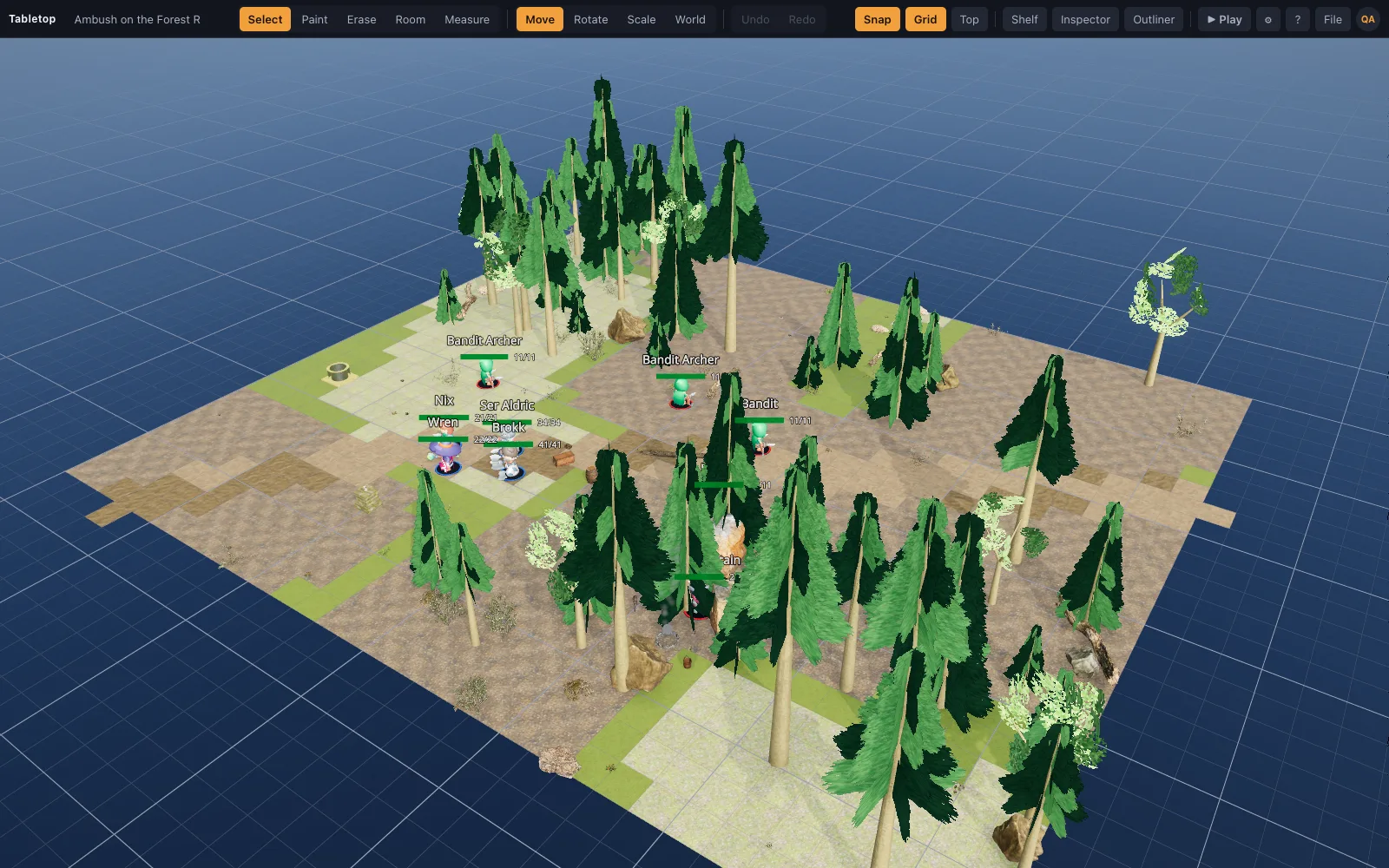
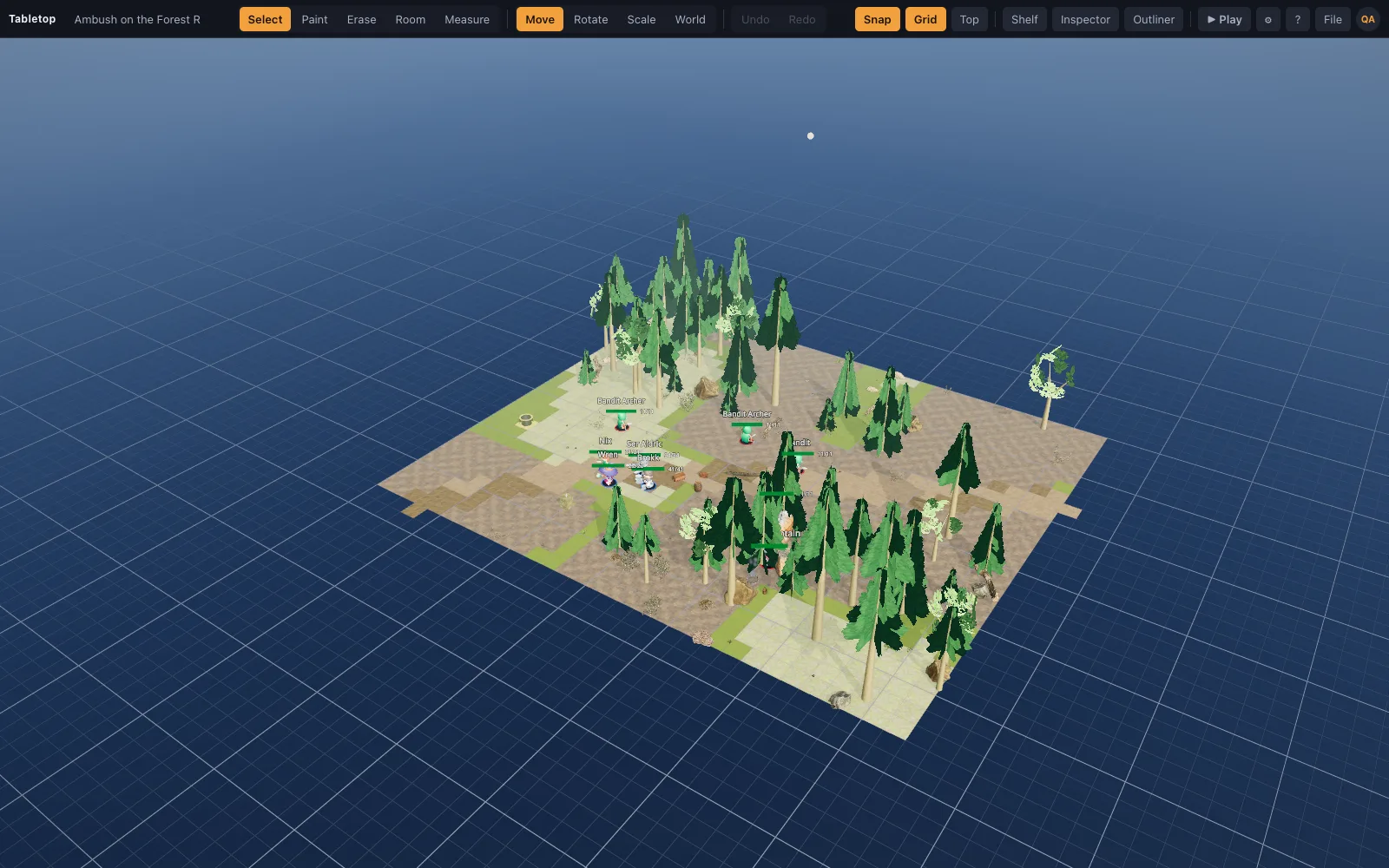
The Ambush on the Forest Road starter scene is already a road with tree cover on both sides and a bend, and a spilled load of crates and barrels where the cart went over. The library has no wagon model, so a wagon on the table is either a 2 by 4 block of crates and barrels from the shelf, which gives the cover and reads as cargo, or your own wagon .glb imported on the Premium plan. Draught animals are simplest as standee tokens made from any image and set to Large, so they cover 2 by 2 squares and block the road the way the rules say. A bank on the high side comes from raising the ground a few feet, and the bandits on it are visibly above the road when the camera drops to eye level.
If you would rather write it than build it, a scene recipe describes the road, the trees and the cargo positions in a short JSON that an AI assistant can draft from the paragraph above and the app builds grid-correct. Either way, mark the mud, the strongbox wagon and the two bandit groups before the session, and let the players discover the oxen.