TaleSpire vs Tabletop Simulator
Both are 3D, both are on Steam, and both get recommended for D&D. TaleSpire is built specifically for tabletop RPGs; Tabletop Simulator is a physics sandbox for every kind of game, with a huge Workshop that includes RPG sets.
Side by side
| Topic | TaleSpire | Tabletop Simulator | TerrainTale |
|---|---|---|---|
| Purpose | Built for tabletop RPGs | General physics sandbox for board, card and miniature games | Built for battle maps |
| Pricing model | One-time Steam purchase per person (around $25) | One-time Steam purchase per person (around $20), with DLC | Free plan with one saved scene; Premium $6/mo or $48/yr |
| Platform | Desktop download | Desktop download, VR supported | Browser |
| Building maps | Snap-together tiles and props | Workshop assets and imported models; freeform | Room tool, tile, terrain and water brushes |
| Grid and measuring | Grid-aware with RPG tools | Grid and measuring tools, less RPG-specific | Ruler in feet with height and diagonal rule |
| Initiative and HP | Built in | Via scripts and Workshop mods | Built in, with conditions |
| Custom content | Community content and Hero Forge import | Very large Workshop, custom imports | Image standees; .glb import on Premium |
| Fog of war | Yes | Hidden zones and fog tools | Yes, a brush the DM paints |
| Learning curve | Moderate | Moderate to steep for RPG use | Short |
TaleSpire and Tabletop Simulator are trademarks of their respective owners and are not affiliated with TerrainTale. Prices and features are described in general terms as we understand them at the time of writing and change often; check each product's site for current details.
Who should pick TaleSpire
RPG groups who want a 3D table designed around their game, with RPG tools built in and a fast way to build dungeons from tiles.
Who should pick Tabletop Simulator
Groups who also play board and card games, want physics and the freedom to import anything, or are drawn to a specific Workshop RPG set. It suits tinkerers who enjoy scripting.
Price compared
Both are per-person Steam purchases, so a five-person group pays five times. Tabletop Simulator is often discounted in Steam sales; DLC is optional.
Learning curve and setup
Everyone installs Steam and the game in both cases. TaleSpire's tools are focused on RPGs, so the path to a playable dungeon is shorter. Tabletop Simulator can do more, but you set more of it up yourself.
Where a 3D browser table fits
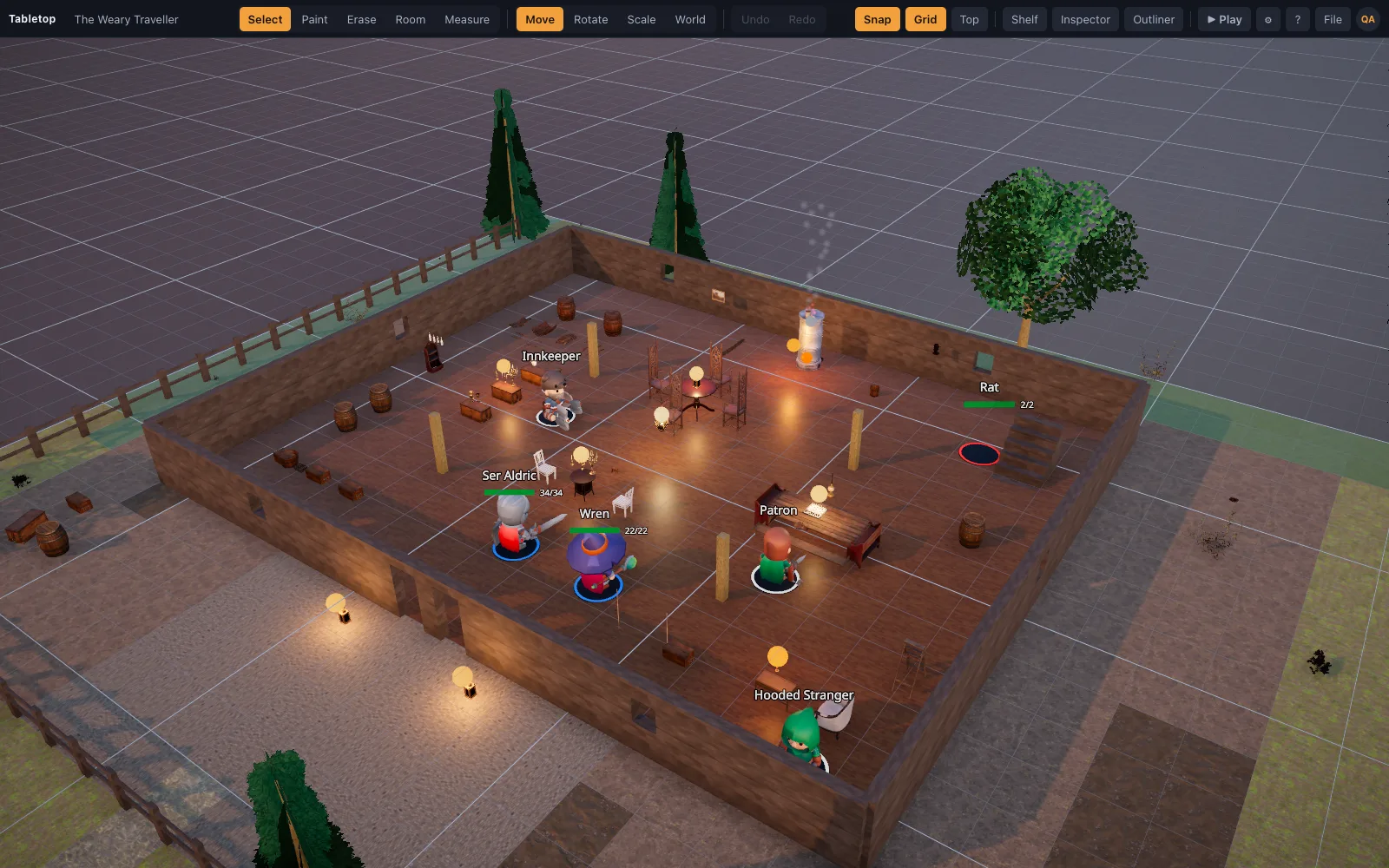
If you like both of these for being 3D but not for being Steam downloads bought per person, TerrainTale is a 3D table that runs in a browser, so players join from a link and pay nothing. It is narrower than Tabletop Simulator and built for one thing, the battle map: a room tool, tile, terrain and water brushes, realistic miniatures, a ruler in feet with height, initiative, HP, conditions, dice and fog the DM brushes on. There is no physics sandbox, no character sheets or rules automation, and no voice or video. The free plan keeps one saved scene; Premium, $6 a month or $48 a year, keeps up to 200 and imports your own models.
Questions
Is TaleSpire or Tabletop Simulator better for D&D?
TaleSpire, for most groups, because it is built for RPGs. Tabletop Simulator is better if you want one tool for many kinds of game.
Does everyone need to buy TaleSpire or Tabletop Simulator?
Yes, both are bought per person on Steam.
Can Tabletop Simulator run D&D?
Yes, with Workshop assets and mods; it is a sandbox, so you assemble the RPG tools yourself.
Do either run in a browser?
No, both are desktop downloads. Browser 3D tabletops such as TerrainTale need no install.
Which has more content?
Tabletop Simulator's Workshop is far larger overall. TaleSpire's content is more focused on RPG building.
Keep reading
TaleSpire alternative
A browser-based TaleSpire alternative: realistic 3D battle maps with photoscanned props, no download or purchase, a free sign-up, and a builder that makes a map in minutes.
Tabletop Simulator alternative
A Tabletop Simulator alternative for D&D: a 3D tabletop built around the 5-foot grid, with a ruler in feet, initiative and HP and realistic maps.
TaleSpire vs Foundry VTT
TaleSpire vs Foundry VTT compared: a 3D tabletop on Steam against a self-hosted 2D platform with automation.
Best Virtual Tabletop in 2026: Picks by What Your Table Needs
The best virtual tabletop in 2026, grouped by need: free, automation, beginners, 3D, in-person on a TV, self-hosted and any system.
3D Virtual Tabletop (3D VTT): Free, in the Browser
A 3D virtual tabletop that runs in a browser tab: realistic battle maps with walls, light and height, painted-miniature figures, a ruler in feet and initiative.
From the blog
Throne room battle maps: the audience chamber as an arena
How to build a throne room battle map for D&D: the dais, the columns, the long approach, guards at the doors and where a fleeing monarch goes, with sizes in 5-foot squares.
· 5 min read
Climbing rules in 5e combat: what it costs, when to roll, and fighting from a ledge
The D&D 2024 climbing rules in combat: 1 extra foot per foot climbed, when a DC 15 Athletics check is warranted, what a ledge gives the creature on it, and what happens when a climber is shoved.
· 5 min read
Invisible creatures on a grid: the 2024 rules and how to run them without cheating
The D&D 2024 rules for invisible creatures on a battle map: advantage and disadvantage, guessing a square, why invisible is not hidden, and how to track an unseen enemy on the grid fairly.
· 5 min read
All articles on battle maps, grid rules and running the game
Ready to put a map on the table?
Open the builder and start, no account needed. Sixteen starter scenes are on the welcome screen; sign up free when you want to save one or play it with your group.