Roll20 vs Foundry VTT
Roll20 and Foundry VTT are the two names most groups weigh first. Roll20 is a hosted browser service with a free tier and subscriptions; Foundry is a one-time licence you host yourself, with a deep module ecosystem. Neither is simply better: they trade convenience for control.
Side by side
| Topic | Roll20 | Foundry VTT | TerrainTale |
|---|---|---|---|
| Pricing model | Free tier; paid subscriptions (roughly $6-11 a month) for more storage and features | One-time licence for the GM ($50 at the time of writing); players join free | Free plan with one saved scene; Premium $6/mo or $48/yr |
| Hosting | Hosted for you in the browser | Self-hosted on your PC or a server, or paid hosting such as The Forge | Hosted, or self-host the single Node server |
| Setup effort | Low: create a game and invite players | Moderate: install, open a port or rent hosting, pick a system and modules | Low: sign up, open a starter scene, share a link |
| Rules automation | Character sheets and roll templates for many systems; deeper automation with the API on higher tiers | Strong, through game systems and community modules | None by design; HP, conditions and initiative are tracked, rules stay with you |
| Official content | Large marketplace including licensed D&D books | Growing set of licensed premium modules plus community content | No rulebook content; a realistic 3D asset library |
| Maps | 2D image maps with dynamic lighting and fog | 2D image maps with strong lighting, walls and fog | Built 3D scenes with light, shadows and height; fog brush |
| Voice and video | Built-in options | Built-in WebRTC options | None; use Discord or similar |
| Customisation | Moderate; API scripts on the top tier | Very high; thousands of modules | Scene JSON export and import, your own models on Premium |
| Learning curve | Gentle to start, fiddly at depth | Steeper, especially with many modules | Short; a map, minis, a ruler and a turn order |
| Best known for | Getting a group online fast | Automation and control for GMs who like to tinker | A 3D battle map that runs in a browser |
Roll20 and Foundry VTT are trademarks of their respective owners and are not affiliated with TerrainTale. Prices and features are described in general terms as we understand them at the time of writing and change often; check each product's site for current details.
Who should pick Roll20
Groups that want to be playing tonight without installing anything, and GMs who buy official adventures and want them ready to run. The free tier is enough to try a campaign, and players only need a browser and an account.
Who should pick Foundry VTT
GMs who enjoy setting things up once and then letting the software handle attacks, damage, effects and templates. The one-time licence appeals to long campaigns, and self-hosting means your data stays where you put it. Expect to spend an evening or two learning modules before it feels effortless.
Price over a year
Roll20 costs nothing on the free tier and a monthly or yearly fee for the paid tiers, so a year of the entry paid tier costs about as much as a Foundry licence. Foundry is a single payment for the GM, but if you do not want to run it from your own machine, a hosting service adds its own subscription. Both prices change; check the current figures before deciding.
Learning curve and setup
Roll20 asks for less up front but can feel clumsy as a campaign grows. Foundry asks for more up front (installation, a game system, a handful of modules) and pays it back with automation. A useful rule of thumb: if nobody at the table enjoys configuring software, start with Roll20.
Where a 3D browser table fits
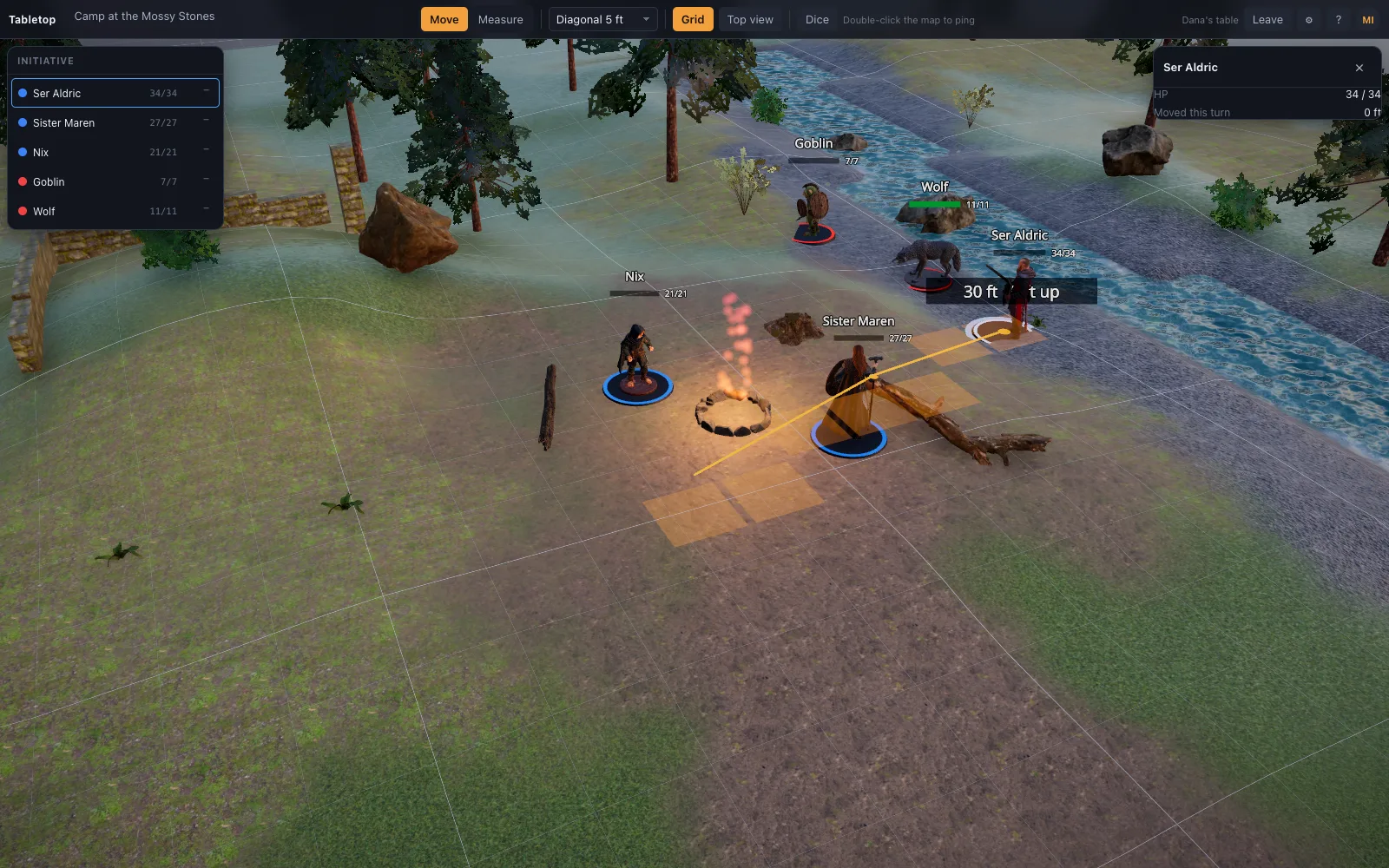
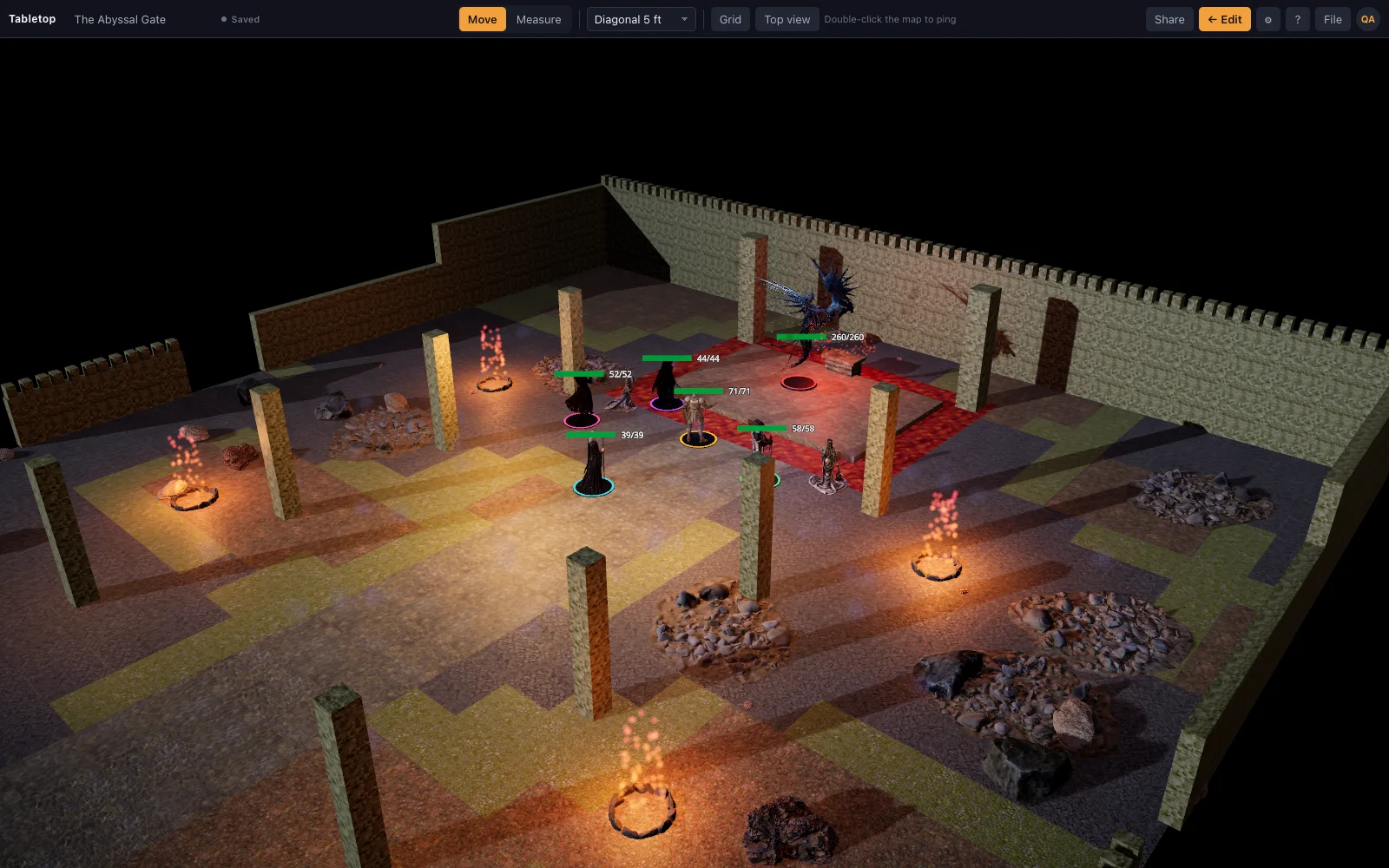
If the Roll20-or-Foundry question is really about getting a map in front of the group, TerrainTale is a third answer that skips both trade-offs: nothing to install or host, and no subscription needed to start. It is a 3D table in the browser for the battle map only. Scenes are built with a room tool, tile, terrain and water brushes and a realistic library; the ruler counts feet with height; initiative, HP, conditions, a dice roller and a fog brush cover the fight. There are no character sheets, rules automation or voice and video, so it sits beside whatever holds your sheets rather than replacing it. The free plan keeps one saved scene; Premium, $6 a month or $48 a year, keeps up to 200 and imports your own models.
Questions
Is Roll20 or Foundry better for beginners?
Roll20 is usually easier for a first campaign because there is nothing to install or host. Foundry rewards GMs who are willing to learn its setup and modules.
Is Foundry VTT cheaper than Roll20?
Over a long campaign it often is: Foundry is a one-time licence for the GM, while Roll20's paid tiers are monthly. Roll20's free tier costs nothing, and Foundry hosting services add a monthly fee if you use one.
Do players have to pay for Roll20 or Foundry?
Generally no. Players can join Roll20 games on a free account, and Foundry players join a GM's licensed game without buying their own.
Which has better automation for D&D 5e?
Foundry, with the right system and modules, is widely regarded as the deeper automation option. Roll20 handles rolls and sheets well, with heavier scripting reserved for its top tier.
Can I switch from Roll20 to Foundry later?
Yes, though there is no perfect one-click move. Community tools can carry some content across, and purchased books are tied to the platform you bought them on.
Keep reading
Roll20 alternative
A Roll20 alternative for groups who want a realistic 3D map and none of the overhead: no character sheets, no macros, a ruler in feet, initiative and HP.
Foundry VTT alternative
A lightweight Foundry VTT alternative: 3D battle maps out of the box, no modules to install or maintain, a free sign-up and a self-hostable server.
Foundry VTT vs Fantasy Grounds
Foundry VTT vs Fantasy Grounds: two automation-heavy virtual tabletops compared on price, hosting, official content and learning curve.
Best Virtual Tabletop in 2026: Picks by What Your Table Needs
The best virtual tabletop in 2026, grouped by need: free, automation, beginners, 3D, in-person on a TV, self-hosted and any system.
How to Play D&D Online with Friends: Free, Nothing to Install
How to run D&D online with friends: voice on Discord, a free browser tabletop for the map, sheets and dice, and how to keep remote sessions fun.
From the blog
Opportunity attacks on a grid: what provokes and what does not
The 5e opportunity attack rule in plain terms: the one trigger that provokes, the moves that never do, how to read threatened squares on a battle map, and the cases tables argue about.
· 5 min read
Sigil is shutting down. Here is what to do before the end of October
D&D Beyond's Sigil 3D VTT closes at the end of October 2026. A practical checklist: what to save, what cannot be exported, and how to rebuild your maps in a browser-based 3D tabletop.
· 6 min read
How to make a D&D battle map without losing a weekend
A repeatable method for building battle maps fast: block the shape, floor and wall it, light it, then dress it. With the three mistakes that cost the most table time.
· 8 min read
All articles on battle maps, grid rules and running the game
Ready to put a map on the table?
Open the builder and start, no account needed. Sixteen starter scenes are on the welcome screen; sign up free when you want to save one or play it with your group.