Reading a battle at a glance with hostile, ally and neutral base rings
A dozen minis on a map is a wall of shapes until you know who's on whose side. TerrainTale colours the ring under each base by disposition — hostile, ally, neutral — so that answer is visible before you've read a single name, and it stays visible whether the mini is an animated character or a standee cut from a picture.
· 5 min read · TerrainTale
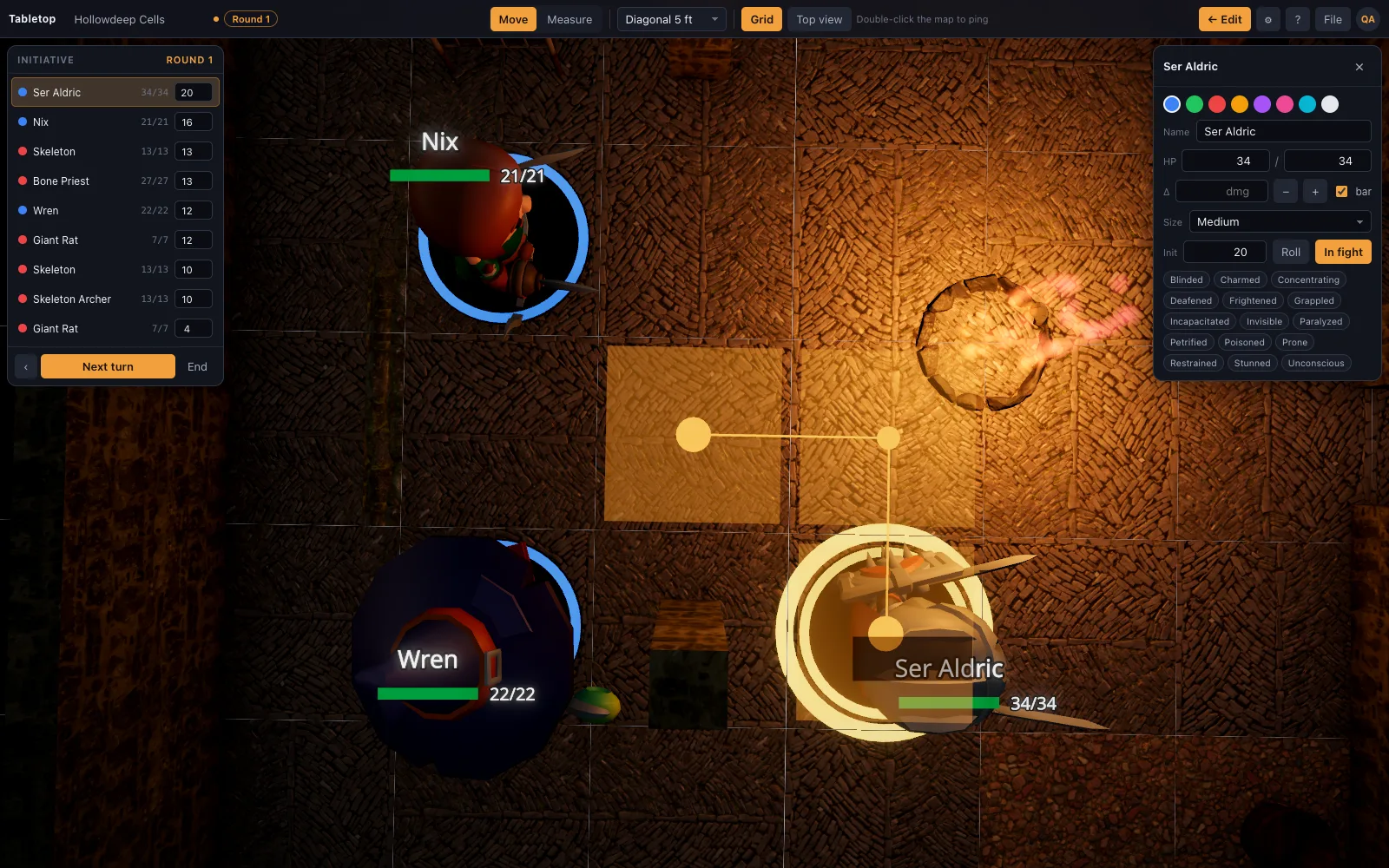
Colour answers the first question of every turn
Base rings in ally, hostile and neutral colours sit under every mini on the table, animated or standee alike. Across a crowded battle map that colour answers 'is this on my side' before you've had to click anything or read a name — a genuine speed advantage once a fight passes six or seven combatants.
Paired with size, HP and the turn glow
A name and HP sit beside each mini in large type, a Large or bigger creature fills the squares its size actually takes, and a glow marks whose turn it currently is. None of that replaces the disposition ring — it stacks with it, so the table carries four separate readable signals (who, how big, how hurt, whose turn) without opening a single panel.
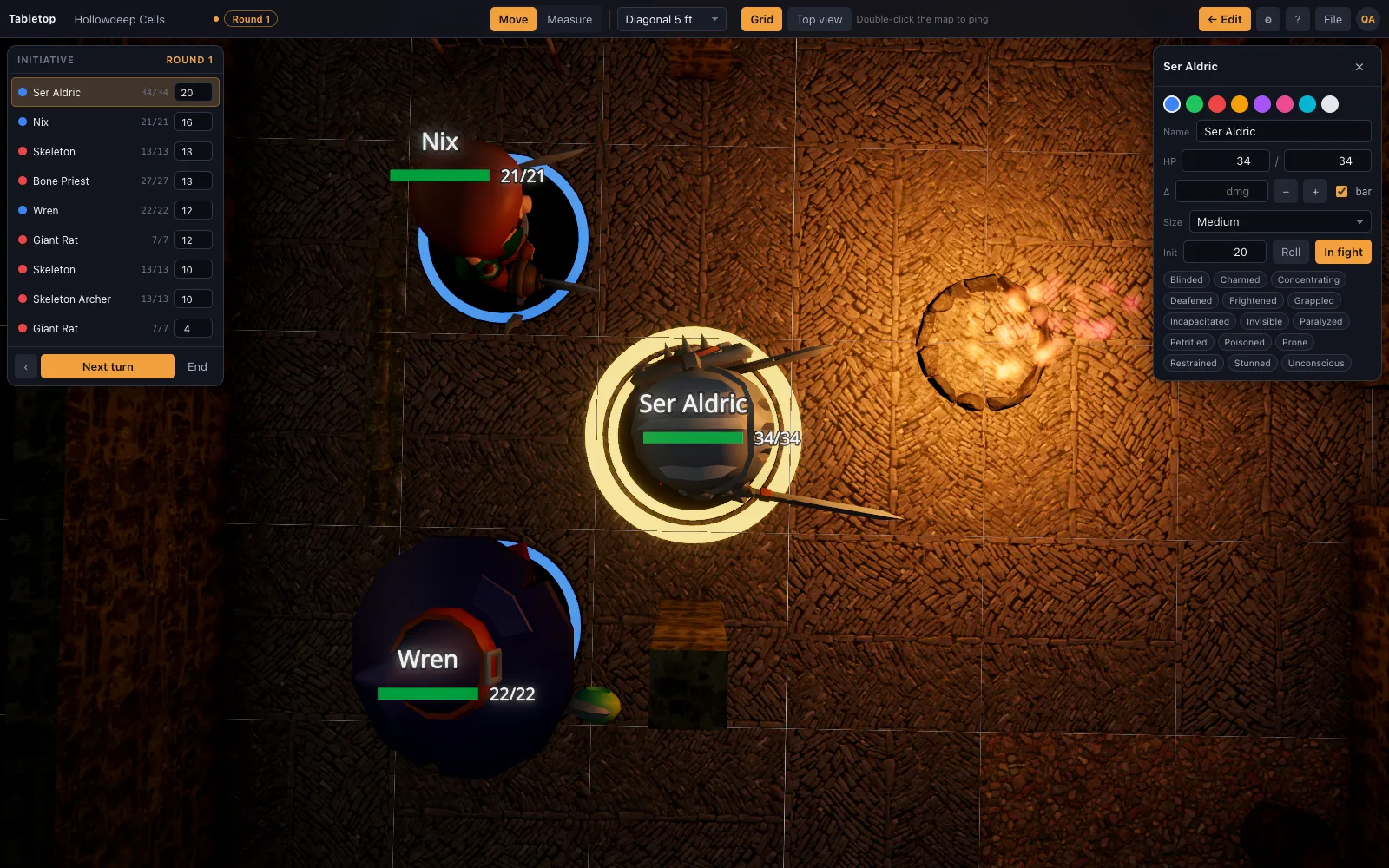
Setting disposition doesn't touch the rules
Marking a mini hostile, ally or neutral is a labelling choice for the table, not a rules mechanic — it doesn't grant advantage, doesn't restrict targeting, and doesn't decide who can be attacked. TerrainTale tracks position, HP, conditions and turn order; the disposition ring is there so a DM or player reads the map faster, and every actual ruling still comes from the book.
Works the same for a standee as for a built-in mini
A monster made from a dropped-in image gets the same base ring as an animated KayKit character. That matters because most tables' rosters are a mix — the party as rigged minis, most monsters as standees — and a colour system that only worked on one kind would defeat the point.
Why this matters more as a fight grows
A duel between two minis needs no colour system at all — you already know who's who. The value shows up once a fight scales to a full party plus a pack of monsters plus a couple of summoned allies: ten or twelve bases on the table at once, several of them added mid-encounter, some of them reinforcements that arrive without warning. Disposition rings keep that crowd sortable at a glance instead of turning into a game of 'wait, whose skeleton is that.'
It also helps a table that includes spectators or a second screen — someone glancing at a shared room from across the couch, or a player who stepped away and is catching up — read the state of the fight without asking anyone to explain it.
A small signal that saves real table time
None of this is complicated on its own — a coloured ring is a small thing. What it saves is the accumulated seconds of 'wait, is that one ours' repeated across every round of a long fight, multiplied by everyone at the table asking the same question independently. Over a two-hour session that adds up to real minutes back, and it costs nothing to set: disposition is chosen once when a mini is placed and rarely needs touching again.