Autosave and scene slots: never losing a map mid-session
The worst moment to lose a battle map is fifteen minutes before the session it was built for. TerrainTale's answer isn't a save button to remember — it's autosave running continuously, backed locally so a dropped connection or a closed tab doesn't cost the work.
· 5 min read · TerrainTale
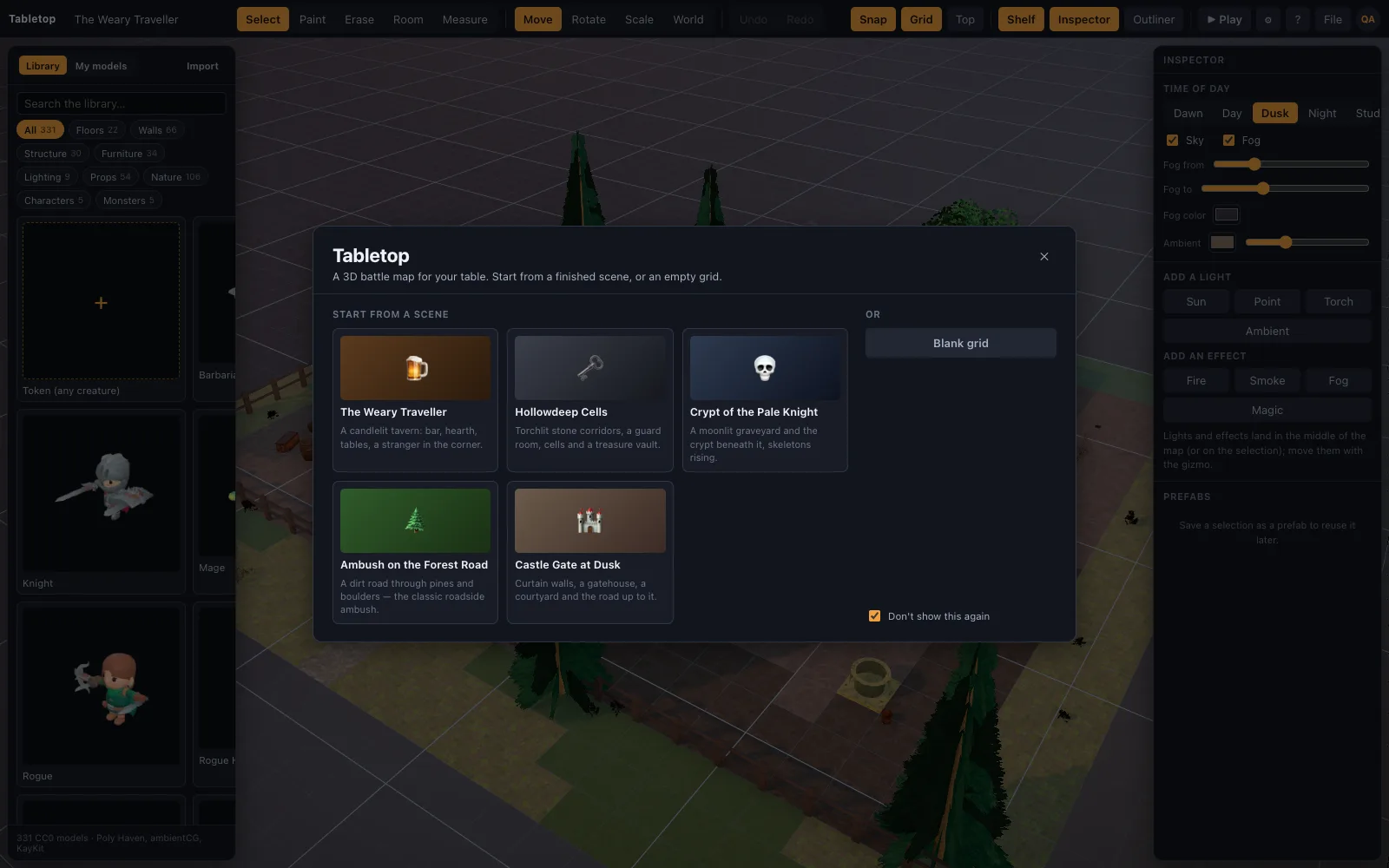
The open scene saves itself
The scene you're editing autosaves to your account automatically as you build, with no save button to remember and no "you have unsaved changes" dialog to dismiss on the way out. It's also backed by IndexedDB locally, so the table survives a reload or a lost connection — the work in progress isn't only living in a server round-trip that could fail at the wrong moment.
When a save can't go through, it pauses instead of looping
If a save is refused — most commonly because a free-plan account is trying to add a new scene past its one-scene limit — the autosaver pauses rather than retrying every few seconds in a loop that would just fail again. It resumes automatically once the reason clears: upgrading the plan, or deleting a scene to free the one slot. The status pill in the app reflects this directly, showing 'Not saved · plan full' rather than pretending the save succeeded.
One slot on the free plan, two hundred on Premium
How many scenes autosave can actually create is a plan limit, not a technical one: the free plan keeps one saved scene in your library, and Premium keeps up to 200. The limit only applies to adding a new scene — re-saving, renaming and deleting a scene you already have are never blocked by it, on either plan.
What happens at the limit
Hitting the limit — opening a blank grid, a template, an import, a copy, or an autosave the server refused — opens a dialog offering to upgrade or delete a scene to make room, rather than silently discarding what's on the table. The unsaved work stays put either way, so hitting the limit costs a decision, not the scene itself.
Autosave versus a deliberate export
Autosave keeps the scene in your account's library as you build, which covers the common case of not losing progress. It's a different thing from exporting a scene as a portable JSON file — a deliberate action for backing a scene up outside the app, moving it between accounts, or handing it to someone else. Both matter, but autosave is the one running in the background the whole time you're working, without you doing anything to trigger it.
Because the two are separate, you can lean on autosave for the day-to-day safety net and still take a deliberate export before something risky — trying a big change you might want to undo wholesale, or handing the file to a co-DM — as a second layer that doesn't depend on the account's saved-scene slot at all.
IndexedDB, and what it means in practice
IndexedDB is the browser's own local database, which is what lets the current scene keep working — and keep saving locally — even mid-reload or with the network briefly down, before the next successful sync to your account catches it up. That's a meaningfully different guarantee from an app that only saves over the network: a flaky hotel wifi connection at a convention, or a laptop that drops a session's wifi mid-build, doesn't cost the table its progress.