Starting from a finished map instead of a blank grid
A blank grid is the biggest reason a battle map never gets built: it asks for a floor plan, a lighting pass and a dressing pass before it's worth showing anyone, and a Thursday session doesn't leave room for all three. File ▸ New from Template skips straight past that by handing you a finished scene instead.
· 4 min read · TerrainTale
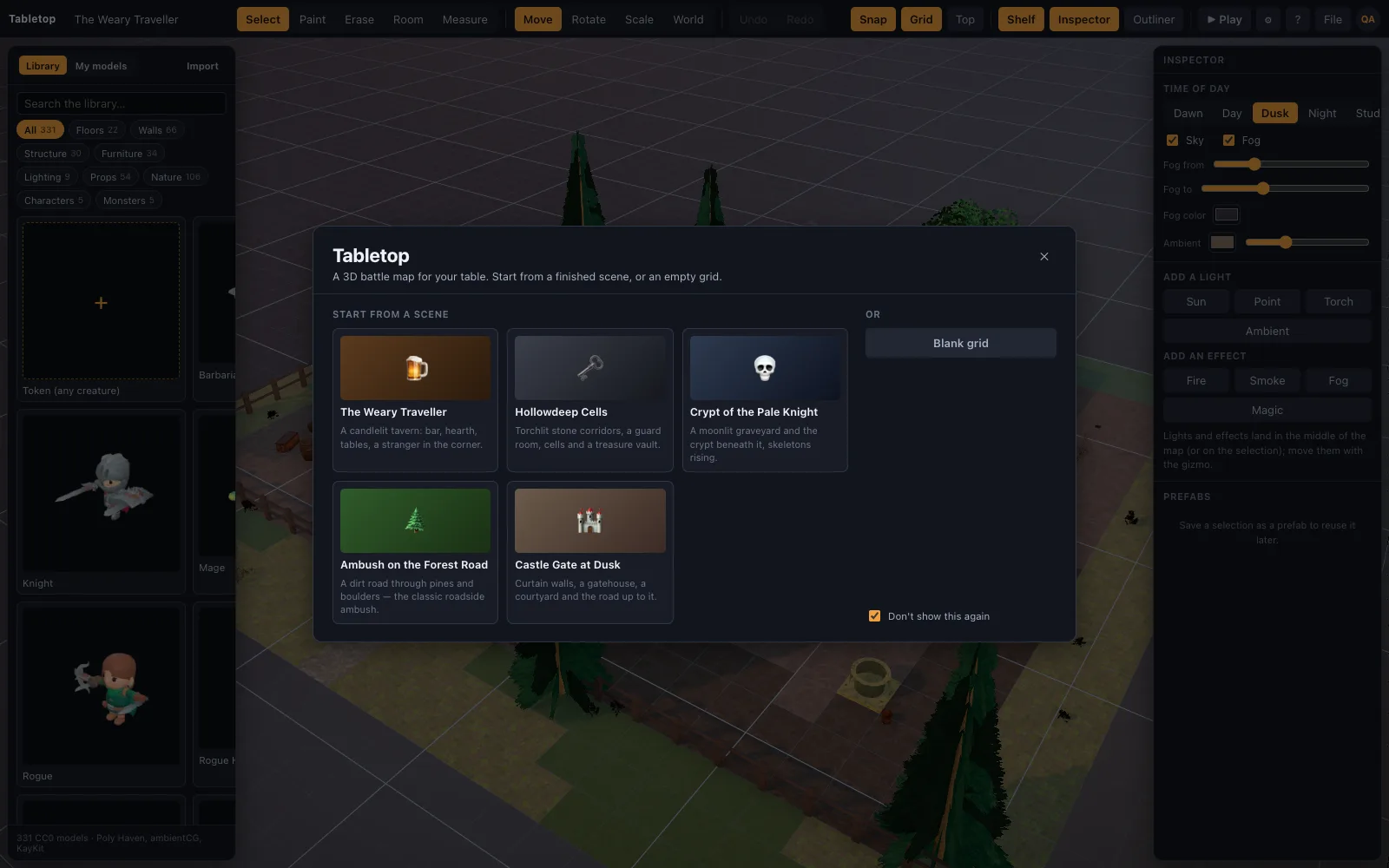
The blank-grid problem
Every map-building guide for this app starts the same way: decide the fight before you draw a wall, because a floorplan with no plan behind it is where sessions die on a Thursday afternoon. A starter scene sidesteps the problem for the most common encounters entirely — the floor, walls, lighting and dressing are already decided.
One step: built and saved
File ▸ New from Template opens the same picker as the welcome dialog: pick a scene — The Weary Traveller, Hollowdeep Cells, Crypt of the Pale Knight, Ambush on the Forest Road, or Castle Gate at Dusk — and it's built and saved to your account in one step, listed in File ▸ My Scenes like any scene you'd built by hand.
It's a real starting point, not a demo
A starter scene isn't a locked preview; it opens fully editable, same as a blank grid would, and it's built from the same realistic, CC0 library as anything else. The only difference from a scene you build from scratch is that someone already made the floorplan and lighting decisions for you.
When a blank grid is still the right call
A starter scene fits a common shape — a tavern room, a dungeon corridor, an outdoor ambush, a fortification. A genuinely unusual space, a very large set-piece, or a location central to your own campaign is still worth building from a blank grid, following the shape-first method: decide the fight, then the floorplan, then lighting, then dressing.
A template also teaches the shape-first method
Opening a starter scene and looking at how it's built is a fast, concrete way to learn the same order of operations the building guide recommends: the floorplan and walls come first, lighting next, dressing last. Seeing a finished example of that order applied to a real room makes the method easier to copy on your own blank-grid scenes later, instead of just reading it as advice.
Templates and blank grids aren't in competition
The right way to think about File ▸ New from Template isn't 'templates instead of building maps' — it's one more starting point alongside a blank grid, useful for exactly the sessions where there isn't time to build from scratch. A DM who enjoys building will still reach for a blank grid most weeks; a DM who's short on time before Thursday has a finished option that doesn't compromise on quality to save that time.
A safety net for a session that runs long
A starter scene is also useful mid-campaign as a fallback: if a session runs toward an encounter nobody prepped a map for, loading a starter scene that roughly fits — a tavern for an unplanned brawl, a forest road for a sudden ambush — beats running a fight with no visual at all, and takes less time than building anything from a blank grid on the fly. Save a Copy afterward if the improvised version is worth keeping for a future session.