XP to Level 3's targeted attacks video: do called shots work in D&D 2024?
On 10 September 2026 the YouTube channel XP to Level 3 published Your Combat Could Be Wayyyyy More Dynamic, a nine-minute video that had passed 100,000 views by 17 September. Its pitch is a homebrew rule for targeted attacks, called shots at the head, the eyes, a leg, an arm or the weapon in an enemy's hand, lifted from the channel's own Fallout-style game, Vault Breaker. The host, in his Guy Combat persona, argues that D&D's roll, miss, roll, hit rhythm bores players and that a rule for aiming at body parts fixes it. The rule is fun and it is also a grenade. Here is what it says, what the 2024 rules already offer, and what it does to a fight on a map.
· 5 min read · TerrainTale
What the video proposes
A targeted attack in the video's version costs both your action and your bonus action, and because it is a special attack it does not benefit from Extra Attack: a level 11 Fighter makes one called shot instead of three swings. You take a penalty to the attack roll that depends on the body part. If you hit, you roll a damage modifier die and multiply your damage by it, and the part hit adds an effect: an eye shot blinds for a turn, a leg shot stops the target Dashing for a turn.
The rule escalates with Bloodied, the 2024 glossary term for a creature at half its hit points or fewer. If a targeted hit leaves the target Bloodied, or it already was, the limb is crippled: the effect lasts until the target's hit points return to full, a crippled arm costs 2d4 damage each time it is used, and a targeted weapon flies 1d6 times 5 feet away. A Critical Hit may sever the limb or destroy the object outright. The host allows that this can kill an enemy in one turn, and his answer is that enemies can do it too, and that he likes combat to feel dangerous.
- Cost: action plus bonus action; no Extra Attack.
- To hit: a penalty by body part.
- On a hit: damage multiplied by a rolled modifier, plus an effect.
- Target Bloodied: the limb is crippled until full hit points; weapons fly 1d6 times 5 feet.
- Critical Hit: sever or destroy.
What the 2024 rules already do
The 2024 Player's Handbook has no called shots and no rule for hitting a body part; hit points are abstract and an attack roll is already the attempt to land the best blow you can. But several of the video's effects exist in the rules under other names. Weapon Mastery gives martial characters a rider on every hit: Topple knocks the target Prone on a failed Constitution save, Slow cuts its Speed by 10 feet, Sap gives its next attack Disadvantage, Push moves it 10 feet. A Battle Master's Disarming Attack makes the target drop what it holds. The Blinded condition is a single spell or a Topple-plus-grapple away.
The difference is cost. Mastery riders are free on a normal hit; the video's called shot costs an entire turn and a penalty for a bigger, swingier payoff. Under the 2014 rules the comparison is starker, since there is no Weapon Mastery and disarming was an optional action in the Dungeon Master's Guide; a table on the 2014 books gets more from the homebrew than a table on the 2024 books does.
Does the maths hold up?
Take the video's own example: an arrow at a charging bugbear, an 8-damage hit multiplied by a rolled 2 for 16. A level 5 Fighter with two normal attacks at 1d8 plus 3 expects roughly 15 damage across both if both hit, and keeps her bonus action. The called shot trades the second attack and the bonus action for a penalty to hit and a multiplier that averages 2 on a d3. Against a single big target that is close to a wash on damage and a clear win on effects; against three goblins it is a clear loss, because the multiplier cannot be split.
Where it breaks is the top end. A multiplier on a Paladin's Divine Smite, a Rogue's Sneak Attack or a spell's damage dice, and the video says a Fire Bolt qualifies, turns one lucky roll into a boss dying in round 1. The host's suggested brakes are the right ones: apply the crippling and Critical effects only to Bloodied targets, make helmets raise the penalty for the head, and drop the head-explodes result. With those, it is a Bloodied-phase finishing rule rather than an opener, and that is a reasonable thing for a table to want.
How it plays on a grid
Two of the effects are map effects. A weapon that flies 1d6 times 5 feet lands 1 to 6 squares away, and the ruling that matters is who chooses the direction; the fair answer is the attacker chooses, and the disarmed creature spends movement and its free object interaction to get it back, or its whole action if the weapon landed behind an enemy. A crippled leg is a Speed question: the video says no Dash, and a table could halve Speed instead, which on a 5-foot grid is 3 squares for most creatures and changes every chase.
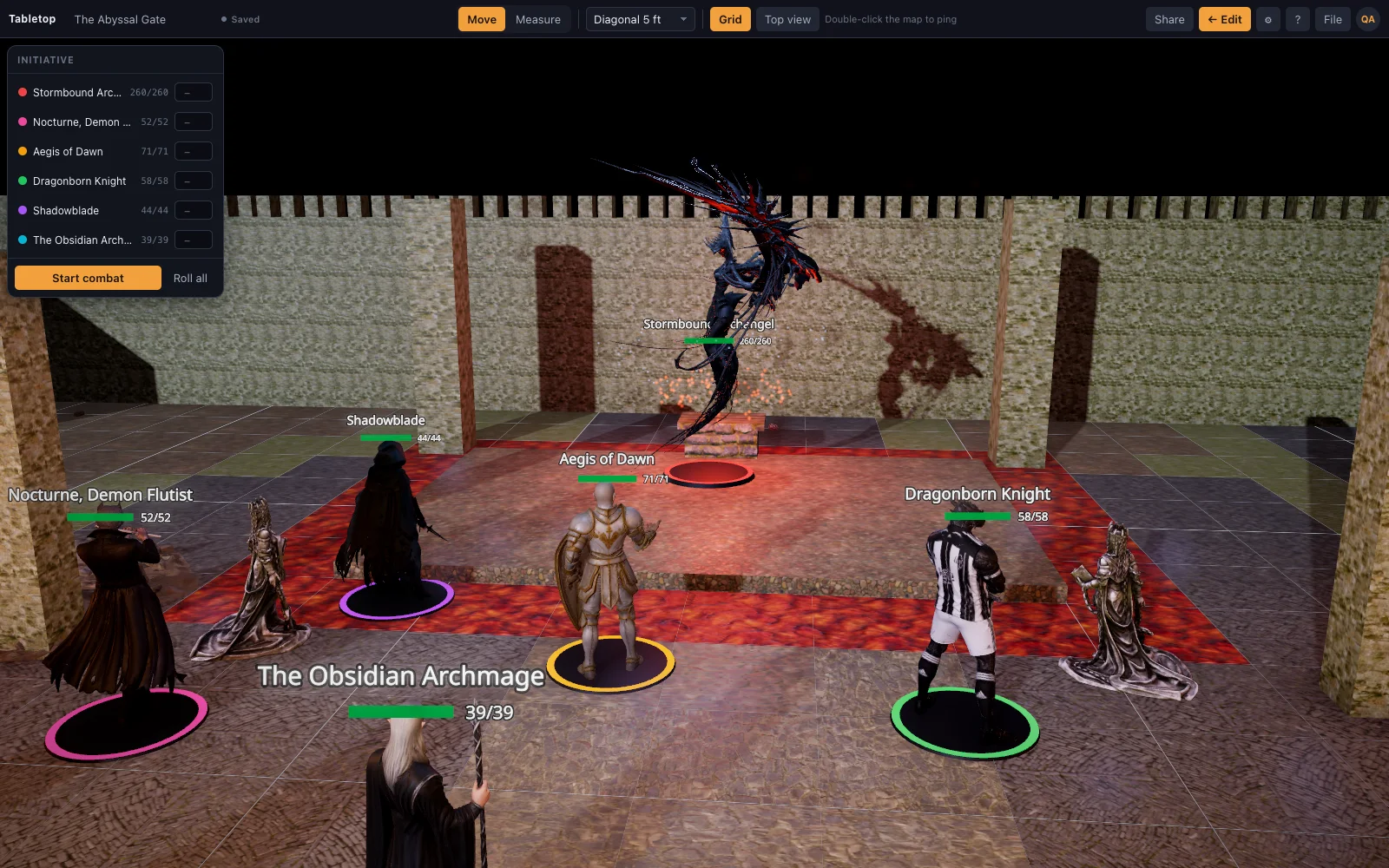
The other map effect is Bloodied itself. If crippling turns on at half hit points, every player needs to see when a monster crosses the line, which means open hit point bars or the DM calling it. TerrainTale's play mode shows a hit point bar on every mini, so the Bloodied moment is visible to the table without anyone asking; the crippled limb is a note beside the token, since no tracker has a slot for a broken arm.
Monsters with the wrong parts
The video hands this part to the viewer. A dragon's wings are treated like legs, a second head like a head, a beholder's eyestalks as eyes that can be shot out one at a time. The host's own suggestion is that a hit on a dragon's wing should slow its flight rather than ground it, which is good instinct: an effect that removes a monster's signature ability in one shot removes the encounter. A table adopting the rule should write each monster's parts and effects on the stat block before the fight, not improvise them under pressure from a player who has just rolled a 20.
Should you use it?
Use it if your table wants swingier fights and plays the 2014 books, where it fills a real gap. On the 2024 rules, try Weapon Mastery and the Battle Master first; most of what players want from a called shot, the trip, the disarm, the slowed leg, is already on the sheet at no cost. If you still want the head shot, take the video's braked version, apply it only to Bloodied targets, and remember the host's own warning that the goblins get it too.