Critical Role Campaign 4: how its three tables actually work
Critical Role's fourth campaign began on 2 October 2025 and did something the show had never tried: thirteen players, one world, and a West Marches structure that splits them across separate tables whose actions bleed into each other. By mid-September 2026 it was past thirty episodes and back from a summer break. The structure is more interesting than the episode count, because it is the part a home group can actually copy.
· 6 min read · TerrainTale
The shape of the campaign
Campaign 4 is set in Aramán, a new world rather than Exandria, where the first three campaigns took place. Brennan Lee Mulligan is the Game Master, which puts Matthew Mercer at the table as a player for the first time in the show's history. It uses the 2024 Dungeons and Dragons rules.
The roster runs to thirteen players: Laura Bailey, Luis Carazo, Robbie Daymond, Aabria Iyengar, Taliesin Jaffe, Ashley Johnson, Matthew Mercer, Whitney Moore, Liam O'Brien, Marisha Ray, Sam Riegel, Alexander Ward and Travis Willingham. The setting premise is a fractured world shaped by the death of gods and the aftermath of a rebellion, which gives every sub-group a reason to be pursuing something different.
Three tables: Soldiers, Seekers, Schemers
After a four-episode overture with the whole cast together, the players divided into three standing groups. The Soldiers' table is Travis Willingham as Teor Pridesire, Laura Bailey as Thimble, Robbie Daymond as Kattigan Vale, Whitney Moore as Tyranny and Sam Riegel as Wicander Halovar. The Schemers' table is Liam O'Brien as Halandil Fang, Taliesin Jaffe as Bolaire Lathalia, Luis Carazo as Azune Nayar and Marisha Ray as Murray Mag'nesson. The remaining players form the Seekers.
Each table tells its own story, and the three stories affect one another. That is the West Marches idea: a shared world with a persistent state, visited by different parties at different times, where what one group does is waiting for the next group when they arrive. The names are doing work as well, since Soldiers, Seekers and Schemers describe three different approaches to the same fractured world rather than three regions of it, which is a looser reading of the format than the original dungeon-crawling version.
Why the format suits a show, and why it is hard
For a production, rotating tables solve a scheduling problem that a thirteen-player single table cannot. Nobody has to be available every week, an episode is four or five voices rather than fourteen, and a session still runs to a watchable length. The cost is continuity work: someone has to track what each table changed and make sure the consequences turn up.
Episode 33, titled Off-Balance, is a Schemers episode built around the politics of Dol-Makjar and a long theatre sequence. That is the format paying off. A five-hour full-cast session could not spend that time on one character, but a four-player table can, and the episode becomes a character piece without the campaign stopping.
What a home group can steal
You do not need thirteen players to use this. The transferable idea is a persistent world state with more characters than fit in one session. If your group of seven can never all make a Thursday, run whoever turns up as a party and let the world remember what they did. Attendance stops being a crisis and becomes an input.
The bookkeeping is the whole job, and it is less than it sounds. Keep one document with the date, who went where, what changed and what is now waiting. Three lines per session is enough. The commonest failure is not tracking too little but planning too much: a West Marches world only works if the players choose where to go, so build locations rather than plots.
- A map the players can see, with places marked and nothing assigned.
- A shared log of what each group did, in three lines per session.
- Consequences that wait: a door left open stays open for the next party.
- Characters who level at roughly the same rate, so any mix of players can go anywhere.
Running the same map for different parties
The practical snag with rotating tables is places. When three groups can visit the same ruin in any order, you want one version of that ruin that holds its state between visits, not three sketches that quietly disagree about where the stairs are. Paper maps drift, because the copy you drew in March is not the copy you redraw in June, and the party who burned the bridge will notice it standing again.
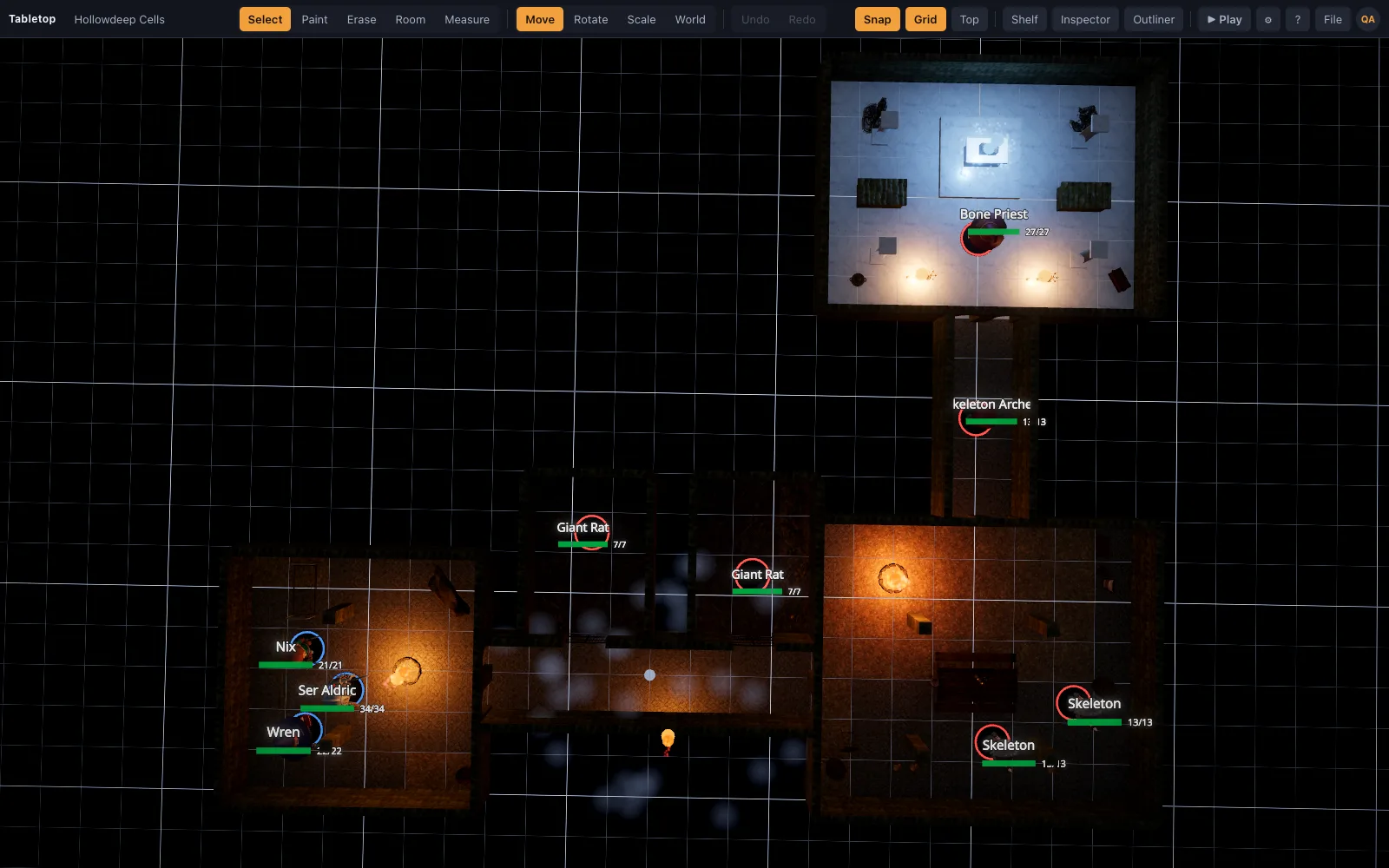
This is the one place where a virtual tabletop genuinely helps a West Marches game more than paper does. A saved scene is the same scene next month, and in TerrainTale a saved scene can be shared by link so whichever players turn up join the same table. The free plan keeps one saved scene and Premium keeps 200, which for a world with a lot of standing locations is the difference that matters.
Where to start watching
Thirty-plus episodes is a real commitment, but the structure makes it easier than a conventional campaign. Watch the four-episode overture for the world and the cast, then pick the table whose premise interests you and follow that thread. Because the tables are semi-independent, you can be behind on two of them and still follow the third.
Episodes air on Thursdays and are carried on the show's own channels. Check the official schedule rather than a third-party listing, since the show has shifted its slot more than once during 2026, including a summer break before the campaign resumed on 28 August 2026. Third-party trackers have also disagreed about episode numbering while three tables run in parallel, so the show's own episode list is the one to trust if you are trying to work out what you have missed.