Hiding rules in 5e combat: the DC 15 check, what you hide behind, and unseen attackers on the grid
Hiding in the 2024 rules is a fixed check with fixed conditions. You take the Hide action, you must be Heavily Obscured or behind Three-Quarters Cover or Total Cover, you must be out of every enemy's line of sight, and you must roll 15 or more on a Dexterity (Stealth) check. Succeed and you have the Invisible condition until you make a sound louder than a whisper, an enemy finds you, you make an attack roll, or you cast a spell with a Verbal component. That replaces the 2014 argument about whether the goblin could see you; on a grid it is a question about which square you are in.
· 5 min read · TerrainTale
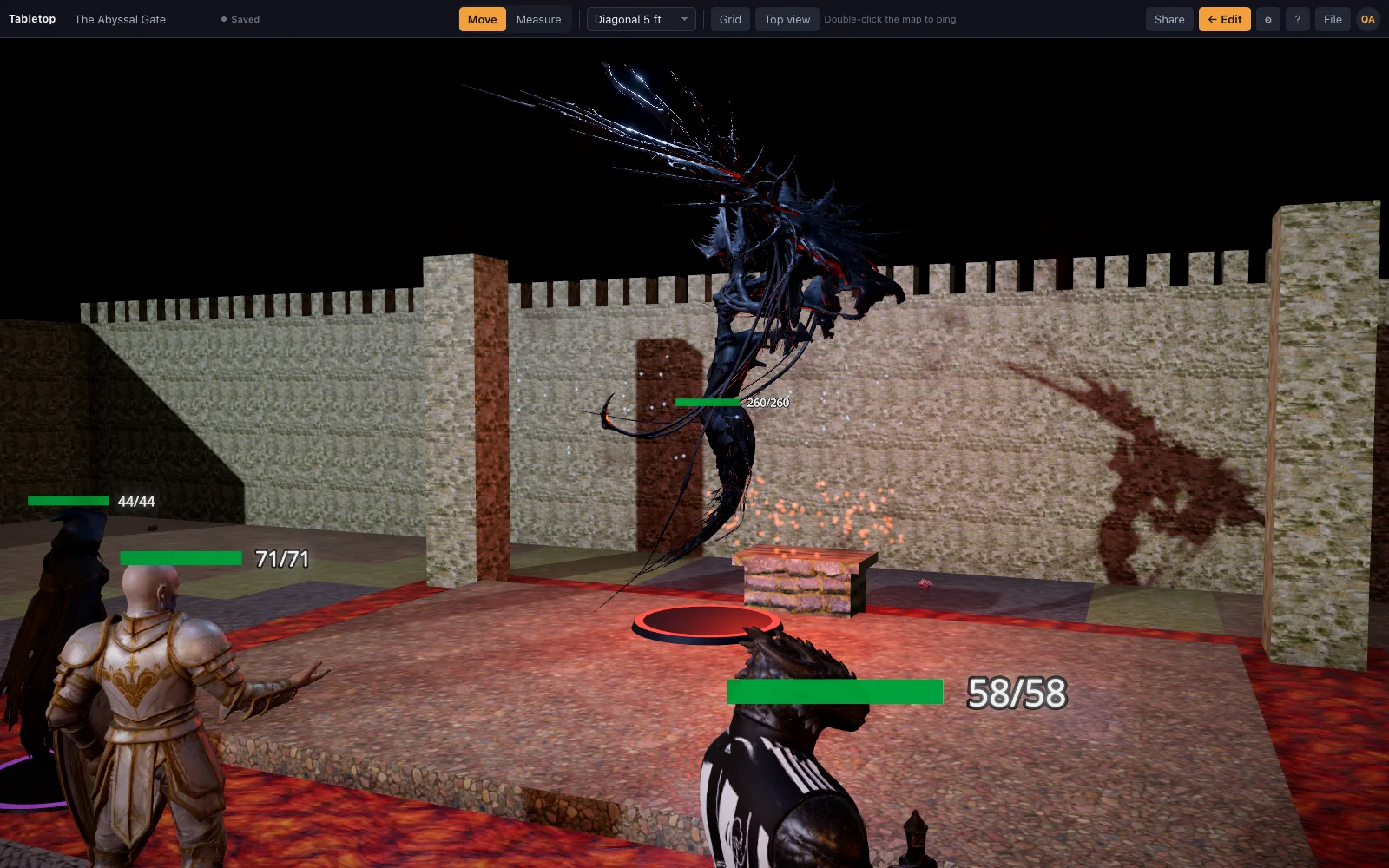
What you need to hide behind
The 2024 rule names the conditions. You can hide if you are Heavily Obscured, which is darkness, thick fog or dense foliage, or if you are behind Three-Quarters Cover, such as an arrow slit or a thick tree trunk, or Total Cover, such as a wall or a closed door. Half Cover is not enough: a low wall or a fellow creature does not let you hide. You also have to be out of every enemy's line of sight when you make the check; if you can see a creature, you can tell whether it can see you.
On a map that means a hiding square is one with a Three-Quarters or Total Cover object between it and every enemy, or one in darkness the enemies cannot see into. It is a stricter list than most tables used under the 2014 rules, where the DM decided whether the circumstances allowed hiding at all, and it makes the rogue's turn a matter of finding the right square.
- Heavily Obscured: darkness, thick fog, dense foliage.
- Three-Quarters Cover: arrow slits, thick tree trunks, a doorway edge.
- Total Cover: a wall, a closed door, a pillar wider than you.
- Not enough: Half Cover, dim light, a friendly creature in the way.
The check and what it gives you
The Hide action is a DC 15 Dexterity (Stealth) check. Note the total: that number becomes the DC for any creature trying to find you with a Wisdom (Perception) check. On a success you have the Invisible condition, which in the 2024 glossary means three things: you have Advantage on Initiative rolls, you are concealed from anything that requires seeing you, and attack rolls against you have Disadvantage while yours have Advantage, unless the creature can somehow see you.
The condition lasts until one of four things happens: you make a sound louder than a whisper, an enemy finds you, you make an attack roll, or you cast a spell with a Verbal component. So a hidden rogue gets one attack with Advantage, and the attack ends the hiding whether it hits or misses. Moving does not end it by itself; walking out from behind the pillar into an enemy's view does, because the enemy finds you by looking.
Being found: the Search action
An enemy that suspects you takes the Search action and makes a Wisdom (Perception) check against your Stealth total. Passive Perception matters too: a creature's passive score is 10 plus its Perception modifier, and a DM can use it to decide whether a guard notices a hidden creature without rolling. Where the enemy has Advantage on the check, add 5 to the passive score; Disadvantage subtracts 5, which is what dim light does to Perception checks that rely on sight.
The DM also decides when you are simply seen. A creature that walks round the pillar to your square finds you without a check, because you are no longer behind cover from it. That is the map deciding, and it is why the hidden token's square should be honest.
Unseen attackers
Two more rules cover attacking what you cannot see. When you make an attack roll against a target you cannot see, you have Disadvantage; you can attack the square you think it is in, and if the creature is not there, you miss. When a creature cannot see you, you have Advantage on attack rolls against it, and if you are hidden when you make the attack, you give away your location when it hits or misses.
So an archer in darkness shooting at a lit party has Advantage on every shot until the party's wizard casts Light on an arrow and fires it into the dark. That is the whole tactical value of light on a night map, and the reason a 3D table with real darkness makes hiding rules matter: the players can see where the light ends.
Marking a hidden token honestly
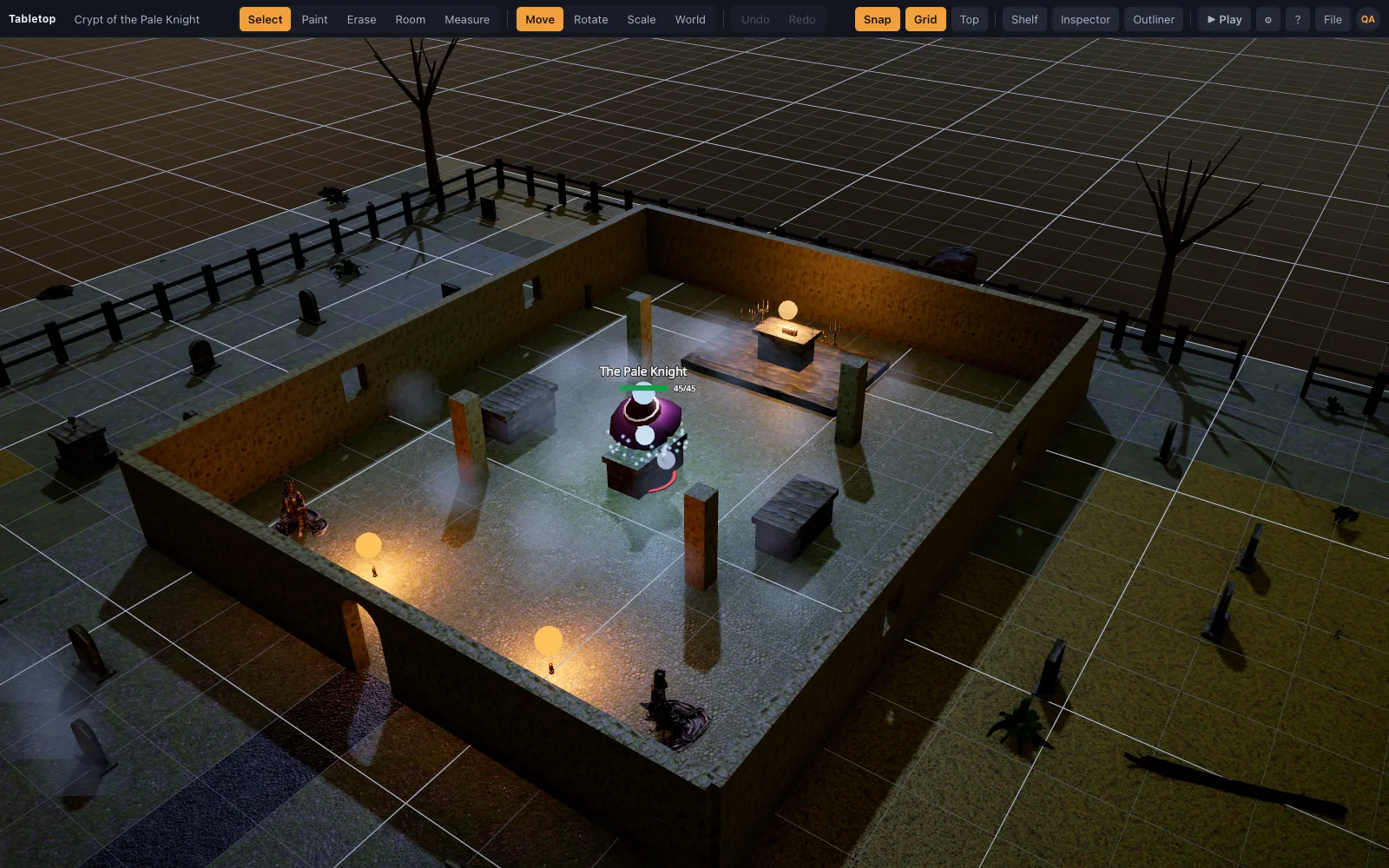
The problem at the table is the token. A hidden rogue is somewhere on the map, and if the mini sits in its square everyone sees it. The honest method is to leave the mini where it is and treat it as known only to the player and the DM, since the other players are not the enemies; monsters are the DM's and the DM knows the rule. For a hidden monster, keep the mini off the map and put it down when it attacks, at the square it attacks from, which is the moment the rule says its position is revealed anyway.
TerrainTale has no fog of war and no hidden-token mode, so this is a table habit rather than a feature: a hidden monster is a mini the DM has not placed yet, and a hidden character is a mini everyone agrees not to look at. On a 3D map with real darkness the agreement is easy, because the enemies genuinely cannot see the square.
What changed from 2014
The 2014 rules had no fixed DC and no list of what you could hide behind; the check was a contest against passive Perception and the DM decided whether hiding was possible, with the note that you cannot hide from a creature that can see you clearly. The 2024 rules set DC 15, name the cover and obscurement required, grant the Invisible condition, and list the four things that end it. The 2024 rules also removed the surprise round: a hidden ambusher gives surprised enemies Disadvantage on Initiative rather than a free turn. If your table plays the 2014 books, expect more arguments and more hiding.