D&D Beyond Maps in September 2026: Scene Prep, shared player journals, and what the roadmap promises
Between 31 August and 14 September 2026 D&D Beyond shipped the first pieces of the DM tooling it promised in its August roadmap. Scene Prep, a notes panel pinned to locations on a map, went live in Maps on 31 August. A free Theater of the Mind Organizer map reached every account on 8 September, alongside player-editable campaign journals and better hit point handling on tokens. On 14 September a patch added tagging to Scene Prep and fixed a server-side memory leak. None of it is a new virtual tabletop; all of it is Wizards making Maps the place a DM keeps the session, which is the more important move.
· 5 min read · TerrainTale
Scene Prep: notes pinned to the map
Scene Prep is a panel inside Maps, opened with the P key, where a DM writes the notes for a scene and pins them to a spot on the map. Each map can hold several scenes, created from the panel's menu, and each scene has a suggested framework, headers and bullet points the team built with designers and with first-time DMs, which the DM can ignore. Pins are dragged into place and can be hidden with the L key so the map stays clean while the reminders stay one click away. The post of 31 August 2026 puts the aim in one line: it lets you close another tab.
Content came with it. Five free Drop-in Encounters shipped with Scene Prep notes written by the D&D Beyond team, Cursed Ship, Harried Hideaway and The Snake Pit at level 1, Game Night at the Sand and Suds at level 2 and Shipwreck Troubles at level 3, and five of the subscriber-only weekly encounters were upgraded with plot hooks and read-aloud text. Brian Perry of the D&D Beyond team wrote in the comments that there is much more in store for DM tools that do not need Maps, and that Scene Prep was the thing the team could do quickly.
- 31 August 2026: Scene Prep live in Maps, five free encounters with prep notes.
- 8 September 2026: Theater of the Mind Organizer map on every account.
- 14 September 2026: Scene Prep tagging, prep list scrolling fix, memory leak fixed.
The Theater of the Mind Organizer
The odd item is a map for people who do not use maps. The Theater of the Mind Organizer is a blank-ish map in the free Basic Maps section whose only job is to hold Scene Prep pins, so a DM running an encounter in narration, or at a physical table, can still keep notes and read-aloud text in one place. The changelog for 8 September 2026 lists it as added to all accounts, which means free users get it without a Maps subscription.
It is a tell. D&D Beyond's staff have said in two places, the roadmap of 18 August 2026 and LaTia Jacquise's comment on the 2 September journals post, that the plan is to bring the tools being built in Maps out of the VTT. The Organizer is the first tool that already lives half outside it.
Player journals everyone can edit
The 2 September 2026 post covers the other half of the drop. The Player Journal in a campaign can now be edited by any player, with a lock while someone is typing so two people cannot overwrite each other; the DM keeps a private DM Journal alongside it, DM entries get the map's name as a header automatically, and pressing J during a Maps session opens a quick note without leaving the map. Entries support headers, lists, colours, emphasis and links, and the Player Journal is reachable outside a live session.
The 8 September changelog adds that hit point management on tokens was improved in the same release and that Arcana Unleashed, the sourcebook whose general release was 15 September 2026, became available to Hero tier subscribers on the platform from 8 September, a week ahead.
What the roadmap still owes
The 18 August 2026 mid-year roadmap listed what comes after Scene Prep. Custom uploads for Maps, drag-and-drop stickers, reveals and token art with persistent storage, described as coming soon. DM tools outside Maps, starting with a refreshed Encounter Builder that supports the 2024 rules. A new rules engine, built on an entity-component architecture the engineering manager Laura Thompson likened to video game design, being tested with a halfling rogue named Charlie, meant to carry future settings including Azeroth, Dark Sun and Dragonlance. A mobile app aimed at in-person play, likely early 2027. Semantic site search that knows D&D abbreviations and lets you pick 2014, 2024 or both.
The roadmap also named a Group Finder: local store events, a Discord looking-for-group channel, and a StartPlaying partnership offering sessions with professional DMs for 99 cents for a limited time. Storied Encounters, weekly drop-in scenarios rewritten around Scene Prep, were promised within a few weeks of the launch; the 14 September changelog's weekly encounters are the first of them.
What it means if you run on a different table
Maps remains a 2D tabletop with a fixed feature set, and none of the September changes alter what it draws; they change where the DM's notes live. For a group that uses D&D Beyond for character sheets and something else for the map, the useful part is the journal, which works without Maps, and the Organizer, which works without a map at all. For a group that wants 3D terrain and real light, Maps is not that and Wizards has not said it will be; Sigil, its 3D tabletop, closes at the end of October 2026.
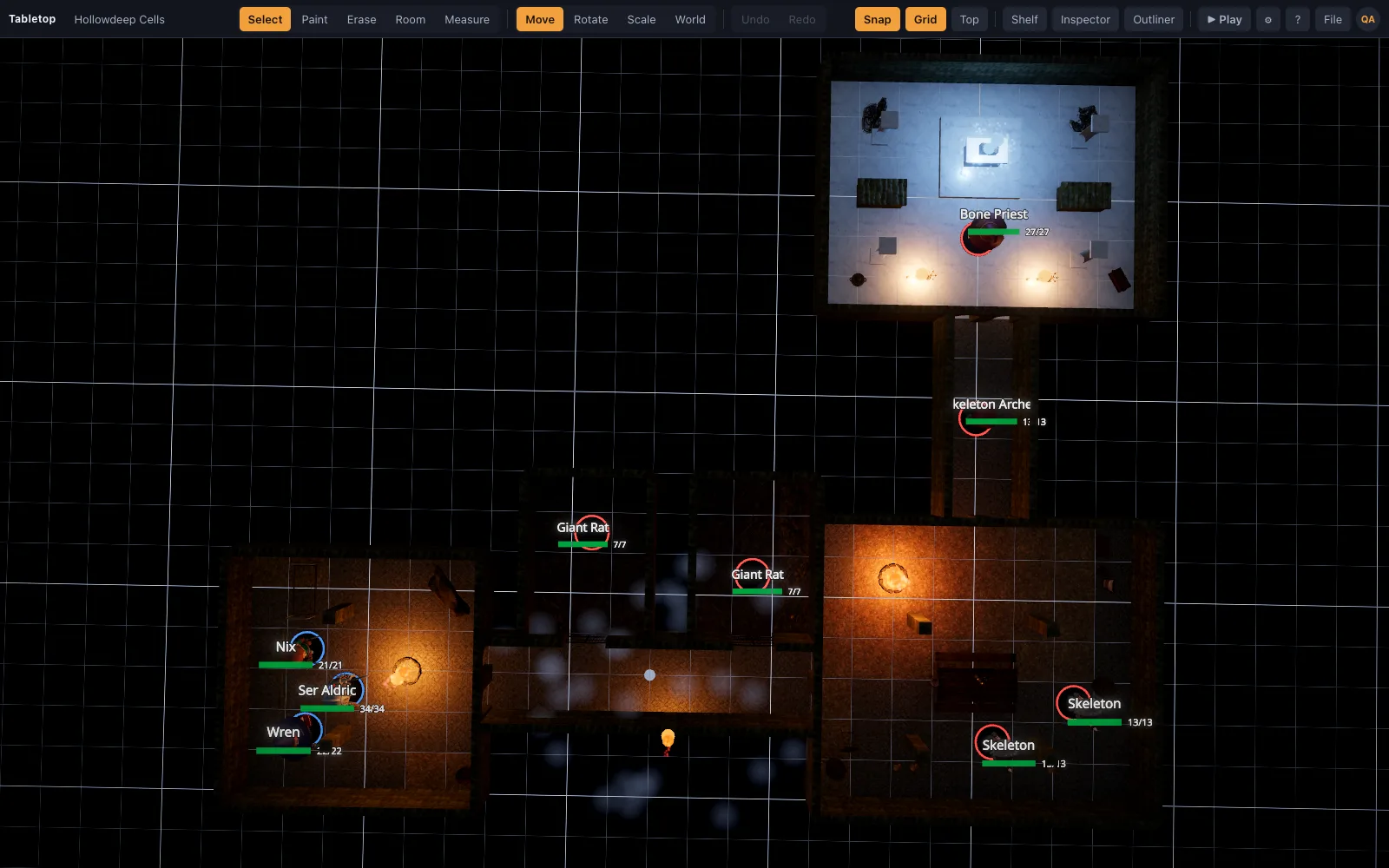
TerrainTale is the 3D option that runs in a browser tab, and it keeps the two things Maps now does well out of scope on purpose: it tracks hit points, conditions and initiative on the tokens and leaves the campaign notes to whatever the DM already uses, which after this month may well be a D&D Beyond journal in the next tab.
Dates to hold Wizards to
Custom uploads were coming soon on 18 August and had not shipped by 14 September. The Encounter Builder refresh has no date. The mobile app is early 2027, hedged with likely. The rules engine has a test character and no release. Scene Prep shipped thirteen days after the roadmap said it was getting its final touches, which is the best evidence so far that the rest of the list is real. Check the changelog, not the posts; the changelog is where the 8 and 14 September changes were actually recorded.