Bridge battle maps: chokepoints, falls and river crossings
A bridge is the cheapest good encounter in the game. It is one shape, it forces a decision in the first round, and it comes with a hazard built in. The design work is almost entirely in two numbers: how many squares wide the span is, and how far it is down to the water. Get those right and the fight runs itself. Get them wrong and you have a corridor with scenery, or a river the party swims across while ignoring everything you built.
· 5 min read · TerrainTale
Width is the dial that sets the whole fight
A bridge two squares wide is a fight about holding a line. Two Medium creatures abreast block it, nobody gets past without shoving or tumbling, and a single character with a polearm is suddenly the most important person in the party. A bridge four squares wide is a fight about flanking, because there is room to move around the front rank. Six squares is not a bridge any more, it is a road with a view.
Pick the width from the fight you want. For a last stand against a horde, go two squares. For a proper skirmish with a monster in the middle, go four. Mark the edge squares clearly, because everything interesting on a bridge happens within 5 feet of the drop, and a player who cannot see where the decking ends will not take the risk that makes the encounter memorable.
- Two squares wide: a chokepoint, best against many weak enemies.
- Three squares: room for a rank of two plus one squeezing past.
- Four squares: a real skirmish with flanking and movement.
- Length of 8 to 12 squares keeps both ends in bow range without being a marathon.
What falling in actually costs
Falling damage in 5e is 1d6 bludgeoning per 10 feet, to a maximum of 20d6, and the creature lands prone. Water changes the arithmetic. Most tables rule that a fall into deep water does no damage below about 20 feet and half damage above it, which is a table ruling rather than a rule as written, so say which way you run it before anyone is shoved.
The real cost of going in the river is not damage, it is time and kit. Climbing out of water costs movement, swimming through rough water is difficult terrain so each foot costs an extra foot, and a character in heavy armour who fails a Strength (Athletics) check is in genuine trouble. Two rounds out of the fight is a heavier punishment than 3d6.
Current, depth and the swim check
Decide three things about the water and write them on the map. Depth, because a knee-deep ford is difficult terrain while a deep channel needs a swim speed or an Athletics check. Speed, because a fast current can carry a creature 10 or 20 feet downstream at the start of each of its turns. Temperature, because cold water is a reason to hand out a Constitution save and a level of exhaustion for a failure.
Without a swim speed, every foot of swimming costs an extra foot of movement. A character with 30 feet of speed crosses 15 feet of water in a turn, which is three squares. That number is what makes the river a barrier rather than a decoration, and it is worth saying out loud the first time someone considers jumping.
Holding one end, and why the enemy wants that too
The interesting version of a bridge fight is not one group crossing while the other defends. It is both sides wanting the far end. Give the enemy a reason to advance: a hostage, a cart full of the thing everyone wants, a ritual on the near bank that needs another minute. Now the chokepoint cuts both ways and the party has to decide whether to hold or push.
Put something at each end that rewards being there. A gatehouse, a stone pillar giving three-quarters cover, a winch that raises a section of decking. Three squares of cover at each end turn a straight line into a position worth taking, and a winch turns the bridge itself into a resource that either side can spend. The moment both ends are worth holding, the middle becomes the most dangerous eight squares on the map.
- A pillar or statue at mid span gives half cover and breaks the archers' line.
- A missing plank makes one square difficult terrain and a great place to shove someone.
- A rope or chain rail is half cover against anything shooting from the water.
The troll under it, and other reasons to look down
The oldest bridge encounter is a creature underneath, and it still works because it puts the threat outside the map the party is reading. A troll climbing up over the edge on round two changes a line fight into a fight with a flank that nobody could have scouted. So do harpies on the piers, a swarm rising out of the water, or a rope ladder the ambushers use.
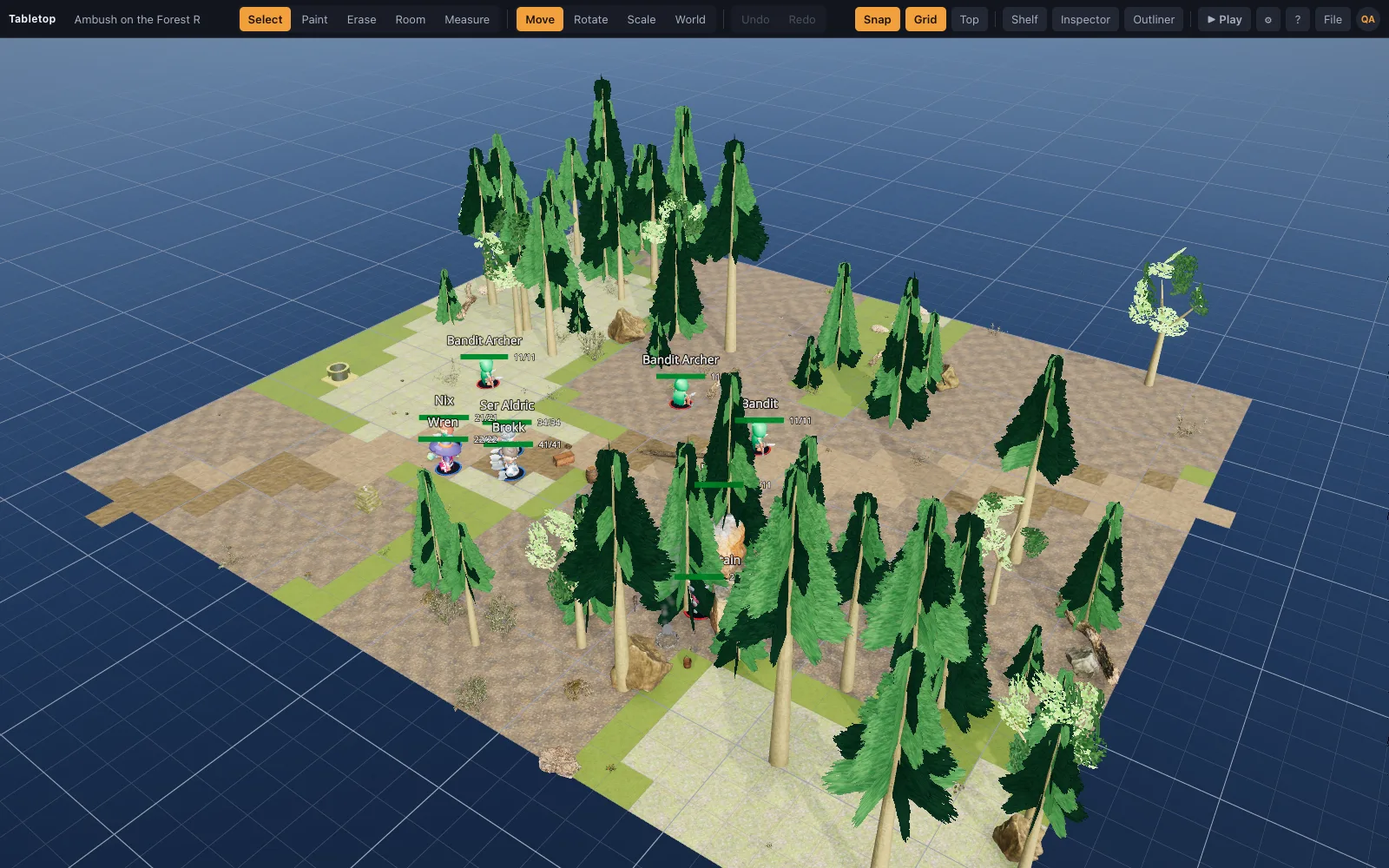
Build the underside as part of the map when you can see it. In a 3D scene the piers, the water and the drop are all really there, so a player asking whether they can climb down and under gets an answer from looking rather than from a ruling. The camera goes to any angle including eye level, which is the quickest way to settle what someone standing at the rail can see.
Building the map in about ten minutes
Lay the river first as a band of water four to eight squares across, then the banks, then the span. Give the two banks different characters: one with cover and a road, one open and muddy. That asymmetry is what makes the crossing a choice rather than a formality, because a party that gets pushed back onto the bad bank has lost something real without anyone taking damage.
Dress it last and stop early. A cart halfway across, a broken rail, a shrine at one end with a coin bowl. Three props is enough to make a bridge feel like a place people use, and any more is decoration nobody will interact with once initiative is rolled. The exception is anything a player might climb, tip over or hide behind, which is not decoration at all and is worth placing deliberately.