Munchkin 5.5E RPG: what was announced in September 2026 and why players are arguing about it
On 8 September 2026 Lynnvander Studios announced Munchkin 5.5E RPG, a roleplaying game built on the 2024 D&D rules under licence from Steve Jackson Games, with a Backerkit crowdfunding campaign to follow in October 2026. The card game it comes from has parodied D&D since 2001: kick down the door, fight the monster, grab the treasure, betray your friends. The announcement produced a small argument within the day. EN World's readers asked what the point is, and Wargamer's Mollie Russell called it the worst crossover idea she had heard in a while. The question underneath is whether a game about betraying the party can be a party game.
· 5 min read · TerrainTale
What was announced
The core release is Munchkin 5.5E: Ye Olde Rulebook, a combined rulebook and sourcebook, with a companion adventure book called The Deadliest Dungeon carrying monsters, traps and loot. EN World's report of 8 September 2026 lists four new playable species, the Mimic among them, and parody subclasses including the Oath of the Killjoy Paladin and the College of Nihilism Bard, plus feats, spells and magic items. There is a subsystem called Pun-spiration, which Wargamer describes as giving free Heroic Inspiration for puns.
The crowdfunding launches on Backerkit in October 2026 with add-ons including card decks, standees, map packs and a rubber duck. Lynnvander Studios is a studio whose licensed games include Buffy the Vampire Slayer, Doctor Who, Star Trek, Terminator and Shadowrun titles. Tribality's report of 10 September 2026 quotes its founder Tommy Gofton on the aim: to give players, in his words, a reason to play it over and over again. No price or page count has been announced.
- 8 September 2026: announcement.
- October 2026: Backerkit campaign.
- Ye Olde Rulebook plus The Deadliest Dungeon; four species, parody subclasses, Pun-spiration.
It has been done before
A commenter in the EN World thread pointed out that this is not the first attempt. Steve Jackson Games published a Munchkin Player's Handbook for the d20 system in the mid-2000s, a parody of the 3.5 edition rulebook it sat beside on the shelf. That book was a joke in the shape of a rulebook, and it is remembered as a joke rather than as a game people ran. The 2026 version is pitched differently: a campaign game with an adventure, a dungeon and a crowdfunding stretch of add-ons, which is a promise that people will play it for more than one session.
The other precedent is the card game itself, on sale since 2001 in many themed editions. Munchkin's audience is large and not all of it plays D&D; the RPG is as much an attempt to move card players to the table as to sell D&D players a joke.
The case against it
Wargamer's opinion piece of 9 September 2026 makes the argument most clearly. Munchkin's engine is player-versus-player: the game is won by the person who reaches level 10 first, and the fun is in the other players sabotaging that person with curses and wandering monsters. Russell's point is that this is exactly the behaviour a D&D table punishes, and she puts it in one line: when players stop co-operating in D&D, things fall apart. Her worry about the cheating mechanic is practical rather than moral: a rule that rewards players for working against each other is a rule the DM has to referee, and refereeing it is work.
She concedes the card game's role as a gateway for new players and allows that the studio might balance it, while saying she is not confident it will. The EN World thread's sharper version is that Munchkin already parodies D&D, so a D&D version of Munchkin is a parody of a parody, and one commenter, MGibster, summed up the sceptical reading as any opportunity to sell a new version of Munchkin.
The case for it
The case for is that D&D tables already do this. The party that argues over loot, the rogue who pockets the gem, the bard who casts Hold Person on the paladin as a bit: every long-running group has one session that was Munchkin in all but name, and most of them remember it fondly. A ruleset that admits it, and gives the DM tools to keep it short and funny, is not obviously worse than pretending it does not happen. One-shots and convention games are the natural home, and a parody rulebook that is genuinely playable for four hours is a real product.
The other argument is the one about mimics. A playable Mimic species is a good joke that is also a good design constraint, and the announcement's list, Killjoy Paladins and Nihilism Bards, reads like people who have been at a table rather than people who have only read the box. Whether the mechanics hold up is what the Backerkit preview will show, and nobody outside the studio has seen them.
Does a backstabbing party work on a grid?
The rules question is simpler than the social one. D&D's 2024 rules do not care whose side a creature is on; an Opportunity Attack triggers when a hostile creature leaves your reach, and whether the fighter counts as hostile to the rogue is the DM's call. On a battle map a party that turns on itself is just a fight with more sides, and the map handles it the same way it handles goblins: reach, cover, movement, initiative. What breaks is the tracking, because the party stops being one team in the initiative order and becomes five.
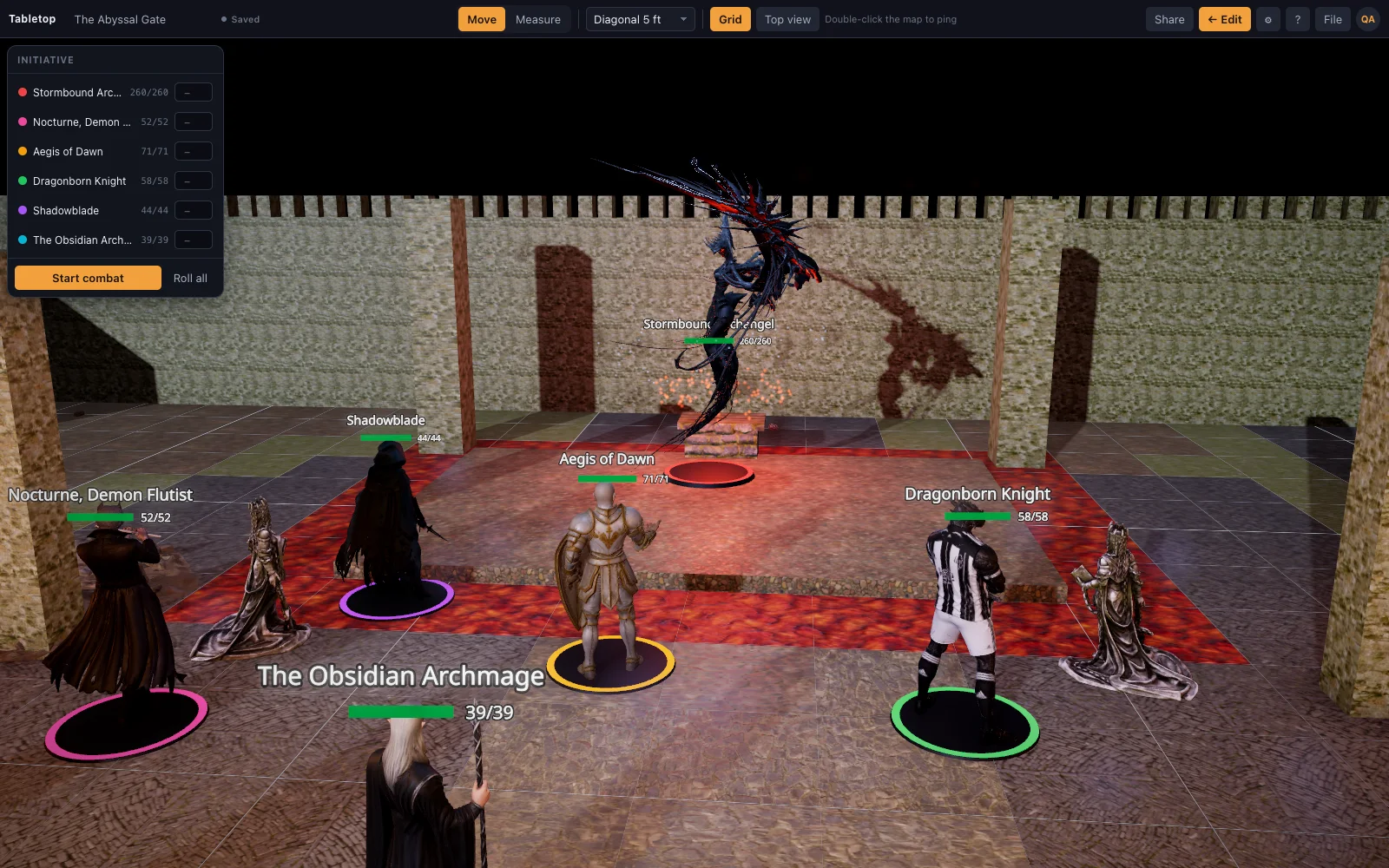
The practical advice for a DM who runs it, or who runs an ordinary session that turns into it, is to keep each character's HP and conditions on the token where everyone can see them, and to enforce initiative strictly, since the temptation in a betrayal is to act out of turn. TerrainTale's play mode keeps HP bars and conditions on the minis and the initiative order on screen, which is enough for a fight where every creature is someone's enemy. The rules are the same; only the alliances moved.
What to watch in October
Three things will settle the argument. First, a preview of the Pun-spiration and betrayal rules, which will show whether the game has a way to end a betrayal rather than only to start one. Second, the length of The Deadliest Dungeon, which tells you whether the studio thinks this is a one-shot or a campaign. Third, the funding total on Backerkit, which will say whether the card game's audience wants to sit at a table. Until then it is a licence, a list of jokes and a date, and the argument about whether it should exist is running ahead of anything anyone has read.