Arena battle maps for D&D: building the gladiator pit nobody can leave
An arena is the one map where the party cannot leave, cannot hide and cannot talk its way out, which is why it makes a good fight and a bad habit. Build the pit as a circle about 16 squares across on the square grid, wall it with a 15-foot drop to the sand, put the crowd above the wall where it is scenery rather than a target, and add two things the players can use: pillars for cover and gates that open on a timer. The gates are the encounter. The first beast is the warm-up; the second gate opening on round 4 is the fight.
· 5 min read · TerrainTale
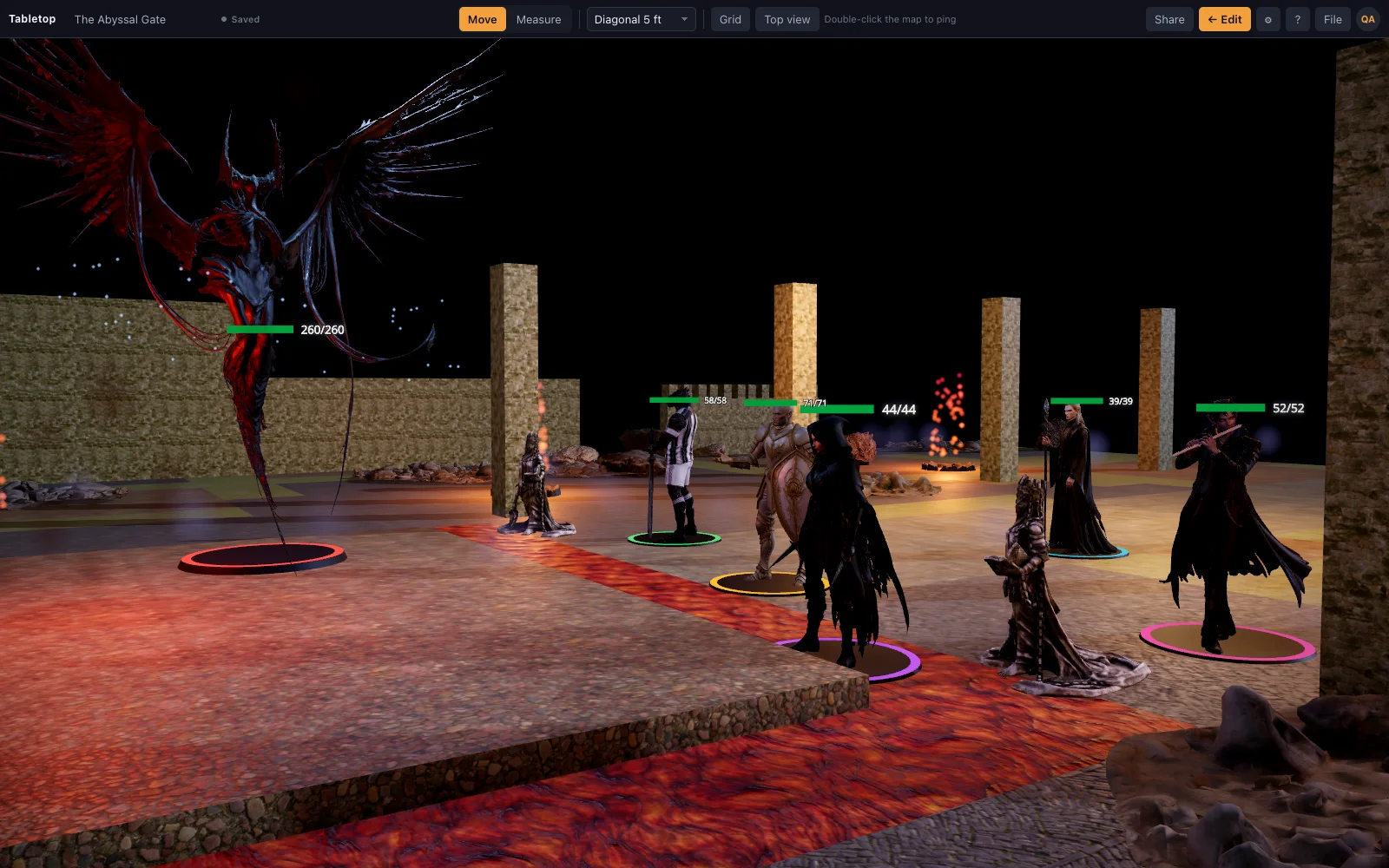
A circle on a square grid
Draw a circle by stepping the wall in one square at a time as it curves. A 16-square diameter works: walk the wall 5 squares straight across the top, then step in 1 square every 2 or 3 squares until it turns the corner, and mirror it. Nobody needs a perfect circle; they need a floor where the corners are gone, because corners are where a party pins a monster and an arena is meant to deny that.
The sand is normal terrain. Do not make the whole floor difficult terrain; the arena's problem is space, not speed. A single patch of churned sand or spilled blood as difficult terrain in the middle is enough to make one square matter.
The wall, the crowd and the height
The wall of the pit is 15 feet high, 3 squares if you stack it, and that height does the work a door does elsewhere: nobody climbs out in one turn. Climbing costs 1 extra foot per foot, so 15 feet of wall is 30 feet of movement and a Strength (Athletics) check the DM sets around DC 15 for rough stone. The crowd sits above the wall, and the crowd is scenery. It roars, throws things and wants blood, and none of that is a stat block. Rule that the crowd cannot be attacked and cannot be reached, and the players will stop trying.
What the crowd can do is change the fight. A cheer when a character is Bloodied, a ripple when the party spares an opponent, a thrown bottle that lands as a distraction; treat it as the DM's voice with 2,000 mouths. In a 3D table the tiers of seats above the wall are the thing the camera sees from the sand, and the sand from the seats, which is the view the players' patron has.
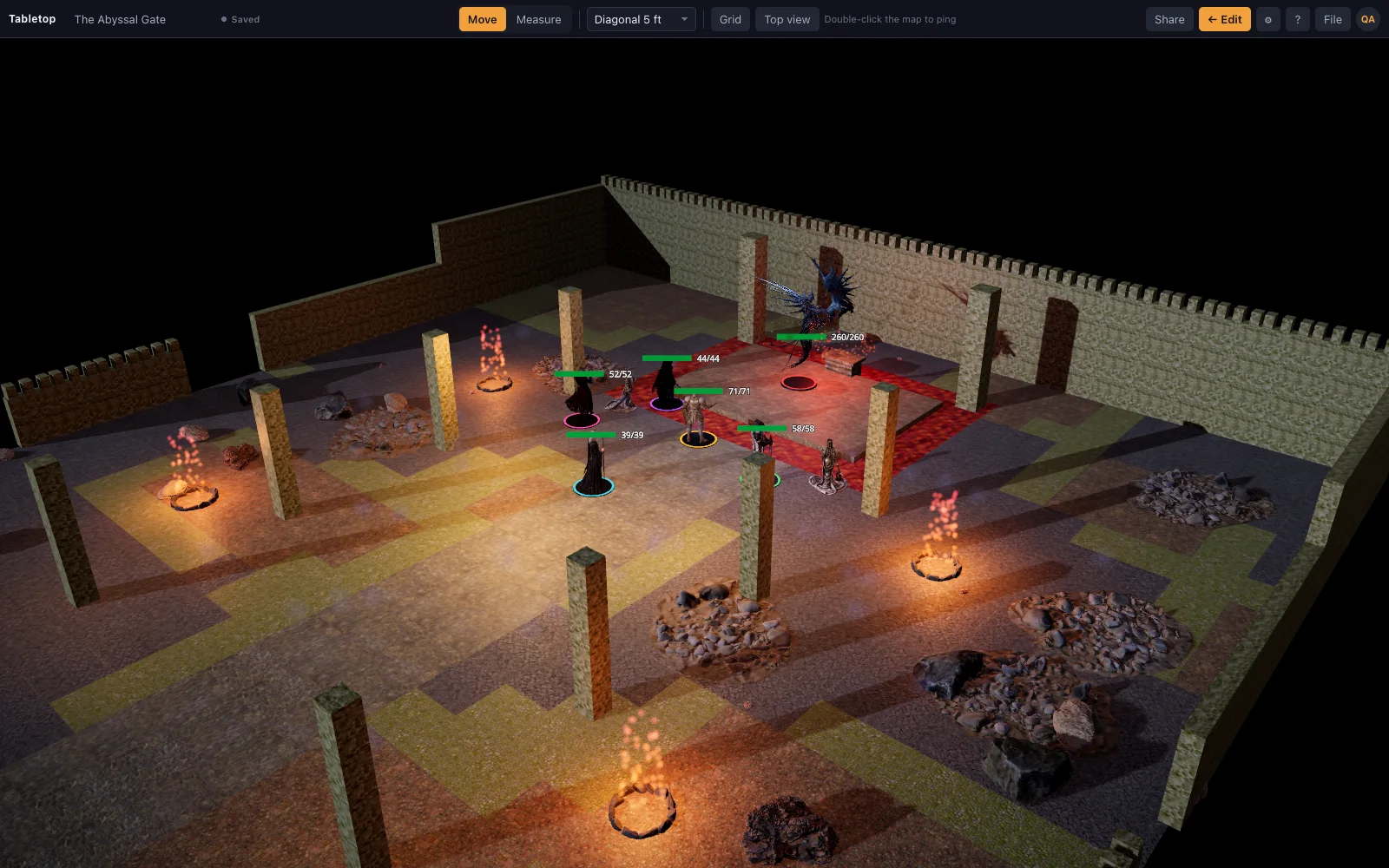
Gates and the beast on a timer
An arena with one opponent is a duel; an arena with gates is an encounter. Put three or four gates in the wall at the compass points and announce a rule: a gate opens on a round the players do not know. The first fight is against whatever the promoter sent, and it is easy. On round 3 or 4 a gate opens and something worse comes out, and it is hungry rather than loyal, so it attacks whoever is nearest, which may be the party's first opponent.
The second gate is what turns a slugging match into positioning. The party that fought with its back to the north gate now has a bear behind it. A Large beast occupies a 2-by-2 square block, so leave the gates 2 squares wide and let the players see that they are.
- Gates 2 squares wide at the compass points.
- Round 1 to 3: the scheduled fight.
- Round 4: a gate opens; the beast attacks the nearest creature, any side.
- Round 7 or later: a second gate if the party is winning too easily.
Pillars, chains and the things on the sand
A bare circle is a bad map because every square is the same. Put 4 pillars in a ring about 3 squares in from the wall: each is 1 square, blocks movement, and gives Half Cover to a creature beside it and Three-Quarters Cover to one crouched behind it. Add a chain hanging from the wall, a rack of the last fighter's weapons, and one trapdoor in the sand that the DM knows about. The pillars are where the archer stands; the weapon rack is where the disarmed fighter runs.
Height above the sand is worth one feature: a platform or a raised dais for the champion, 5 feet up, which makes the champion Large in effect and gives the party something to climb.
Running the fight nobody can leave
The arena removes the party's two favourite tools, retreat and negotiation, so it must give them something back or it is a grind. Give them the crowd: a Charisma (Performance) check on a kill or a spared foe that sways the audience, and an audience that turns can force the promoter to open the exit gate early. Give them the gates: a clever party lures the bear into the guards. And give them a clock: the fight ends when the promoter says, so the party's goal may be surviving 10 rounds rather than killing everything.
Track hit points openly. In an arena every creature's condition is visible to the crowd, so there is no reason to hide the monsters' hit point bars; TerrainTale's play mode shows HP bars and conditions on every mini, which for once is exactly the fiction.
Reusing the pit
One arena map serves a campaign. The same pit is a gladiator fight at level 3, a trial by combat at level 7 where the party fights a single knight, and a fight against a bound demon at level 12 when the gates open on something the promoter did not put there. Change the opponents, the gate schedule and what the crowd wants; leave the sand, the pillars and the wall. The players will recognise the place, and the recognition is the reward.