Crypt and catacomb battle maps: layouts that play well in 3D
Crypts are the most forgiving map in D&D. The genre does the work: everyone knows what a crypt looks like, undead are the easiest monsters to justify, and a few sarcophagi turn any rectangle into a fight with cover. The difference between a crypt that plays well and one that does not is almost entirely layout and light, and both are quick to get right.
· 7 min read · TerrainTale
Four crypt layouts
Almost every good crypt map is one of four shapes, and knowing which you are building saves an hour of dithering.
- The chapel: one large vaulted room, 10 by 14 squares, altar or central tomb at the far end, sarcophagi in two rows. A boss fight room; the rows are cover and the aisle is the kill zone.
- The gallery: a long corridor lined with niches, 3 wide and 20 long, with a room at each end. Fights happen in the corridor, with skeletons stepping out of niches behind the party.
- The ossuary maze: small rooms joined by short passages, none bigger than 6 by 6. Good for a crawl with several small fights, bad for a single big one.
- The sunken vault: a chapel with a lower level, reached by stairs, where the real tomb is. Height matters here, so it is the one that benefits most from a 3D table.
Sarcophagi are the furniture
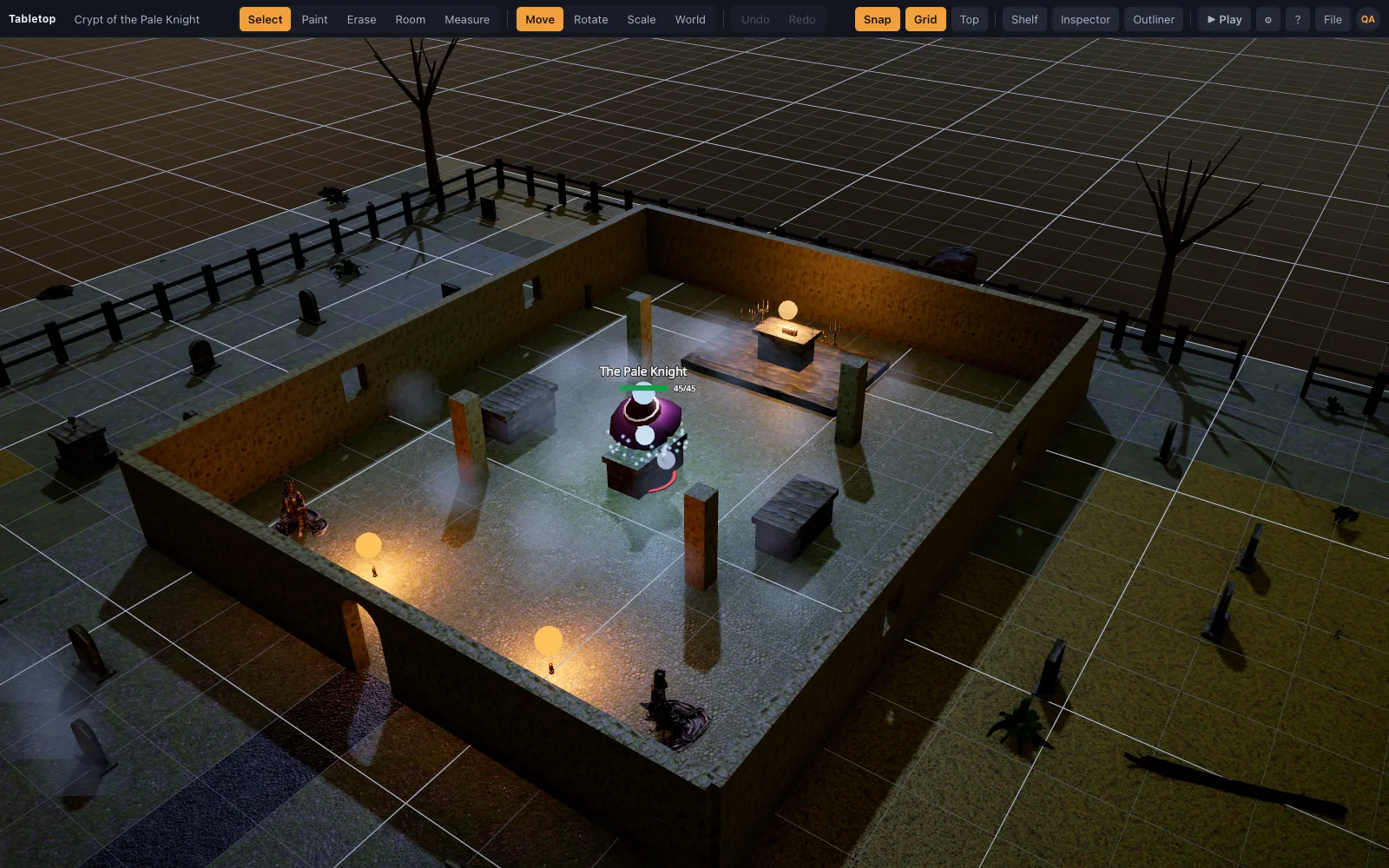
A stone sarcophagus is 5 feet wide and 10 long, so it takes a 1 by 2 block of squares and stands about waist high. That is half cover for anyone behind it, a barrier that has to be climbed or walked round, and a lid that can be pushed off as an action. Place them in pairs with a square between, and the room has lanes. Place one across a doorway and the room has a chokepoint. Place a single one in the centre, on a raised step, and it is the boss's throne.
Add a few stone niches in the walls (the Crypt kit in TerrainTale's room tool gives you walls with recesses ready), a couple of fallen candelabra, and some broken flagstones as difficult terrain near the entrance where the roof has come in. That is a dressed room in five minutes.
Alcoves and the ambush turn
The reason crypts are frightening is that things come out of the walls. Model it on the map: every niche is a possible sarcophagus, every sarcophagus a possible skeleton. A gallery corridor with eight niches and three skeletons among them is a fight where the party has to decide whether to check each niche and lose time, or run the corridor and get attacked from behind. Do not tell them which niches are occupied; place the skeleton minis when they rise.
On a VTT, keep the sleeping undead off the table until they act. Drop the mini in when it climbs out, and it arrives in initiative order the moment it is placed.
Light is the atmosphere
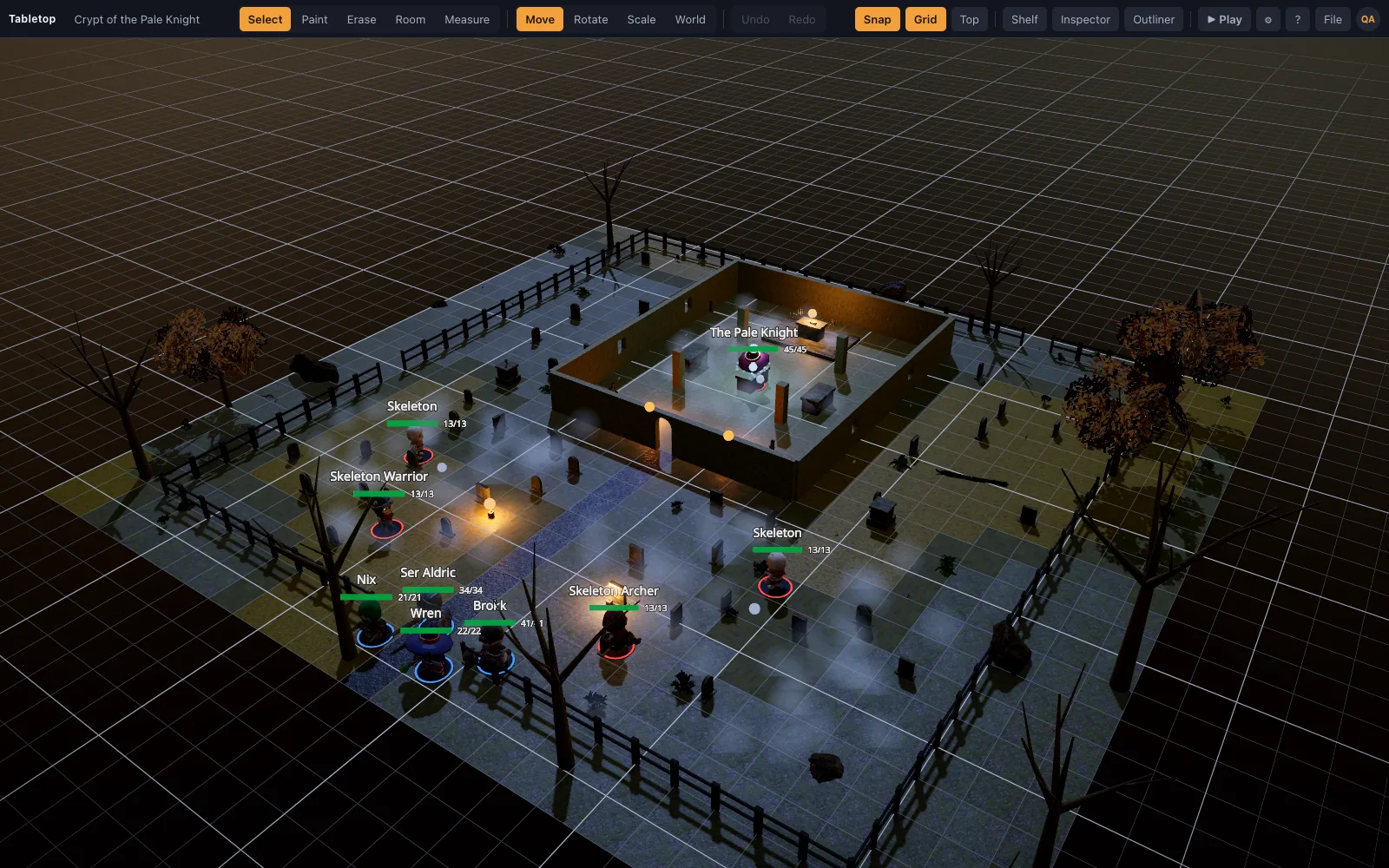
A crypt lit like a tavern is a storage room. Give it two or three small light sources at most: a guttering brazier by the altar, a shaft of moonlight from a grating, the party's own torches. Everything else should be dim or dark. Dim light gives disadvantage on Perception checks that rely on sight and makes creatures lightly obscured, which matters when the skeletons are standing in the niches you cannot see into. Darkvision helps the elves and dwarves and not the humans, which is a difference worth playing.
On a 3D table the light does this for you: a single brazier throws real shadows down the aisle, and the far end of the chapel simply is not visible until someone walks a torch down there. The starter scene Crypt of the Pale Knight is built this way, with a moonlit graveyard outside and a dark crypt below it.
Populating it
Skeletons and zombies are the low-level stock, and they are better in numbers than in strength. Six skeletons in a gallery are more interesting than one wight. At mid levels a wight or a ghast with a retinue works, and the undead trait that matters most is that most of them do not care about difficult terrain in their own halls. For a boss, put the tomb on a raised dais with steps so the fight has height, and give the boss a reason to stay near it: a phylactery, a relic, a door it is guarding. A crypt where the villain runs into the maze is a chase; a crypt where it stands its ground at the altar is a fight.